By Okoi Obono-Obla
I. INTRODUCTION
It is a great delight and extremely exciting that I have been chosen to speak to the students and staff of this burgeoning institution, which was principally founded to train and nurture leaders of this country for the next generation.
I was excited when I received a phone call from my colleague, Barrister Victor Essien, informing me that Mrs. Umoden had requested that he contact a Human Rights Activist to speak to the students and staff to mark the 49th anniversary of Nigeria’s attainment of political independence from Great Britain.
I was surprised that a school which I had regarded as a bastion of conservatism, and a place for children of the elite — a class I have consistently and persistently criticized for its short-sightedness, corruption, laziness, moral bankruptcy and waywardness in several fora, including the mass media and the internet — would want me to speak to the children of these same people.
I then received a call from Mrs. Umoden, formally inviting me. I asked why an outspoken Human Rights Lawyer and Activist like myself, whom the elite and government regarded as an irritant and a pain for his outspokenness and strident advocacy against bad governance, corruption, graft, and for the protection of human rights and social and political change, should be asked to speak to students of the same people I have consistently condemned. She answered that the school had taken a deliberate decision that the lecture must be delivered by an Activist because the authorities wanted a frank and straightforward message to lift the students from complacency. She added that the school is conscious of the fact that the students, as leaders of the next generation, must be equipped to be socially conscious and to be in the vanguard of the expected change that is looming large for the next generation. Hence, the choice of me.
I have been asked to speak on “The History of Nigeria: Who We Are and What Went Wrong.” It is such a broad topic. I wondered why a Historian was not chosen. What I have been asked to speak on is historical in content and perspective. I am a Lawyer and Social Advocate, but I am expected to be abreast of the history of Nigeria by virtue of my training and work. A lawyer, as a social engineer worth his salt, must be abreast of the historical and constitutional development of his country. I will therefore not shrink from my obligation simply because I have been asked to discuss the history of my country, a task that might have been better done by an expert in the field. I will strive to the best of my ability to fulfill this assignment.
II. WHO WE ARE: BEFORE NIGERIA
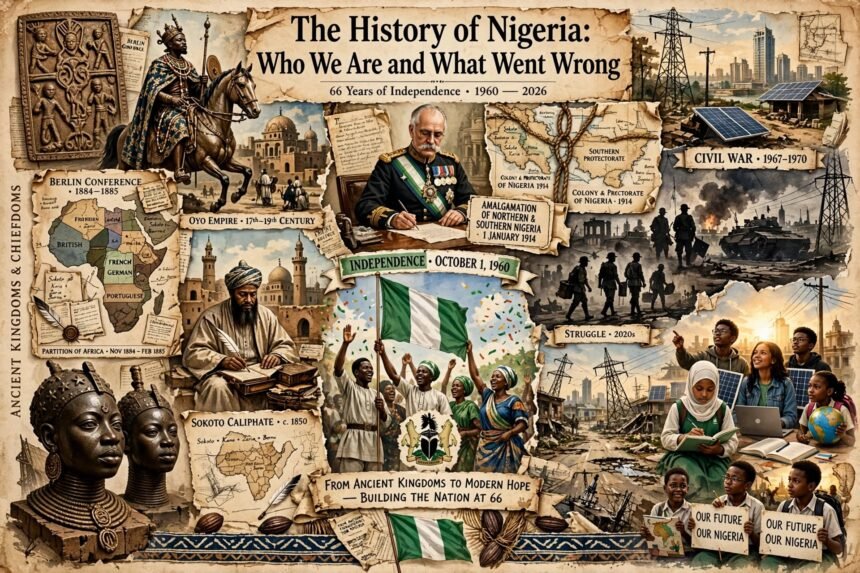
Before there was a country known as Nigeria, there were great and glorious empires and kingdoms in this territory: the Songhai Empire, the Oyo Empire, the Benin Empire, the Kanem-Bornu Empire, and the Sokoto Caliphate founded by Usman Dan Fodio in the 19th Century.
There were also numerous kingdoms and chiefdoms dotted across this part of Africa from time immemorial, which I do not wish to enumerate here because they number more than 450. For brevity of space and time, I will restrict myself to those I have mentioned above.
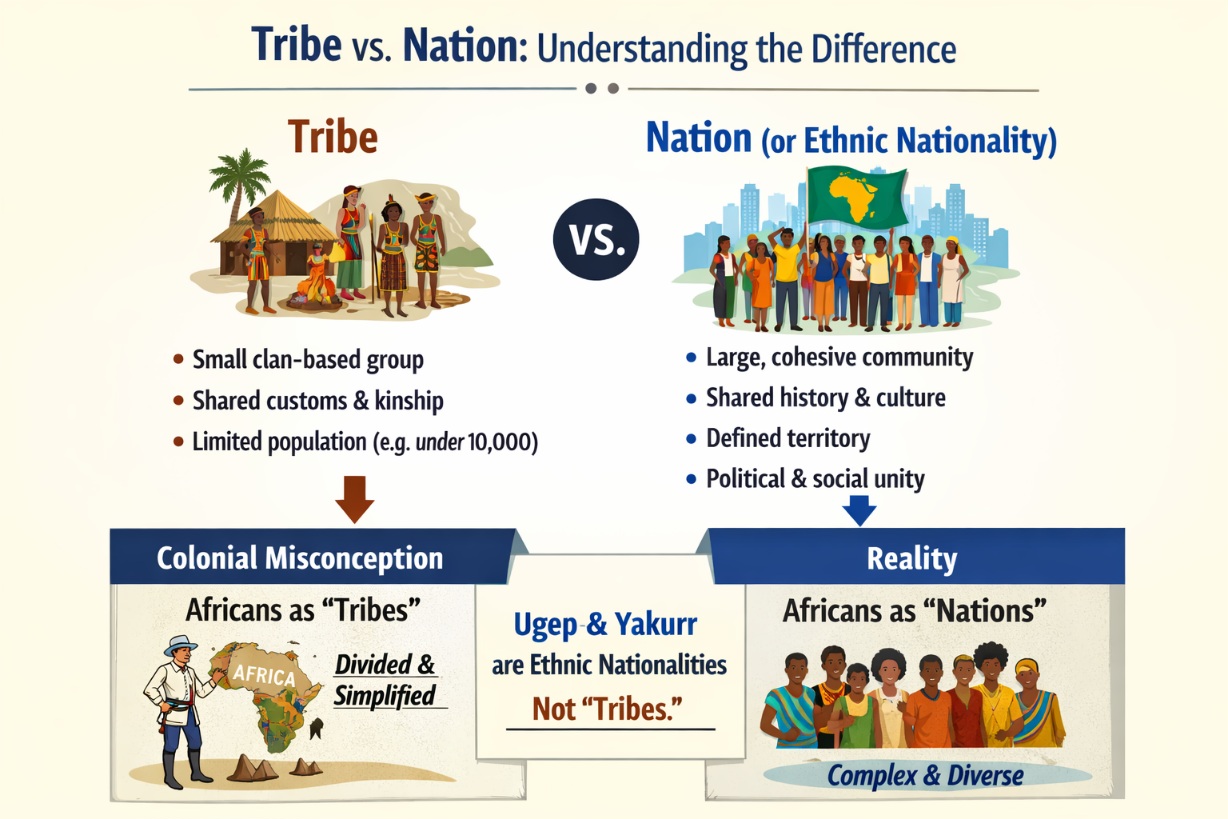
These empires, kingdoms and chiefdoms comprised people from diverse ethnic nationalities which we presently find in Nigeria, including the Yoruba, Igbo, Hausa, Fulani, Edo, Efik, Ejagham, Yakurr, Tiv, Ibibio, Ijaw, and many others.
III. THE COLONIAL CREATION OF NIGERIA
The history of Nigeria as a political entity began when European colonialists organized a Conference in Berlin, Germany, under the leadership of Chancellor Otto von Bismarck in 1884-1885, to discuss and agree on the balkanization and partition of Africa. The European imperialists, in their racist mentality, dismissed Africa as a ‘Dark Continent’ which must be civilized by Europeans whom God had chosen as the superior race. At that conference, Africa was shared among the major European powers such as Germany, France, Portugal, Spain and the United Kingdom.
After the Berlin Conference, the British moved quickly to affirm and consolidate its hold on the territory that would become Nigeria. Before then, Britain had already established a presence in many parts of the country, especially in Lagos where a Colony was established in 1861. In the area presently known as the Niger Delta, a Protectorate known as the Oil Rivers Protectorate (later the Niger Coast Protectorate) was formed.
To secure its economic interest, Britain granted a Royal Charter to the Royal Niger Trading Company. In return, the Company was to protect British political and economic interests in the North. The Company established its headquarters in the confluence town of Lokoja (present capital of Kogi State) and expanded its trading activities to the North-West and North-East of the River Niger. Treaties were signed with several independent African states such as Sokoto, Gwandu and Nupe, thus effectively denying rival German and French incursions into the Northern Region.
After many bloody and ruthless military expeditions to subdue ethnic nationalities that fiercely resisted intrusion — such as Benin, Ilorin, and Arochukwu — the colonialists decided to amalgamate the Northern Protectorate, the Colony of Lagos, and the Colony and Protectorate of Southern Nigeria to form one country known as the Colony and Protectorate of Nigeria.
In 1900, the Royal Charter granted to the Royal Niger Trading Company was revoked and a decision was taken that Nigeria would be administered as two Protectorates — one in the South and one in the North. Lagos was incorporated into the Southern Protectorate in 1906.
In 1914, Lord Frederick Lugard amalgamated the Northern and Southern Protectorates. The underlying objective for this fusion was purely economic and administrative, not altruistic.
It is important to mention that the name ‘Nigeria’ was coined by Flora Shaw, who later became Lady Lugard, the wife of the first Governor-General of Nigeria. Some cynics argue that Nigeria is a failure and will remain a failed state because it was cobbled together by British colonialists. One of the greatest leaders of post-independence Nigeria, Chief Obafemi Awolowo, dismissed Nigeria as a mere geographical expression in one of his seminal works.
I do not subscribe to the view that Nigeria is doomed because it was artificially created. Many countries were artificially created, including the United States of America, Australia, India, Brazil, Canada, Singapore, Indonesia and Malaysia. Some of these countries are great industrial, military, economic and political powers today.
IV. THE STRUGGLE FOR INDEPENDENCE
The colonial empire in Nigeria started crumbling after the end of the Second World War and the promulgation of the Universal Declaration of Human Rights, which proclaimed and recognized the right of every people to self-determination and independence. This ignited agitation for an end to colonialism.
It was this wind of change that propelled nationalists like Herbert Macaulay, Dr. Nnamdi Azikiwe, Chief Obafemi Awolowo, Sir Ahmadu Bello and others to start political movements to agitate for independence.
In 1954, a Federal Constitution came into force, and constitutional conferences that would set up the political framework for post-independence Nigeria were held in London from 1957 to 1959.
On 1st October, 1960, Nigeria was granted what I will call ‘Flag and Political Independence’. It was not economic or social independence, and I think this is the genesis of the multifaceted and monumental problems which have continued to dog the country since independence.
In 1963, the Independence Constitution was jettisoned and a new Republican Constitution came into force.
V. THE FIRST REPUBLIC (1963 – 1966)
The country’s political system was modeled after the Parliamentary System of Government. There was a Prime Minister and a ceremonial President, and a House of Representatives at the federal level.
The Prime Minister was Sir Abubakar Tafawa Balewa of the Northern People’s Congress (NPC). The President was Dr. Nnamdi Azikiwe. The President’s responsibilities were largely ceremonial; executive powers were vested in the Prime Minister and his Cabinet.
There were three Regions at independence: Northern, Western and Eastern. The Regional Premiers were Sir Ahmadu Bello (Northern Region), Chief Samuel Ladoke Akintola (Western Region) and Dr. Michael Okpara (Eastern Region). Another Region, the Mid-Western Region, was created in 1963/1964 with Chief Dennis Osadebay as its Premier.
After independence, the country was fairly stable until several crises erupted: the fractionalization of the Action Group in the Western Region, the census crisis of 1963, the federal election crisis of 1964, the Tiv riots, and agitation by minorities for greater autonomy. These centrifugal forces conspired to set the country on fire.
VI. THE FIRST MILITARY INTERVENTION AND THE CIVIL WAR (1966 – 1970)
These crises led to the toppling of the civilian government of Sir Abubakar Tafawa Balewa on 15th January, 1966, in a military coup d’état led by a group of young military officers under the leadership of Major Chukwuma Kaduna Nzeogwu. The Prime Minister, the Premiers of the Northern and Western Regions, Sir Ahmadu Bello and Chief Akintola respectively, and scores of senior military officers were killed.
The conservative wing of the military wrestled power from the coup plotters and a Federal Military Government under Major-General J.T.U. Aguiyi-Ironsi was constituted. Military Governors were appointed for the four Regions.
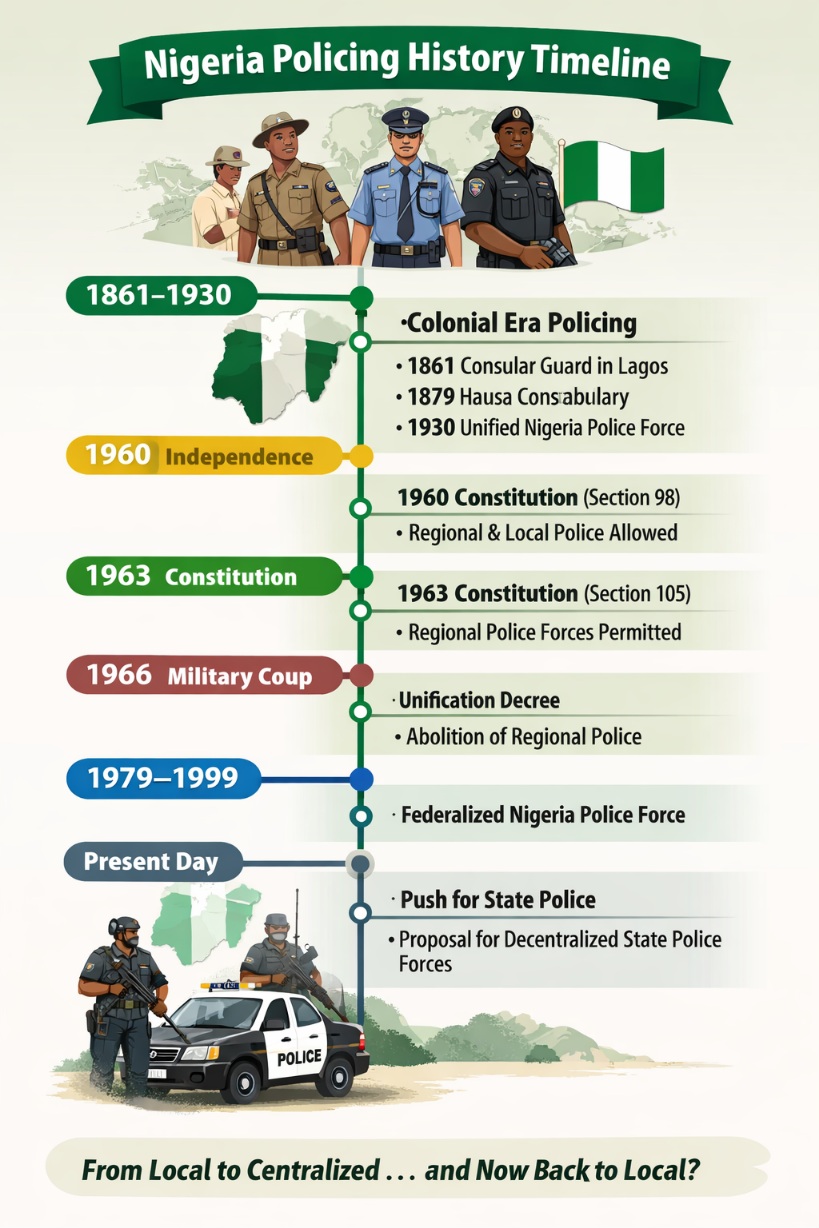
The coup inflamed ethnic nationalism and regionalism, leading to tensions and the mass killing of people of Eastern Region extraction living in Northern Nigeria. General Aguiyi-Ironsi enacted the Unification Decree, repudiating the federal system and replacing it with a unitary system. The Regions became Groups of Provinces. This further heightened tension, as it was perceived in the North as a ploy to reduce Northern participation in governance and to advance Igbo interests.
Another military coup took place on 29th July, 1966. General Aguiyi-Ironsi was killed. The leaders of the counter-coup installed General Yakubu Gowon as Head of State. However, the Military Governor of the Eastern Group of Provinces, Lt. Col. Chukwuemeka Odumegwu Ojukwu, refused to accept General Gowon on the ground that he was not the most senior military officer.
There was another round of mass killings of Easterners in the North. A constitutional conference was held in Aburi, Ghana, to settle the political deadlock. The resolutions reached — known as the Aburi Accord — were repudiated by the Federal Military Government.
This led to the secession of the Eastern Region from the Federation on 30th May, 1967, and the declaration of the Republic of Biafra.
On 27th May, 1967, just before the secession, the Federal Government abolished the four regional structures and replaced them with twelve states: Lagos, Mid-Western, North-Western, North-Eastern, North-Central, Western, Kwara, South-Eastern, Rivers, East-Central, Benue-Plateau, and Kano States.
The Federal Government ordered police action against the Eastern Region, which escalated into a civil war. The war was bloody, and an estimated more than one million Nigerians, mostly of Eastern extraction, were killed. The civil war ended in January 1970 with the slogan “No Victor, No Vanquished.”
VII. THE ERA OF MILITARY RULE AND SECOND REPUBLIC (1970 – 1999)
After the civil war, a programme for return to civil rule was announced. However, the Federal Military Government of General Gowon was toppled in a coup on 29th July, 1975. General Murtala Muhammed became Head of State.
More states were created in February 1976, bringing the number to nineteen. A timetable for return to civil rule was announced and a Constituent Assembly was established to debate a draft constitution.
General Muhammed was assassinated in another military coup on 13th February, 1976. He was succeeded by General Olusegun Obasanjo. In 1979, the military handed over power to civilians. Alhaji Shehu Shagari was elected the first Executive President of the Second Republic.
President Shagari’s government was toppled on 31st December, 1983, by General Muhammadu Buhari, who became Military Head of State from January 1984 to August 1985, when he was himself toppled by General Ibrahim Babangida.
General Babangida styled himself Military President and ruled with draconian decrees which suppressed human rights. He failed in his promise to hand over power after he annulled the presidential election of Chief M.K.O. Abiola, widely adjudged the freest and fairest election in Nigeria’s history, held on 12th June, 1993. Forced to step aside, Babangida constituted an Interim National Government under Chief Ernest Shonekan.
In November 1993, the Interim National Government was toppled by General Sani Abacha. General Abacha was a complete dictator who ruled with harsh decrees. He clamped down on pro-democracy agitation, jailed General Obasanjo for an alleged coup plot, and ordered the execution of the renowned writer and environmental activist, Ken Saro-Wiwa, for his agitation for resource control for the people of the Niger Delta.
General Abacha died suddenly in June 1998 and was replaced by General Abdulsalami Abubakar, who returned power to civilians on 29th May, 1999, after General Olusegun Obasanjo won the presidential election.
VIII. WHAT WENT WRONG?
Today, as we mark 66 years of nationhood in 2026, the questions I asked in 2009 remain painfully relevant.
An adult of 49 years who is still immature, groping and has no sense of direction has failed. At 66, the verdict is even starker.
After 66 years, what can we boast of? Dilapidated primary and secondary schools and glorified universities where violence and cultism reign supreme. Poor and crumbling infrastructure — roads, railway lines, and airports. Virtually no power infrastructure, despite the fact that President Obasanjo’s administration budgeted more than $16 billion for the power sector — a sum stolen by privileged but selfish Nigerians and siphoned abroad, many of whom are today governors, senators, and ministers.
At 49, universities were closed for more than five months, yet the President went to Saudi Arabia to open a University of Technology. At 66, we still cannot organize a credible election, run a functional and efficient local government system, or boast of any major achievement other than kidnapping, armed robbery, stealing of public funds, rigging of elections, lawlessness, political instability, and advance fee fraud (419).
Nigeria remains one of the poorest countries in the world despite huge human and natural resources. It is a shame. The Nigerian elite must bow its head in shame. Some countries which do not have the kind of resources Nigeria is endowed with have seen tremendous development.
What then is the problem?
The problem lies squarely on the shoulders of the Nigerian elite. The failure is due to selfishness, corruption, graft, religious fundamentalism, ethnic nationalism, prolonged military rule, indiscipline and greed. Today, the country is almost completely lawless.
IX. CONCLUSION: THE CHALLENGE TO THE NEXT GENERATION
Time has finally come for the elite to have a rethink and change for the better. If it took China just fifty years to become a superpower, I do not see any reason why Nigeria cannot, through deliberate and focused planning and selflessness on the part of our leaders, achieve the same.
We wasted 49 solid years. We have now wasted 66 years.
Can we do what China has done in the next fifty years? The change will be effected by your generation because in the next 20 years or thereabout, your generation will surely be saddled with the leadership of this country. I believe your generation will not be like the present one that has squandered every opportunity for this country to develop and become great. Otherwise, we can as well say goodbye to Nigeria.
Thank you.
THE HISTORY OF NIGERIA: WHO WE ARE AND WHAT WENT WRONG
Revised Edition for the 66th Independence Anniversary – 1st October, 2026
Originally delivered on 1st October, 2009 to Students and Staff of Access High Schools, Calabar, Cross River State Nigeria