

By Okoi Obono-Obla
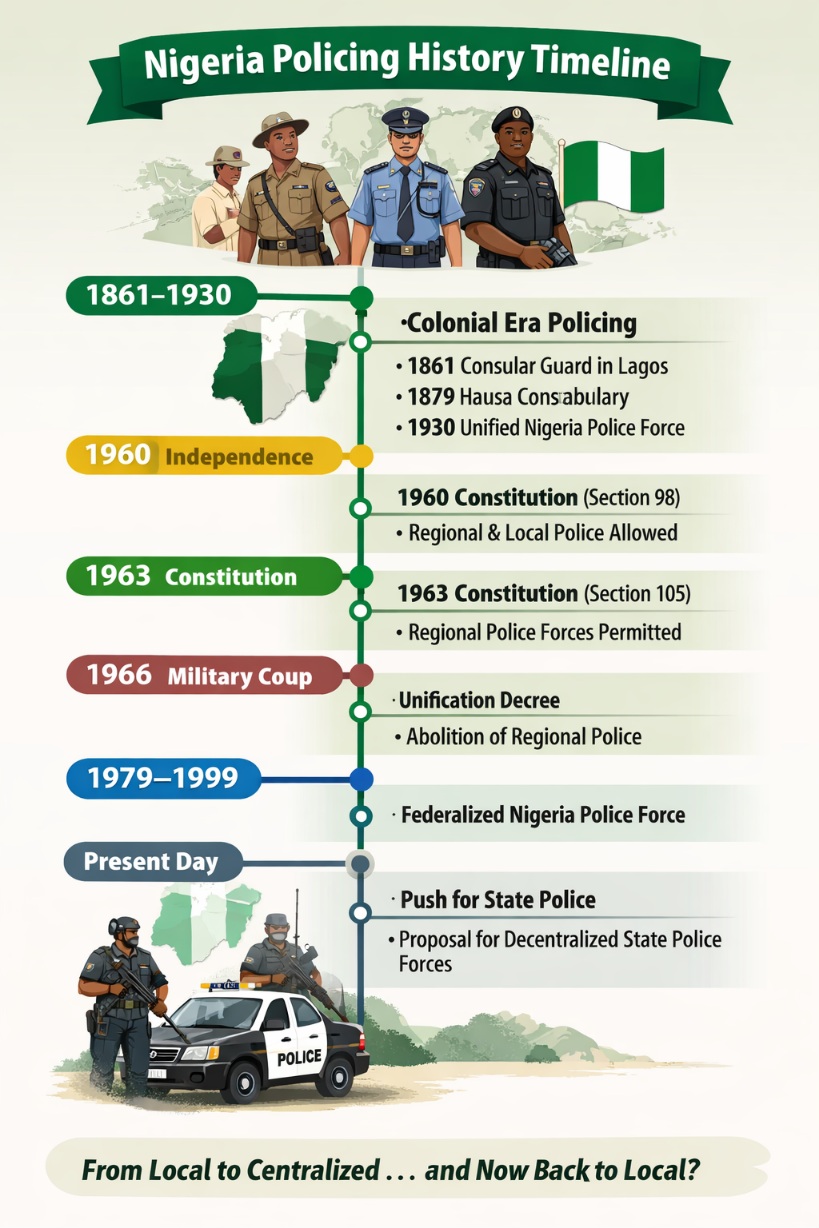
The Nigeria Police Force traces its origins to 1861, when the British established the Consular Guard in Lagos. By 1879, the Hausa Constabulary was formed, primarily to enforce colonial authority. Other regional constabularies followed, including the Lagos Police (1896) and the Niger Coast Constabulary (1894). These forces were militarized, serving colonial interests rather than community protection.
In 1914, the amalgamation of the Northern and Southern Protectorates created Nigeria, but policing remained fragmented until 1930, when the colonial administration merged regional forces into a single Nigeria Police Force headquartered in Lagos.
At independence in 1960, the Constitution (Section 98) established the Nigeria Police Force but did not fully federalize it. Arms and ammunition were placed under the concurrent legislative list, allowing regions to maintain local police forces. Section 98(7) explicitly permitted regional legislatures to authorize native or local government police within provinces.

The 1963 Constitution (Section 105) reaffirmed this arrangement, again allowing regional legislatures to maintain local police forces. Thus, Nigeria operated both federal and regional policing until January 15, 1966, when the military coup led by Major General Johnson Aguiyi-Ironsi abolished regionalism through the Unification Decree. Regional police forces were scrapped, and policing became centralized under the federal Nigeria Police Force.
Under the 1979 and 1999 Constitutions, the Nigeria Police Force remained federalized. However, after nearly six decades of centralized policing, Nigeria continues to grapple with insecurity—terrorism, banditry, kidnapping, and violent crime—exposing the limitations of a one-size-fits-all policing model in a heterogeneous society.
Today, with an executive bill before the Senate proposing decentralization and the creation of state police forces, Nigeria appears poised to return to a more localized policing structure, echoing its pre-1966 arrangements. This represents a significant shift in the country’s security architecture and may mark the end of the Nigeria Police Force as a unified national institution.
Conclusion:
Nigeria’s policing history reflects its political evolution—from colonial militarized control, through regional autonomy, to federal centralization under military rule. The current push for state police forces suggests a recognition that centralized policing has failed to adequately address Nigeria’s diverse security challenges. Decentralization may offer a more responsive and community-based solution, though it also raises concerns about political misuse at the state level.