By Ozodi Osuji Ph.d
Yesterday, September 27, I shared a video in which a Jamaican Parliamentarian said that it is not the whole story to blame only white folks for slavery and ignore the other parties in the slavery business. If someone must pay reparations for slavery, he asked for all those implicated in the sordid business of selling and using human labor for free to be made to pay, not just some of them but all of them.
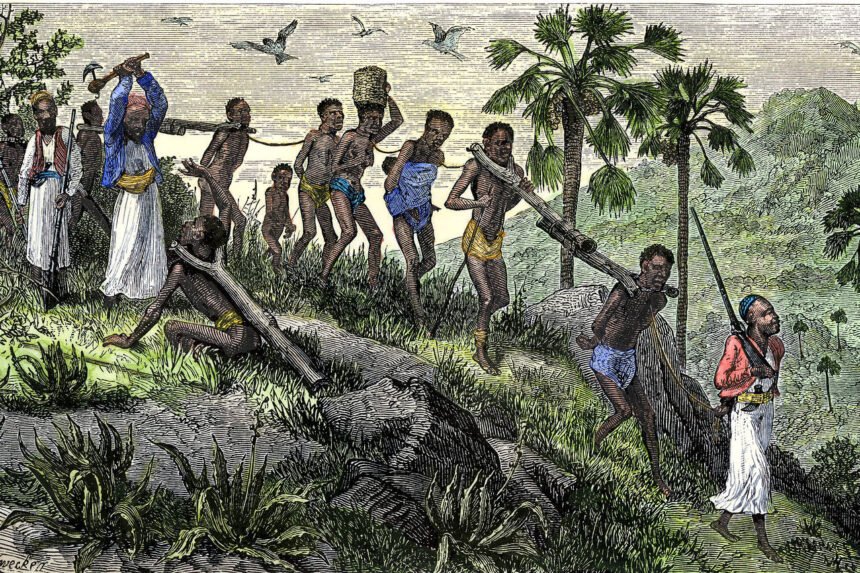
Here are the facts. Some Africans captured or kidnapped and sold their people. Some Arabs bought African slaves. Some white folks bought African slaves in West Africa and resold them to farmers in the New World.
Let us then be rigorous in employing terms. What is the percentage of Africans who kidnapped their fellow Africans and sold them to either Arabs or Europeans? I do not know.
Africans of the slave trading era did not keep data on who was caught and sold. I dare say that it was probably not more than thirty percent of adult Africans that were engaged in the slave trade.
What is the percentage of Arabs that bought and used slaves to better their lives? There is no data on this subject. But we can reasonably estimate that the percentage is no more than thirty-three percent of the Arab adult population engaged in the slave trade.
What we hear is that about 18 million Africans were sold to Arabs during the entire slave period (500-1900 AD). It is reported that Arabs castrated the male slaves and reduced the women to sex slaves.
It is estimated that about 12 million Africans were transported to the New World during the entire transatlantic slaving era (1515-1900 AD). Arabs enslaved Africans for 1300 years, whereas Europeans enslaved Africans for 400 years.
“When considering all white Americans, including those in Northern states where slavery was illegal, the percentage of families owning slaves drops significantly. Fact-checkers and census analyses estimate that about 7.4% of all U.S. families owned slaves, and roughly 5% of individuals in slaveholding states were recorded as slaveholders. Viral claims suggesting that only 1–2% of Americans owned slaves are misleading because they use inappropriate denominators, such as the total U.S. population rather than households in slaveholding regions.
Social and Economic Context
Even though a minority of whites legally owned slaves, slavery underpinned the broader social, economic, and legal systems in the South, benefiting many non-slaveholding whites indirectly. Slave ownership concentrated wealth and political power, and the institution shaped Southern society, politics, and culture until the Civil War. Most slaveholders owned relatively few enslaved people: 88% held fewer than twenty, and nearly half held fewer than five slaves.
Summary
Southern white families: ~30–37% owned slaves
All U.S. families: ~7.4% owned slaves. “
From Copilot A1
Many white Americans of the slave trading era came to America as indentured servants and therefore were not in a position to have slaves, although after serving their indenture, some of them acquired land and bought slaves to help them farm the land.
We can reasonably assume that no more than 33% of the white American population had slaves.
Now, if you ask all Europeans, Arabs, and Americans to pay reparations for the slave trade, you are essentially asking for 100% of these people to pay a tax for what less than thirty-three percent of their people did. Does that seem right in your mind? Should we ask the majority of the people to pay a price for what a minority of the people did?
We send to prison those who commit crimes, not all people. Let us then do a study and find out the specific Africans, Arabs, and Euro-Americans who participated in slavery and ask them to pay reparations to their ex-slaves.
We can make life easier for ourselves by forgiving all those who participated in slavery in Africa, Arabia, and America. However, having forgiven them, we can then pass laws that use our collective tax dollars to provide free education at all levels for ex slaves in the Americas and Arabia and also provide them with publicly paid health care.
This alternative seems more doable than harping on what cannot be morally justified: paying reparations by the majority that did not participate in slavery.
You do not rob Peter to pay Paul; you do not ask the 70% of Arabs and Americans whose ancestors did not participate in slavery to pay for it.
If you say that slaves’ labor was used to accumulate capital that paid for the Industrial Revolution, you are partially correct.
“Savery, an English inventor, created the first steam-powered pump designed to remove water from coal mines.
He patented his device in 1698, marking the earliest known steam engine invention.
His engine used steam to create a vacuum that lifted water but had significant limitations, including a pumping height of only about 32 feet.
Practical Steam Engine: Thomas Newcomen (1712)
Newcomen, an English ironmonger and inventor, developed the first practical atmospheric steam engine around 1712.
His design improved upon Savery’s concepts by introducing a piston and cylinder system, making it far more effective for pumping water out of mines.
Newcomen’s engine became widely used and laid the foundation for later advancements.
Later Improvements: James Watt
Although not the discoverer, James Watt significantly improved Newcomen’s engine in the mid 18th century, increasing efficiency and enabling broader industrial use.
Summary
The steam engine evolved through several key contributors:
Thomas Savery — first invention (1698)
Thomas Newcomen — first practical engine (1712)
James Watt — major improvements (1760s–1770s)
This progression established the steam engine as a cornerstone of the Industrial Revolution.” Wikipedia
The steam engine was applied to production by the owners of capital. We can focus on them and try to find out who they were and who their descendants are and talk to them about paying reparations. We should not generalize and say that all Americans and Europeans participated in the Industrial Revolution and the slavery business. The majority of them were serfs during the slave trading era.
It is not good enough to take one or a couple of classes in logic, and now one sees oneself as a logician, and that one can engage in rigorous intellectual work. On that basis, one points out what seem like stereotypes and generalizations in other people’s writing and then concludes that what they said is not valid.
It is intellectually valid to say that Africans, Arabs, and Europeans engaged in the slave trade even though not more than 33% of them did so. It is an acceptable generalization and stereotyping to make that valid statement. If you insist on being pedantic and remind us that not all those people engaged in slavery, your point is taken but irrelevant to the argument.
EFFORTS TO AVERT GUILT FEELING AND DEPRESSION BY DENYING AFRICANS ROLE IN SLAVERY AND BLAMING ONLY WHITE FOLKS FOR IT
Thinking about the evil of slavery gives me a sense of guilt; I feel remorse that my people participated in that iniquity.
I suspect that if Africans accepted responsibility for slavery, many of them would become depressed. To avoid depression, they deny their participation in the sordid business of selling their own people to foreign buyers.
We know that those who blame other people for their criminal behaviors tend not to feel guilt and remorse. Criminals, anti-social personalities, sociopaths and psychopaths, blacks and whites, blame other people for their crimes. They do not feel guilt, remorse, or depression.
It is not enough to blame other people for the crimes you see committed by your people; you must accept the role played by your people and seek ways to make meaningful amends for them instead of childishly denying the obvious: that it was some Africans who kidnapped their people and sold them to some Arabs and white folks.
Evil is evil regardless of who committed it. Making yourself seem perfect by blaming other people for your criminal thinking and behavior is what we see in extant Africa, where many of the politicians are mostly in government to steal their people’s money and refuse to develop Africa, and the average African lives like a dog, whereas there are obscenely wealthy Africans.
Generally, I do not have Africans around me who deny responsibility for the poor state of Africa and instead seek scapegoats to blame. This tendency to blame other people and not oneself has led to many Africans stealing from their national treasury and blaming white folks for the resulting lack of development in Africa. I banish such people from my company; therefore, I immediately unfriended the 419 thinkers trying to play intellectual games with me to justify the sad situation of Africa. If all you want to do is try to use pseudo-logic and intellectualism to justify your participation in making Africa poor and blame the West for it, I get rid of you. Go try your false intellectualism with the 419 and Yahoo boys that exist all over Africa.
Many Nigerian 419 criminals masquerading as scholars try to make those who state the truth feel like what they said is wrong; they try to shame them and thus use shame to control them and try shutting them up, and that way keep being the corrupt subhuman beings that have made a royal mess of governance in Africa.
I have a word for these criminal shysters: the era of political correctness is over. Liberals are no longer ruling the West; therefore, we cannot engage in political correctness and thus leave you as you engage in outrageous stealing from your African people and keep Africa poor while you blame white folks for what you did to Africans.
We must now call out these criminals who loot their people’s wealth, render them poor, and blame other people for what they did.
They laugh like jackals while their people live in abject poverty that resulted from their criminal activities.
• Depression is a state of unhappiness; since depression often results from feeling guilty for what one did or thinks that one did, one may deny what one did and blame other people for doing it. Depression is thus falsely cured by blaming other people for one’s actions. However, if one forms the habit of always blaming other people for one’s issues to avoid depression, one tends to remain infantile in one’s psychological structure, and worse, one may become a paranoid personality. These are clinical issues that I am not going to discuss in this essay but merely allude to them. If you are a clinician and want to learn more about the relationship between depression and paranoia, see William Meissner’s book, The Paranoid Process; also see his book, Psychotherapy and the Paranoid Process. He wrote from a psychoanalytic perspective.
Ozodi Osuji
September 28, 2026