By Okoi Obono-Obla
1. The Town Where It Was Signed: Maroua
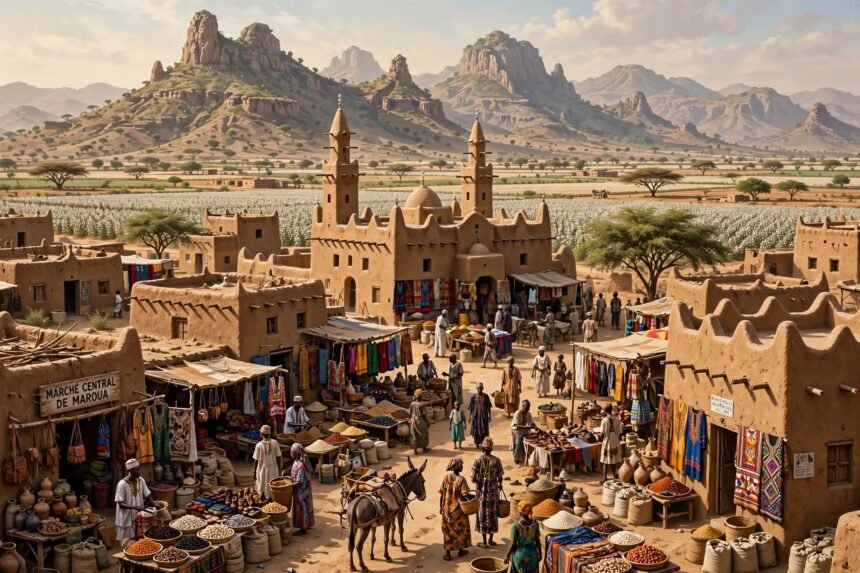
Maroua is the capital of the Far North Region and the Diamaré Department in Cameroon. It sits in Cameroon’s extreme north, at the foothills of the Mandara Mountains, very close to the Nigerian border.
It is a Sahelian city located on the Ferngo and Kaliao rivers, at about 10°35’50″N 14°18’57″E, elevation 384m. It is a bustling city in the Far North region of Cameroon, known for its vibrant markets, unique Sahelian culture, and rich history. Situated near the Mandara Mountains, Maroua has a population of about 400,000 people and is considered Cameroon’s 5th largest city.
The city inhabitants are mainly Fulbe/Fulani ethnic group, with Guiziga and Mofu who occupied the area in the 17th and 18th centuries. The city is characterized by its semi-arid climate, Islamic culture, and the palace of the Lamido of Maroua.
Economically, Maroua is an important center for the cotton industry and serves as a central hub for trade, education, and agriculture in the region. Its most famous industries are traditional: Embroidery, leather goods, jewelry, pottery are the important economic activities in the city of Maroua.
The city also has the Maroua Salak Airport and is home to the University of Maroua.
It was in this frontier market town — chosen by President Ahmadu Ahidjo to show that the far north mattered — that General Yakubu Gowon arrived from Lagos in May 1975.
2. What Is The Maroua Declaration?
The Maroua Declaration was signed on 1 June 1975 by Ahmadou Ahidjo, President of Cameroon, and General Yakubu Gowon, the head of state of Nigeria in Maroua, Cameroon.
It was the final meeting in a chain of border negotiations:
The problem of the maritime border featured prominently in discussions held between Gen. Yakubu Gowon and President Ahmadu Ahidjo in Garoua from 4th to 6th August, 1972, in Kano from 30th August to 1st September, 1974, and in Maroua from 30th May to 1st June, 1975. The last meeting resulted in the issuing of the “Maroua Declaration”
The declaration was not about the town itself. It was a maritime boundary treaty. It extended the 1971 Yaoundé II Declaration and drew a precise line on British Admiralty Chart 3433 from the mouth of the Akwayafe River out into the Gulf of Guinea.
On June 1st, 1975, Gowon and Ahidjo concluded the Maroua Declaration that redefined and extended the 1971 maritime boundary agreement.
Its legal effect was profound:A
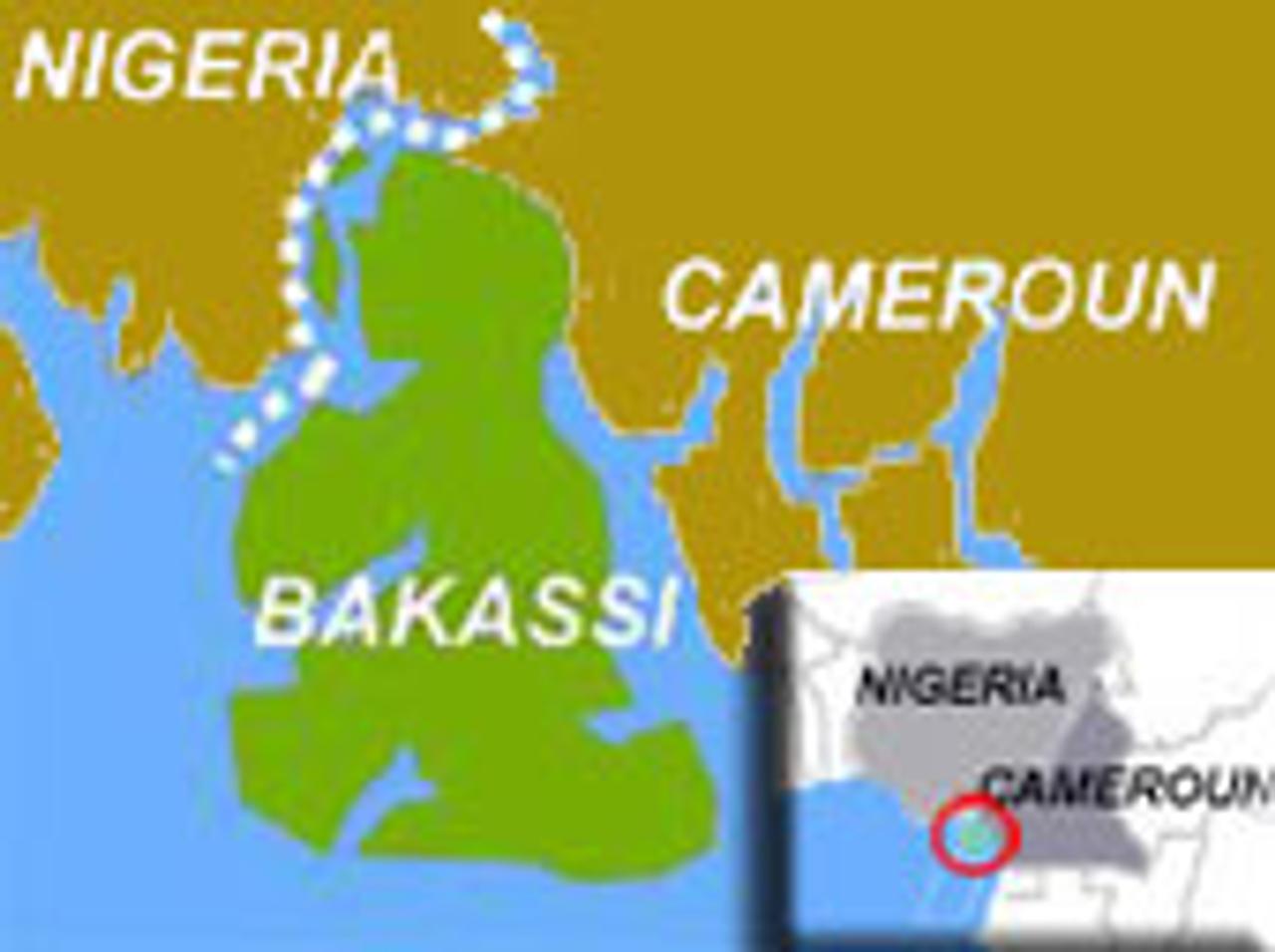
The Maroua and Yaoundé II Declarations which were entered into between President Ahidjo of Cameroon and General Yakubu Gowon of Nigeria vested the ownership of the Bakassi Peninsula on the Republic of Cameroon.
#### 3. Why Did Gowon Enter Into It?
a) The 1967 Debt: The root is not 1975 but 1967. When the Nigerian Civil War started, Biafra needed sea access through eastern Nigeria/Cameroon.
When the Nigerian Civil War was raging on, the government of Gowon reached an agreement with President Ahmadu Ahidjo of Cameroon which led to the closure of the maritime borders from where the Biafran soldiers obtained their foreign military supplies.
Ahidjo closed Cameroon’s border, airspace and ports to Biafra, denying Ojukwu a lifeline. Gowon never forgot.
b) The Gratitude Theory: This is the most cited explanation in Nigerian literature:
The Nigerians also claim that the Kano and Maroua Declarations were the outcome of Gowon’s largesse and gratitude to Ahidjo in recognition of Ahidjo’s support during the 1967-1970 Nigerian Civil War.
c) Practical Purpose — Oil and Peace: By 1970-74, both countries were licensing the same offshore blocks. There were naval clashes and fishermen were being arrested. Both leaders, moderates who believed in OAU principles of inviolable borders and good neighborliness, wanted a quick political solution to prevent war and to allow orderly oil exploration.
The official map of Nigeria in the 1970s even recognized Bakassi as part of Cameroon’s territory — showing how far Lagos had gone in accepting the compromise.
4. Was It Ratified By The Supreme Military Council?
No — and this is the critical point.
In May 30 – June 1st, 1975 Gowon and Ahidjo met in Maroua… The Maroua accord certainly conceded Cameroon sovereignty over to Bakassi and a lot more besides. But, two months later, Gowon had been ousted by the General Murtala Mohammed military junta, whose Supreme Military Council refused to ratify the agreement.
On 29 July 1975, Gowon was overthrown while in Kampala. The new Murtala Muhammed / Olusegun Obasanjo regime adopted a more nationalist, legalistic stance:
It argued that under military rule, cession of territory required ratification by the Supreme Military Council as the legislature. Gowon had signed alone.
It invoked effective occupation — Bakassi was inhabited by Nigerians (Efik) for centuries.
The rising value of oil made ratification politically impossible.
Nigeria therefore disowned the Declaration from 1975 to 1994, while Cameroon treated it as binding.
5. Why Did The ICJ Rely On It?
When Cameroon took Nigeria to the International Court of Justice in 1994, it based its case on three documents: the Anglo-German Agreements of 1913, Yaoundé II (1971), and Maroua (1975).
Nigeria argued:
the Maroua Declaration was invalid and nonbinding because although the Nigerian head of state had signed it, the agreement had not been ratified either by Parliament or any other governmental process.
The ICJ on 10 October 2002 rejected that completely:
The ICJ held that under international law the declaration was valid and came into effect upon signing by the head of state.
Why?
i) International Law, Not Domestic Law: Under the Vienna Convention, a Head of State can bind his country. Domestic non-ratification is irrelevant internationally.
ii) It Was A Legal Instrument: The Court found the text had precise coordinates and clear intent to create obligations, not a mere communiqué.
iii) It Was Part of a Chain:
The ICJ ruling rested on multiple treaties, including: The Anglo-German Treaty… The Maroua Declaration of 1975… which refined maritime limits… Although Nigeria argued that the Maroua Declaration was never ratified, the ICJ considered it binding.
The final judgment states:
In finding in favour of Cameroon, the ICJ upheld the validity of the 1913 agreement and the Maroua Declaration.
And on Bakassi specifically:
Instead, it was, in large measure, predicated on the 1975 Maroua Declaration; pursuant to which Nigeria, the Court held, acknowledged Cameroonian sovereignty over the area.
Thus, a handshake in a Sahelian cotton market town in 1975 — born out of gratitude for help in 1967 — became, 27 years later, the legal anchor on which the ICJ awarded the oil-rich Bakassi Peninsula to Cameroon, leading to Nigeria’s formal handover in 2008 under the Green Tree Agreement.