By Okoi Obono-Obla
Mohammed Bello Doka’s article of September 24, 2026, titled in substance that President Bola Ahmed Tinubu has never attended the United Nations General Assembly and is afraid to step on American soil, is written with eloquence but collapses upon contact with facts.
I write this rejoinder not as a spokesman for the Presidency, but as a Nigerian, a lawyer, and a citizen concerned about the corrosion of public discourse when invective replaces verification.
Let us separate what is verifiable from what is tendentious.

First, the claim that President Tinubu has never attended UNGA is false.
President Tinubu attended the 78th Session of the United Nations General Assembly in New York in September 2023 and delivered Nigeria’s national statement, calling for UN reform and investment in Africa. That is a matter of video record, UN archives, and contemporary reporting.
What is true is that since then, Vice President Kashim Shettima has led Nigeria’s delegation at the 79th Session in 2024, the 80th Session in 2025, and now the 81st Session in 2026. That makes it three consecutive absences, not four. Mr. Doka’s decision to erase 2023 from history is not an error of research; it is a deliberate distortion to manufacture a pattern of “never.”
If we are to debate whether the President should have attended in 2026, let us debate three absences, not a fictional four. Accuracy matters.
Second, the 1993 forfeiture is public record, but Doka misstates its legal meaning.
In 1993, following an investigation into a heroin trafficking network in Chicago, the United States government filed a civil forfeiture action against funds in accounts linked to Mr. Tinubu and others. He forfeited $460,000. He was not criminally charged. He was not criminally convicted. He did not plead guilty to any crime.
The Presidential Election Petition Court in September 2023, faced with this same exhibit by petitioners Peter Obi and Atiku Abubakar, held precisely that: it was a civil forfeiture, not a criminal conviction, and did not meet the constitutional threshold for disqualification under Section 137(1)(d) of the 1999 Constitution.
One may hold whatever moral view one wishes about the forfeiture. But to present a 33-year-old civil settlement as proof of a heroin conviction is legally illiterate. A forfeiture is not a conviction. Our law knows the difference.
Third, the FOIA litigation is misrepresented.
American activist Aaron Greenspan indeed filed FOIA requests and sued in June 2023. In April 2025, Judge Beryl Howell of the U.S. District Court for the District of Columbia ruled that the FBI and DEA could no longer issue a Glomar response — that is, a refusal to confirm or deny the existence of records — and must search for and process non-exempt records.
That is all the court did. The court did not find that the President trafficked in heroin. It did not order the release of incriminating files. It did not make any criminal finding. It ruled on a procedural question of FOIA law. As the court itself noted, the case concerns access to records.
Doka writes that the FBI submitted a “399-page unredacted file” and that the President’s lawyers are suppressing it. That is not in the public docket. What is in the public docket is that agencies were ordered to search. The leap from “ordered to search” to “hiding guilt” is speculation.
And yes, a citizen — even a President — has the right to assert privacy in a FOIA proceeding. That is what the statute provides. To argue that assertion of a legal right proves consciousness of guilt would destroy the very concept of due process.
Fourth, the Paris canard.
President Tinubu departed Abuja on August 30, 2026 for a three-week annual leave, first in London and then in Paris, arriving in Paris on September 13. The Presidency announced this as a working vacation.
Doka claims the Paris visit produced “no announced agreements, no signed deals, no evidence of engagement with anyone of consequence.” This is demonstrably false. On September 17, 2026, French President Emmanuel Macron hosted President Tinubu for a private dinner at the Élysée Palace. On September 18, 2026, President Tinubu met with Mr. Vincent Bolloré and executives of the Bolloré Group — owners of Canal+, interests in MultiChoice and Universal Music Group — to discuss expansion in Nigeria’s creative and digital economy. The Presidency issued statements on both.
One may argue that these engagements are not as weighty as UNGA bilaterals. That is a fair debate. But to say they did not happen is false reporting.
Fifth, the central thesis: fear of America.
Here Doka abandons fact for psychoanalysis. The argument is: If there is no impediment, why has he not attended? Therefore, he must be afraid of arrest or embarrassment in the United States.
This is a classic non sequitur. There are many reasons a President may delegate UNGA — domestic priorities, preference for other diplomatic tracks, a strategic decision to let the Vice President retain a speaking slot that Nigeria has worked to keep on Day One, or simply a decision to take annual leave as provided by law.
One may disagree with that judgment. I myself believe Nigeria’s President should as a rule be present at UNGA, where 193 nations gather and where bilateral meetings on the margins often matter more than the speeches.
But disagreement with a scheduling choice does not entitle us to invent a fugitive theory. There is no warrant, no indictment, no travel restriction on the President of Nigeria. He has travelled extensively to Europe, the Middle East, Asia, and Africa. To claim he cannot travel “anywhere” because he did not travel to New York this September is rhetorical excess.
Doka cites Seneca and Confucius about conscience. I would offer a different principle: the law of evidence. He who asserts must prove. The burden is not on the President to prove he is not afraid of America; the burden is on the accuser to prove the facts that show fear is the reason. No such facts are offered.
Finally, the cost to Nigeria.
Doka is right on one point: UNGA matters. Absence has a cost in visibility and momentum. That cost should be debated honestly and without fabrication. When we fabricate that the President has never attended, when we erase his meetings in Paris, when we convert a civil forfeiture into a criminal conviction, we weaken, not strengthen, the case for accountability.
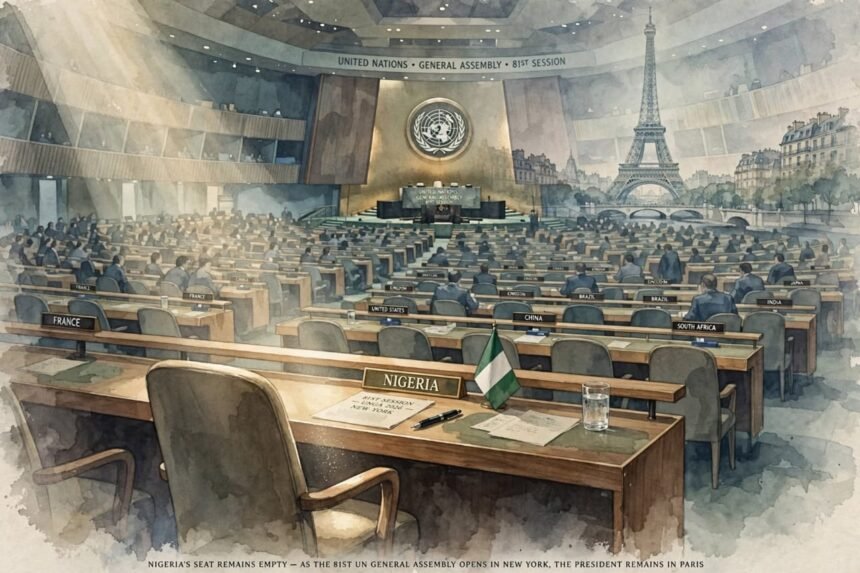
Nigeria deserves a robust opposition and a fearless press. It also deserves facts. An empty seat in New York should be debated with a full set of facts on the table.
The seat this year is indeed occupied by the Vice President. The question why should be asked. But it should be asked with the record intact — including 2023, including the legal distinction between forfeiture and conviction, and including what actually happened in Paris.
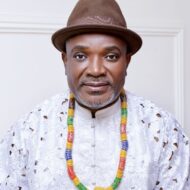
Okoi Obono-Obla is a lawyer and former Special Assistant to the President on Prosecution.