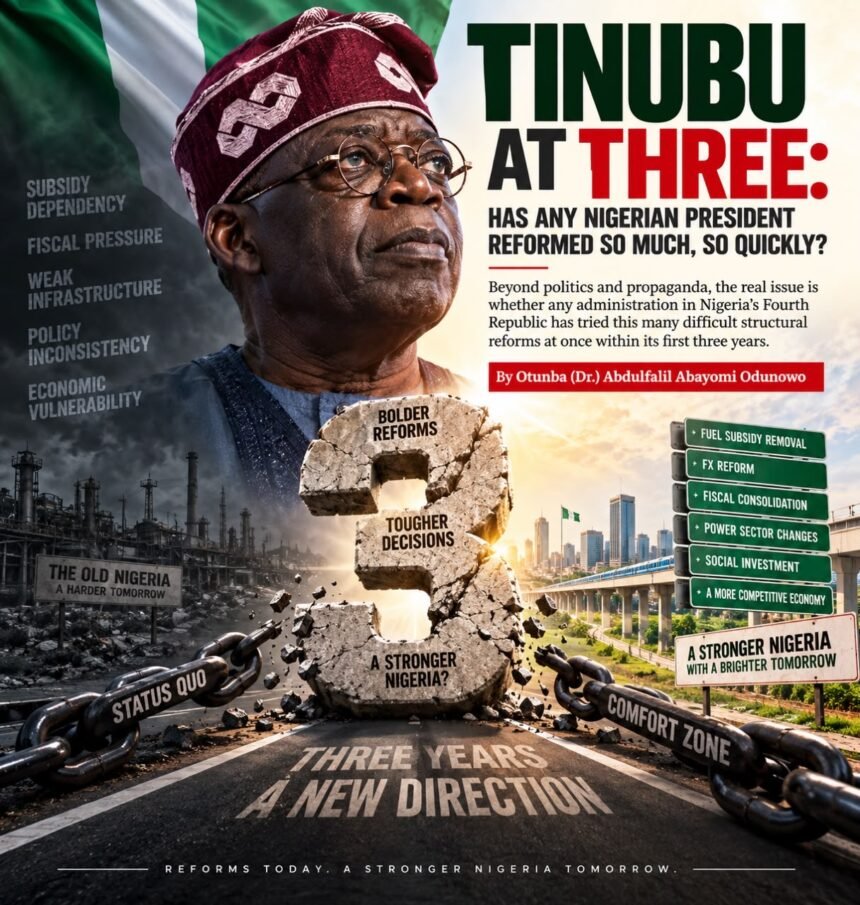
By Otunba (Dr.) Abdulfalil Abayomi Odunowo
Beyond politics and propaganda, the real issue is whether any administration in Nigeria’s Fourth Republic has tried this many difficult structural reforms at once within its first three years.
There is a question Nigerians ought to weigh without the filter of party loyalty, ethnic sentiment, or political hostility:
Has any Nigerian President in the Fourth Republic attempted this scale of fundamental economic, fiscal, and institutional reform within his first three years in office?
The question is not whether President Bola Ahmed Tinubu has made mistakes. He has. It is not whether Nigerians have endured serious economic hardship since May 2023. They have. Nor should anyone act as though every road, railway, power plant, or government programme commissioned since May 2023 began with the Tinubu administration. Governments inherit projects, institutions, debts, opportunities, and problems from those who came before them.
The more useful question is different: What structural shifts have actually taken place, how consequential are they, and how does their concentration within three years stack up against earlier administrations?
That’s where the Tinubu record becomes historically compelling.
THE ECONOMIC SURGERY
Tinubu inherited an economy weighed down by a costly petrol-subsidy regime, multiple foreign-exchange rates, severe FX shortages, heavy debt-servicing pressure, weak government revenues, and vast infrastructure deficits.
Rather than manage those distortions gradually, his administration chose what can fairly be described as economic shock therapy.
The petrol subsidy was removed on inauguration day.
The multiple foreign-exchange windows were dismantled. The exchange rate moved closer to a market-determined framework. A broad tax restructuring followed, culminating in four major tax reform laws. Electricity regulation was decentralised, allowing states to build their own electricity markets. Consumer credit was institutionalised through CREDICORP.
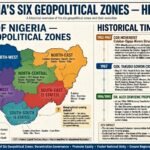
A national student-loan system, NELFUND, became operational. Regional development institutions were expanded across the six geopolitical zones. And the Federal Government went all the way to the Supreme Court in pursuit of financial autonomy for Nigeria’s 774 local governments.
Whether one agrees with every step or not, the sheer concentration of structural change is hard to miss.
THE SUBSIDY QUESTION
Nigeria had debated petrol-subsidy removal for decades. Successive governments knew the system was fiscally unsustainable, yet political resistance repeatedly blocked full removal.
Tinubu ended the old subsidy arrangement immediately after taking office. Official figures and contemporary reporting put the cost of the regime at more than ₦4 trillion in 2022 alone, with peak daily outlays cited at around ₦18.4 billion. What the reform unquestionably did was dismantle a major subsidy architecture that had created huge room for arbitrage, fraudulent consumption claims, smuggling, and fiscal leakage.
The reform also imposed severe costs on ordinary Nigerians through transport and living expenses. Any honest assessment has to admit both realities. Claims that subsidy removal automatically “eliminated corruption” should be treated cautiously; the more precise point is that it shut down a major channel of fiscal leakage and rent-seeking.
FOREIGN EXCHANGE: ANOTHER SACRED COW
Nigeria’s multiple exchange-rate regime created conditions in which privileged access to official foreign exchange could itself become massively profitable.
Tinubu’s administration and the Central Bank moved toward exchange-rate unification and broader market price discovery. The CBN later reported that the verified $7 billion FX backlog had been cleared. That matters. Foreign investors and Nigerian companies can’t function efficiently where legitimate foreign-exchange obligations remain trapped for years.
The reform was painful because naira depreciation sharply raised import costs and fed inflation. Still, it confronted a distortion previous administrations had struggled to resolve.
GOVERNMENT FINANCES ARE CHANGING
Federation revenues have risen significantly. States and local governments now receive much larger nominal allocations than before the reforms. Nigeria’s tax-to-GDP ratio has improved from the low single digits toward the low teens, while a redesigned tax framework aims to simplify administration, widen compliance, and reduce multiple taxation.
These reforms shouldn’t be judged only by how much government collects. Here’s the thing: the real test is what government does with the extra money. Higher revenue without better roads, schools, hospitals, security, electricity, and water isn’t transformation. Nigerians are therefore entitled, quite rightly, to demand accountability from federal, state, and local governments, especially now that more money is moving through the federation.
TRADE AND CAPITAL MARKETS
Nigeria has posted successive trade surpluses. In Q2 2025 alone, the trade surplus reached approximately ₦7.46 trillion, driven by stronger exports, including non-oil and manufactured goods, even as crude volumes fluctuated.
The Nigerian equities market saw extraordinary nominal expansion. By May 2026, the All-Share Index had climbed from roughly 53,000–56,000 points at the time Tinubu assumed office to around 250,000, with market capitalisation rising from about ₦30 trillion to over ₦160 trillion. Government policy is one factor in stock-market performance; inflation, exchange-rate movements, corporate earnings, interest rates, and investor expectations are others. That distinction matters if this assessment is to stay objective.
INFRASTRUCTURE ON AN EXTRAORDINARY SCALE
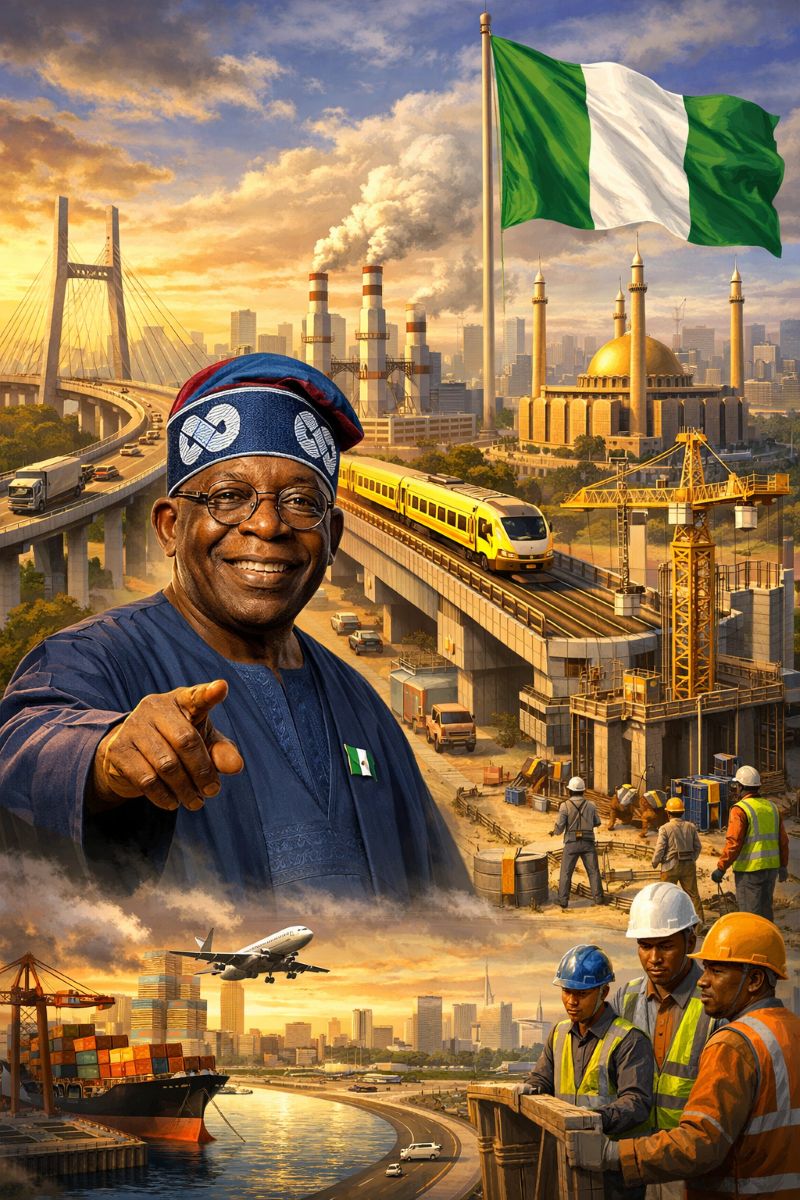
Perhaps the clearest physical expression of the Tinubu administration is its infrastructure ambition. The Lagos-Calabar Coastal Highway and Sokoto-Badagry Super Highway are enormous transport corridors. Official reporting around the third anniversary indicated more than 2,700 kilometres of highways and major roads under construction, reconstruction, or rehabilitation across Nigeria, with later figures citing completed kilometres and an even larger pipeline of ongoing works.
Other major projects include progress on the Abuja-Kaduna-Zaria-Kano road, East-West Road, and numerous federal road interventions.
But intellectual honesty demands an important distinction. Not every project completed or advanced under Tinubu was conceived by Tinubu. The Second Niger Bridge is fundamentally a Buhari-era achievement. Buhari’s administration also completed the 326-kilometre Itakpe-Ajaokuta-Warri railway and the 156.5-kilometre Lagos-Ibadan standard-gauge railway.
The Abuja Light Rail existed before Tinubu; the legitimate Tinubu achievement was restoring and revitalising passenger operations. The 700 MW Zungeru Hydroelectric Power Project was substantially advanced and largely completed under the previous administration, though formal steps and operations continued into the Tinubu years.
Giving previous administrations their due doesn’t diminish Tinubu. If anything, it makes the achievements that genuinely belong to him more credible.
THE ELECTRICITY REVOLUTION THAT COULD BE HISTORIC
One reform whose importance may not be fully understood until years from now is the Electricity Act 2023. For decades, Nigeria tried to manage electricity largely through a centralised national structure. The new framework allows states to establish electricity markets and regulate generation, transmission, and distribution within their jurisdictions. Several states have since begun developing their own markets and projects.
Tinubu’s administration has also tackled metering, legacy debts, transmission weaknesses, and rural/off-grid electricity. The real test, of course, is electricity delivered. Nigeria cannot industrialise on roughly 5,000–6,000 MW available to a population exceeding 200 million. If decentralisation eventually produces multiple competitive state electricity markets, the Electricity Act could rank among the most consequential economic reforms of the Fourth Republic.
NELFUND: QUIETLY BUILDING HUMAN CAPITAL
One programme deserves closer attention. The Nigerian Education Loan Fund has changed the architecture for financing tertiary education. By mid-2026, official figures indicated that more than 1.5 million, and in some updates approaching 1.6 million, students had gained access, with over ₦282 billion disbursed. Later reports showed continued growth in both beneficiaries and total outlays.
The significance goes beyond the amount spent. Nigeria is gradually moving toward a system where a parent’s inability to immediately pay tertiary-education costs does not automatically end a young person’s education. If managed transparently and sustainably, NELFUND could become one of Tinubu’s most important social-policy legacies.
CONSUMER CREDIT: ANOTHER STRUCTURAL SHIFT
Another potentially transformative development is the establishment of the Nigerian Consumer Credit Corporation, CREDICORP. Developed economies are not built on salaries alone; they’re also built on responsible credit. Workers should be able to finance vehicles, equipment, appliances, and productive assets over time rather than saving the full purchase price before they can participate in the economy. The expansion of consumer credit, together with related youth initiatives, therefore reflects an effort to alter the financial architecture around the Nigerian household.
AGRICULTURE AND MECHANISATION
The administration has expanded agricultural mechanisation, irrigation, inputs, and dry-season production interventions. Its strategy has included plans for the deployment of thousands of tractors over several years. But announcements and equipment procurement can’t be the final measure. The true agricultural scorecard is simpler: How many additional tonnes of rice, maize, wheat, tomatoes, and other food products are Nigerians producing? And ultimately, has food become more affordable? Until those questions can be answered convincingly, agricultural intervention remains a work in progress.
LOCAL GOVERNMENT AUTONOMY
One of the administration’s potentially historic institutional interventions received less public attention than subsidy removal. The Tinubu government pursued litigation seeking financial autonomy for Nigeria’s 774 local governments. The Supreme Court delivered its landmark judgment in July 2024, affirming direct allocations and democratic governance at the local level.
It would be constitutionally inaccurate to say “Tinubu granted local-government autonomy.” But it is entirely fair to credit his administration with initiating and championing the federal action that produced the judgment. Implementation has met resistance and delay; full effect remains incomplete. If fully carried out, stronger local governments could have enormous consequences for grassroots development, primary healthcare, rural roads, markets, sanitation, and local security.
NOW COMPARE THE PRESIDENTS
Historical comparison requires fairness.
Umaru Musa Yar’Adua
President Umaru Musa Yar’Adua cannot reasonably be judged as though he enjoyed two full terms. He served for less than three years before illness overwhelmed his presidency. Yet his administration produced the Niger Delta Amnesty Programme, emphasised the rule of law, acknowledged flaws in the election that brought him to power, and pursued electoral and institutional reforms. The Niger Delta intervention alone had enormous consequences for oil production and national stability. Yar’Adua deserves his place in history. But measured purely by the breadth of simultaneous structural economic reform, Tinubu’s first three years have been markedly more aggressive.
Goodluck Jonathan
President Goodluck Jonathan also left significant achievements. His administration pursued the historic privatisation of electricity distribution and generation assets. It implemented the Agricultural Transformation Agenda. Rail services were revived. Aviation infrastructure received substantial investment. YouWIN supported entrepreneurship.
Universities were expanded. Nigeria’s telecommunications and digital economy continued their rapid growth. And perhaps most importantly for democracy, Jonathan conceded the 2015 presidential election, strengthening Nigeria’s democratic tradition. His record should never be erased simply to elevate another President. But Tinubu’s reform programme has gone after a larger number of entrenched fiscal and monetary distortions at the same time.
Muhammadu Buhari
President Muhammadu Buhari presents perhaps the strongest infrastructure comparison. His administration completed major rail projects, roads, and bridges. The Second Niger Bridge is a monumental Buhari-era legacy. His government completed the Itakpe-Warri and Lagos-Ibadan railway projects and pursued thousands of kilometres of road construction, rehabilitation, and maintenance. Buhari also expanded social-investment programmes, infrastructure financing, and agricultural interventions.
So, saying Buhari “did not achieve half of what Tinubu has done” would be historically difficult to defend.
But there is a major difference. Buhari largely avoided the simultaneous removal of the two biggest distortions facing the Nigerian economy: petrol subsidy and the multiple exchange-rate regime. Tinubu confronted both almost at once. That is the fundamental distinction.
THE REAL HISTORICAL QUESTION
So perhaps the wrong question has been asked. The question should not be: “Has any Nigerian President done half of these things?” Counting programmes is not a serious way to judge governments.
The stronger question is this: Has any President of Nigeria’s Fourth Republic undertaken, within his first three years, this concentration of politically dangerous structural reforms across petrol subsidy, foreign exchange, taxation, electricity, education financing, consumer credit, infrastructure, agriculture, fiscal federalism, and regional development all at once?
On the evidence currently available, making the case against Tinubu on that specific question is difficult.
But there is one final qualification, and arguably it is the most important.
REFORM IS NOT AN END IN ITSELF
History will not ultimately judge Tinubu by the number of reforms announced. Nigerians shouldn’t either. The Nigerian mother buying garri does not eat GDP statistics. The worker travelling from Ijebu-Ode to Lagos cannot fuel his vehicle with foreign reserves. The unemployed graduate cannot pay rent with the stock-market index. And a farmer cannot irrigate his farm with a government press release.
The ultimate measurement must therefore shift from macroeconomic stabilisation to household prosperity. Can Nigerians afford food? Is electricity becoming more reliable? Are factories producing more? Are real wages rising? Are businesses creating jobs? Are farmers becoming more productive? Are Nigerians safer? Is poverty declining? Is the naira preserving purchasing power?
Those are the indicators that will determine the final verdict. President Tinubu himself has acknowledged that many Nigerians still face economic hardship and that democracy must ultimately “be felt in the pocket.” That should be the standard by which the administration is judged.
MY VERDICT
After three years, it is reasonable to argue that President Bola Ahmed Tinubu has undertaken one of the most concentrated programmes of structural economic reform Nigeria has seen in the Fourth Republic.
Fuel subsidy reform. Foreign-exchange reform. Tax restructuring. Electricity decentralisation. Student financing. Consumer credit. Local-government fiscal reform. Regional development institutions. Agricultural mechanisation. And large new infrastructure corridors.
Some have produced encouraging results. Some remain incomplete. Some have imposed enormous hardship. And some may take years before their real consequences can be judged. Implementation gaps, especially on local-government autonomy, and the lag between stabilisation and broad-based welfare gains remain very real.
So Tinubu’s greatest achievement at three years is not that he has completed a fixed number of projects. It is that his government has been willing to confront, almost simultaneously, several structural problems Nigeria had debated, postponed, and managed around for decades.
But courage in beginning reform is only half the task. The second half, and the more important half, is making reform improve the lives of ordinary Nigerians.
If today’s painful restructuring eventually produces affordable food, productive industries, reliable electricity, stronger wages, jobs, consumer purchasing power, and greater security, history may judge the Tinubu reforms as a turning point. If those benefits fail to reach ordinary households, Nigerians will understandably ask what all the sacrifice was for.
That is why the question before Nigeria should no longer be merely: HOW MUCH HAS TINUBU DONE?
The question that will define his legacy is: WHEN WILL THE REFORMS BE FELT IN EVERY NIGERIAN HOME?
That is the standard. That is the challenge. And ultimately, that is how history will judge the Tinubu presidency.
Otunba (Dr.) Abdulfalil Abayomi Odunowo
National President SCN
SpeakUp Collective Nigeria
Wednesday 16th September 2026