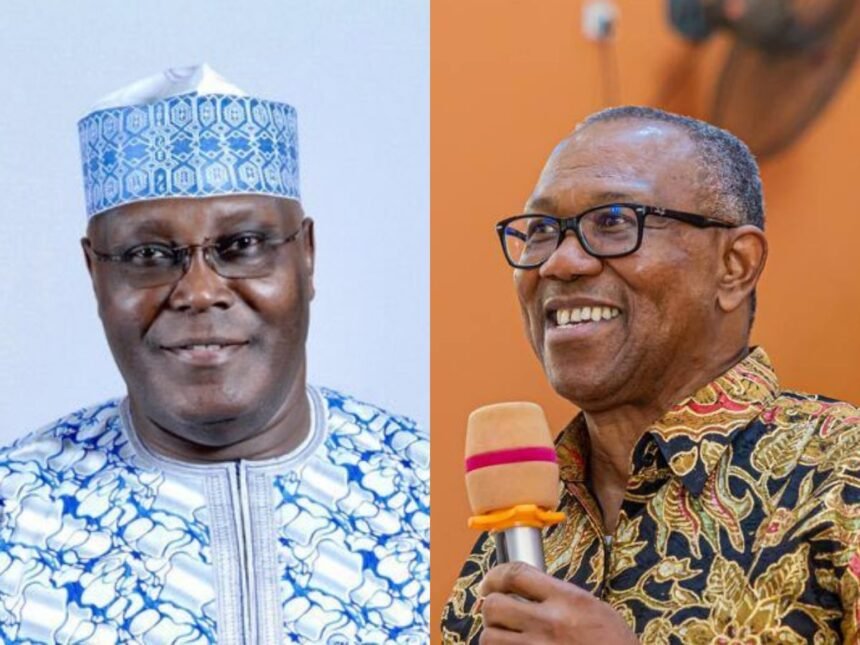
By Umar Ardo, Ph.D
The political significance of recent Nigerian elections may sometimes lie less in who won than in who failed to make an impact. Three elections deserve to be viewed together: the Anambra governorship election of November 2025, the Federal Capital Territory Area Council elections of February 2026 and last week’s Osun governorship election. Taken individually, each can be explained away as a local contest with peculiar circumstances. Taken together, however, they reveal a pattern that Peter Obi, Atiku Abubakar and the opposition coalition cannot afford to ignore as they prepare for the 2027 presidential election.
2. The pattern is becoming uncomfortably predictable: *enormous national political visibility is not translating into equivalent grassroots electoral strength*.
3. The first warning came from Anambra State. In November 2025, Peter Obi was still in the Labour Party – the party on whose platform he contested the 2023 presidential election and with which he had become synonymous. Yet Labour lost the Anambra governorship election woefully. More significantly, Labour even lost Obi’s own polling unit. At Polling Unit 019, Agulu Ward 11, Anaocha Local Government Area, APC’s Nicholas Ukachukwu polled 73 votes against Labour’s George Moghalu with 57, while APGA scored 38. Premium Times reported that Obi himself had voted at the same polling unit.

4. A polling-unit result cannot, by itself, determine a presidential election. But its symbolism cannot reasonably be dismissed. For a politician whose political strength rests substantially on a powerful personal connection with voters, the inability of his political organisation to carry even his immediate polling unit raises a fundamental question: “How effectively can Peter Obi’s personal popularity be translated into organised electoral power”? This question would acquire an even greater significance three months later.
5. In February this year the Local Council elections in the Federal Capital Territory provided a test of the electoral strength of the newly formed coalition. The results of the FCT Area Council elections were even more revealing. By then, Atiku Abubakar and Peter Obi were together within the emerging ADC political coalition. The FCT election consequently offered them an opportunity to demonstrate that their combined national popularity could be translated into grassroots electoral strength. They did not merely endorse ADC candidates from afar. They campaigned for them physically.
6. Just 48 hours before the election, The Guardian Newspaper reported that Atiku and Obi jointly appeared on the campaign trail in Abuja, canvassing support for ADC candidates and presenting the contest as an important test for the opposition. The result, however, did not produce the breakthrough that their intervention might have suggested. The election covered the six FCT Area Councils and 62 councillorship positions. APC ultimately emerged with overwhelming control of the councils, while ADC failed to win a chairmanship, or even a councilorship.
7. This was not an election in which the two men were distant national personalities. They were campaigning together for the same party. The result therefore raised another important question: “*If the combined political capital of Atiku and Obi could not translate into a decisive ADC breakthrough in the Federal Capital Territory, what organisational machinery exists to translate their national popularity into votes across the 36 states in 2027”?*
8. Then came Osun gubernatorial election which seems to have answered the question. The ADC went into the election with considerable political visibility. Atiku, who actually won Osun State in the 2023 presidential election, personally campaigned for its candidate, Najeem Salaam. Rauf Aregbesola, a former two-term governor of Osun and National Secretary of the ADC, also played a prominent role.
9. Yet, when the complete results were counted and announced, ADC obtained only 17,180 votes, finishing a distant third. Adeleke’s Accord polled 511,067 and APC’s Bola Oyebamiji 444,815. ADC won no local government area.
10. No matter how one looks at it, the result is just difficult to reconcile with the growing narrative of ADC as an emerging “Third Force”. A party aspiring to challenge the incumbent President in a nationwide election must demonstrate more than national media visibility. It must demonstrate electoral depth, which so far it has failed to as Osun did not demonstrate that depth. Indeed, the result is particularly striking because Salaam was not an obscure candidate. He was a former Speaker of the Osun State House of Assembly. The campaign also enjoyed the direct intervention of two nationally prominent figures associated with the ADC. Yet the party still finished with only 17,180 votes out of over one million votes cast. That is not merely a defeat. It is a warning.
11. Now let us put the three elections together. In Anambra, Peter Obi’s Labour Party lost the governorship, including Obi’s own polling unit. In the FCT, Atiku and Obi campaigned together for ADC candidates, yet ADC failed to capture a single chairmanship, or councilor. In Osun, Atiku campaigned for ADC’s candidate, Aregbesola led the party’s effort in his former state, yet ADC finished a distant third with only 17,180 votes. Three elections. Different states. Different circumstances. Different parties and candidates. But one recurring pattern: *the gap between political personality and political organization remains wide.* This is the uncomfortable hard reality that Obi, Atiku and the entire opposition coalition must confront.
12. There is little doubt that both men possess substantial personal political capital. Obi demonstrated extraordinary national appeal in 2023. Atiku has contested the presidency repeatedly and retains a formidable political network. But these three elections showed that personal popularity is not the same thing as electoral machinery. A presidential candidate cannot personally be present at every ward, polling unit and collation centre; a national rally cannot substitute for a local organisation; social-media followers cannot substitute for polling-unit agents; and political excitement cannot automatically become votes. All these must be taken into account in defining the strategic planning of the opposition.
13. The APC’s principal advantage is precisely that it combines a nationally established party structure with federal incumbency and extensive state-level political networks. The opposition therefore requires something more than popular candidates. It requires an organisation capable of converting their popularity into votes.
14. The emerging danger is that the opposition may be mistaking political noise for political strength. ADC has generated enormous attention since Atiku, Obi and other prominent politicians came together into the party. But as is increasingly becoming evident, political attention is not electoral strength. A party becomes a “Third Force” not because commentators call it one, but because voters demonstrate their willingness to abandon the established parties and vote for it.
15. The evidence from these three elections does not yet demonstrate that this has happened. That does not mean it cannot happen before 2027. It means the opposition has work to do. The lesson for Obi and Atiku is obvious. Neither Anambra nor FCT nor Osun can predict the outcome of the 2027 presidential election. But together they provide an empirical warning that should not be ignored. Obi’s popularity did not save Labour in Anambra. Atiku and Obi’s joint presence did not produce an ADC breakthrough in FCT. Atiku’s and Aregbesola’s personal interventions did not prevent ADC from collapsing to 17,180 votes in Osun. The pattern is becoming too consistent to be dismissed as coincidence. The problem may not be that Obi and Atiku lack supporters. The problem is whether their supporters are sufficiently organised, coordinated, motivated and electorally connected to turn support into victory. And that is the central challenge of 2027.
16. The opposition cannot defeat an incumbent President merely by producing two nationally recognised politicians and placing them on a new party platform. It must build the machinery that connects those politicians to the Nigerian voter at the most basic level of the electoral system. Because elections are ultimately not won by the loudest political narrative. They are won by votes. And votes do not organise themselves.
17. Anambra, FCT and Osun should therefore be treated neither as prophecies of defeat nor as reasons for despair. They are warning signals. They tell Obi and Atiku that the time for assuming that national popularity will automatically translate into presidential votes is over. Or the electorate being despondent with an incumbent will automatically lead to voting against it. They must now answer a much harder question: *Where is the organisation that will carry the Obi and Atiku phenomenon from Abuja and the social media into Nigeria’s 176,000-plus polling units?* Until that question is convincingly answered, the opposition’s political visibility will remain considerably greater than its demonstrated electoral capacity.
18. And after Anambra, FCT and Osun, the pattern is becoming difficult to ignore. The opposition has personalities. It has publicity. It has political excitement. What it still needs to prove is that it has the machine to win an election. That is the hard reality confronting Obi, Atiku and the entire opposition coalition as 2027 approaches.