

By Okoi Obono-Obla
The release of the breakdown of INEC voters registration has once again reignited the old debate about who holds the key to the Nigerian presidency. With a total of 103,428,715 registered voters, the numbers on their face look intimidating for some and reassuring for others. But numbers alone do not make a President in Nigeria. The framers of our Constitution knew this.
In October 1975, the military government of General Murtala Muhammed inaugurated a Constitution Drafting Committee to produce a draft constitution as part of its transition to civil rule programme. The Committee was chaired by the eminent jurist Chief Frederick Rotimi Williams, QC, SAN, and comprised eminent Nigerians including constitutional authority Professor Ben Nwabueze, SAN. It was popularly called the Committee of 49 Wise Men. In 1977, the succeeding military government of General Olusegun Obasanjo convened a 230-member Constituent Assembly to deliberate on the draft. That Assembly agreed to abandon the parliamentary system with its encouragement of fractious tendencies and adopted the presidential system with a strong presidency whose constituency is the entire country. This was intended to curb the fissiparous tendencies inherent in our federation with its centripetal and centrifugal pulls, hence the insertion of the national spread requirement.
Let me break down the figures:

1. North West – 25,083,411 (24.25%)
2. South West – 19,614,274 (18.96%)
3. North Central – 16,965,787 (16.40%)
4. South South – 15,823,550 (15.30%)
5. North East – 13,965,475 (13.50%)
6. South East – 11,976,218 (11.58%)
Total North (NW+NE+NC) is 56,014,673 (54.16%) while Total South (SW+SS+SE) is 47,414,042 (45.84%). The North has 8,600,631 more voters.
On a superficial reading, some argue that any candidate who corners the North coasts to victory in 2027. This is a profound misreading of our Constitution.
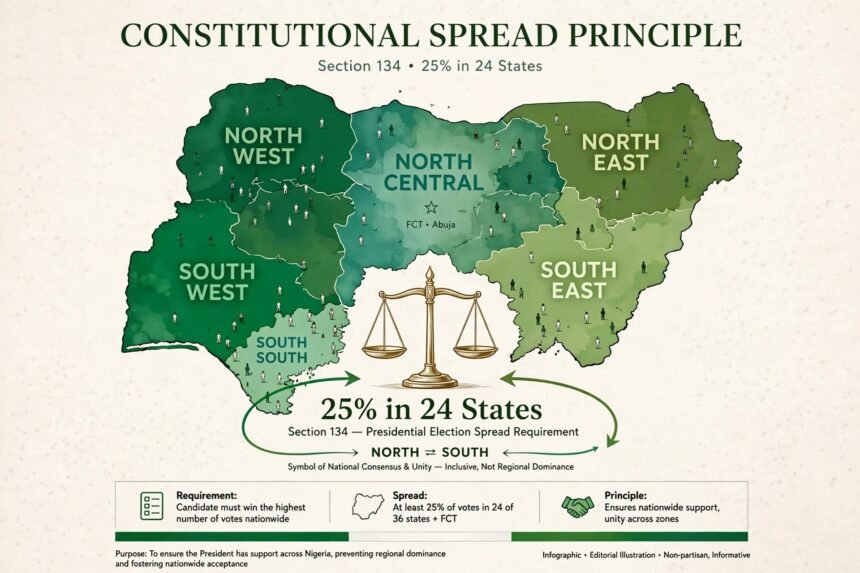
The safeguard is Section 134(2) of the 1999 Constitution. A candidate must have the highest number of votes AND not less than one-quarter of the votes in at least two-thirds of all States and the FCT – 25% in 24 States. You must be nationally acceptable.
We saw this play out from 2003 to 2011. Muhammadu Buhari was hugely popular in Northern Nigeria. In 2011 under the CPC he won 12 states overwhelmingly and polled over 12 million votes. But he could not become President because he failed the spread test in the South. His popularity was deep but not wide. The Constitution rejected a regional presidency.
That failure triggered the elite consensus that produced the APC in 2013. Buhari’s CPC brought the North West bloc, Bola Ahmed Tinubu’s ACN brought the South West bloc. The merger was a constitutional necessity to satisfy Section 134. It worked in 2015 because it gave Buhari 25% in 27 states.
The lesson for 2027 is clear: No candidate can win by sweeping Kano, Kaduna and Katsina alone. Even with all 56 million Northern votes, if you fail to secure 25% in at least five Southern states to make 24 states, INEC cannot declare you winner. A run-off becomes mandatory.
The presidency was never designed for the region with more voters. It was designed to compel national integration. The road to Aso Rock does not lie in cornering one region, but in forging a pan-Nigerian consensus.