By Okoi Obono-Obla
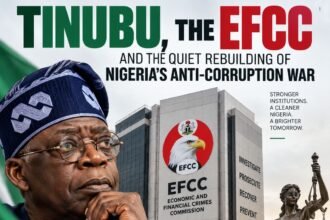
Mohammed Bello Doka is a brilliant journalist and writer who was once Special Adviser to the former Attorney-General of the Federation and Minister of Justice, Abubakar Malami, SAN, and is sympathetic to the political aspirations of the ADC presidential candidate, Atiku Abubakar. Both of us belong to a WhatsApp group known as Matto Circle, and he shared a news item published today on his blog, Abuja News Network, titled “Tinubu Begs US Court to Delay Release of Drug Trafficking Records.” I responded to the blazing headline thus:
There are false narratives, misrepresentations and distorted facts, predicated on the assumption that Nigerians are fools who will swallow such distortions hook, line and sinker to arrive at a premeditated narrative.
The purported action in the United States of America is nothing more than a request for information under the Freedom of Information Act (FOIA). The court processes themselves are clearly marked as a civil action, not a criminal action. What is a civil action? It is an action invoking the jurisdiction of the court to seek redress for a civil wrong.

This fundamental distinction is deliberately ignored by those peddling these stories.
The forfeiture against Abubakar Malami was brought under the laws of Nigeria. President Bola Ahmed Tinubu’s forfeiture case, which was concluded 33 years ago, was brought under the laws of the United States of America. Although the procedures for civil forfeiture in Nigeria and the United States are slightly different, they are premised on the same principle.
Malami’s forfeiture case is a civil action brought under the Proceeds of Crime (Recovery and Management) Act, 2022. President Tinubu’s case was a civil action brought under 18 U.S.C. § 981. In both jurisdictions, the principle is the same: to recover assets arising from unlawful activity. Both actions are civil, not criminal.
That is precisely why Malami is enjoying his freedom and is presently on the campaign trail to become Governor of Kebbi State. It is also why the same Atiku Abubakar who peddled false narratives against President Tinubu on account of a 33-year-old civil forfeiture against an account linked to him sees nothing wrong with Malami’s case. Why the hypocrisy and double standard?
What Non-Conviction Based Forfeiture Really Means
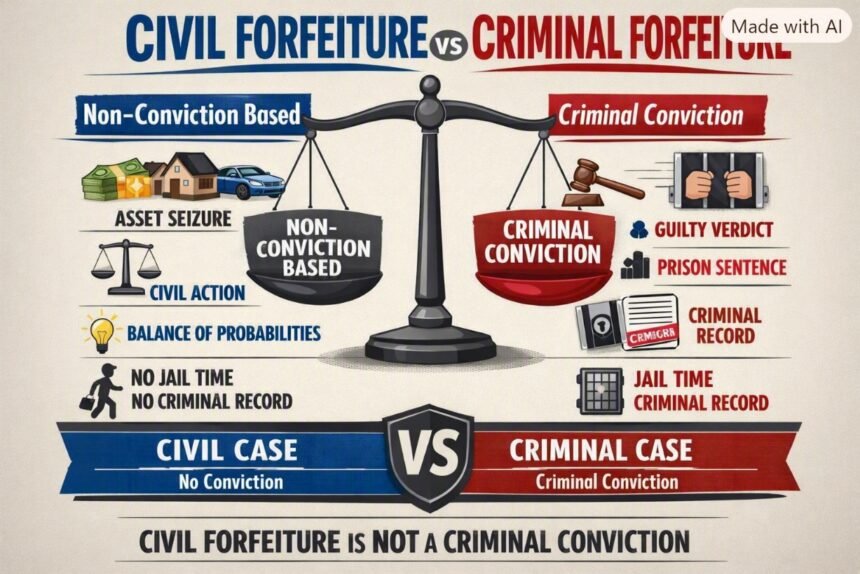
The recovery of assets in both cases is technically known as Non-Conviction Based Forfeiture (NCB). This is a legal process that allows the government to seize property connected to unlawful activity without requiring a criminal conviction against the owner.
Its key aspects are:
1. Civil Basis: It is pursued as a civil action against the property itself (in rem), not against the person. The property is the defendant.
2. Burden of Proof: The state must show, usually on a balance of probabilities in Nigeria and on a preponderance of evidence in the U.S., that the property is linked to unlawful activity.
3. Purpose: It prevents persons from benefiting from illicit gains, even where prosecution is impossible or evidence is insufficient for a criminal trial.
4. Effect on Liberty: It does not result in imprisonment or a criminal record. It only strips the asset in question.
5. Safeguards: Owners can contest the forfeiture and attempt to prove the property was acquired lawfully, with full judicial oversight and a right of appeal.
The Constitutional Context in Nigeria
The 1999 Constitution of the Federal Republic of Nigeria (as amended) does not contemplate that a person who suffers non-conviction based forfeiture is barred from contesting elections. This is because forfeiture is a civil process, not a criminal conviction.
Section 137(1)(d) and (e) provides that a person is disqualified from contesting for President if:
(d) He is under a sentence of death or imprisonment for an offence involving dishonesty or fraud; or
(e) Within ten years before the election, he has been convicted and sentenced for an offence involving dishonesty, or found guilty of contravening the Code of Conduct.
Thus, while non-conviction forfeiture may arise from allegations of corruption or unlawful activity, it is not the criminal conviction envisaged by the Constitution to operate as a bar against any person contesting an election. Only a criminal conviction by a court of competent jurisdiction or a finding by the Code of Conduct Tribunal, as expressly stated in Section 137, can disqualify a candidate.
Conclusion
Civil forfeiture under Nigeria’s Proceeds of Crime Act 2022 and civil forfeiture under U.S. federal law are fundamentally the same: they are civil, remedial mechanisms for asset recovery, not criminal punishments.
Civil forfeiture and criminal conviction are therefore distinct legal mechanisms. While forfeiture can strip assets linked to unlawful activity, it does not equate to a conviction under Nigerian or American law. Consequently, it cannot disqualify a person from contesting the Presidency, and it cannot be logically applied as a disqualification against President Tinubu in one breath while being dismissed as inconsequential in Malami’s case in another.