By Eneojo Herbert Idakwo
- Ranching is a business
- The government itself is talking about investment
- There is already evidence that private ranching works
- The strongest argument is economic, not political
- The Middle Belt should not become the default land bank
- Voluntary participation creates a better investment proposition
- There is Nigerian evidence for voluntary settlement
- Government should sell the opportunity, not allocate the land
- Wase illustrates both the opportunity and the danger
- Ranches should become livestock estates
- There is already a financing argument for this model
- Ranching should be financeable
- What the government should provide
- The 2026 Livestock Master Plan points in this direction
- The government should learn from its own policy language
- The Middle Belt does not need to reject ranching
- The danger of coercion
- A better national bargain
- The ultimate test is profitability
- The Middle Belt should be offered an investment opportunity, not a land obligation
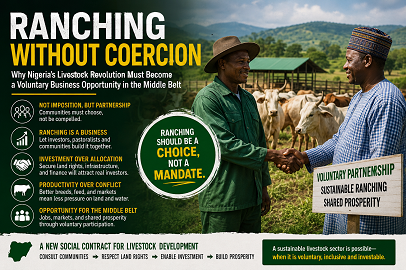
Why Nigeria’s Livestock Revolution Must Become a Voluntary Business Opportunity in the Middle Belt
Nigeria has reached an important point in the long-running debate over cattle production.
There is little serious argument left for defending an inefficient livestock system that allows animals to move freely across farms, highways and communities in search of pasture and water. Nigeria needs a more productive livestock economy. It needs better genetics, reliable feed, veterinary services, modern abattoirs, dairy processing, cold-chain infrastructure and commercially managed ranches.

The more difficult question is where ranching should happen, who should provide the land and whether communities should be required to surrender land for an industry that is fundamentally a private economic activity.
That question has become particularly contentious in the Middle Belt.
The latest warning came from the Middle Belt Forum, which on August 17 rejected what it described as compulsory allocation of Middle Belt land for cattle ranching. The organisation demanded the suspension of the Federal Government’s renewed ranching policy and called for broad consultation with affected communities before any land acquisition or allocation. It specifically raised concerns about Adamawa, Plateau, Kaduna, Benue, Taraba and the Federal Capital Territory.
The MBF’s position should not be dismissed as opposition to livestock development.
It raises a more fundamental question about the economic architecture of the proposed livestock transformation.
Should ranching be treated as a government land-allocation programme, or should it be treated as a private business opportunity in which pastoralists, cattle owners, investors and communities voluntarily participate?
The second approach deserves serious consideration.
Ranching is a business
The starting point should be simple.
Cattle production is an economic activity.
A cattle owner buys animals, provides feed and water, pays workers, manages veterinary risks and sells livestock, milk, meat or breeding stock for profit. A dairy operator processes milk for the market. A feed producer sells fodder. A ranch manager provides livestock services.
The structure is fundamentally commercial.
Nigeria already understands this principle in other agricultural sectors.
A poultry farmer is not normally allocated community land by the Federal Government before starting a poultry business. A rice farmer is not entitled to public land simply because rice is important to national food security. A palm plantation is not established by government compelling communities to surrender ancestral land for the benefit of a private plantation owner.
Cattle production should ultimately operate within the same economic logic.
The state should create the conditions for investment. It should provide regulation, security, infrastructure, credit support, veterinary systems, market access and technical assistance.
It should not necessarily become the landowner and ranch operator.
This argument is not new. Nigerian livestock experts have previously advocated a private-sector-driven ranching model, arguing that individuals and groups who want to operate ranches as economic ventures should establish them, while government provides an enabling environment and facilitates access to land through lawful arrangements.
That principle has become even more relevant under the Federal Government’s current livestock investment strategy.
The government itself is talking about investment
The Federal Ministry of Livestock Development has repeatedly presented ranching as an investment opportunity.
In March 2026, the ministry said the private sector was central to the transformation of Nigeria’s livestock industry. It reported that the Nigerian Association of Chambers of Commerce, Industry, Mines and Agriculture had unveiled a $50 billion investment initiative aimed at supporting a livestock sector that the government hopes can reach a $74 billion economic scale.
The ministry identified ranching, red meat, dairy, leather, processing, cold-chain logistics and veterinary services as investment opportunities.
That changes the way the ranching question should be approached.
If ranching is an investment opportunity, then investors should be allowed to compete for land, capital and customers.
The government can de-risk the investment.
It can provide roads.
It can provide electricity.
It can provide water infrastructure.
It can provide veterinary laboratories.
It can facilitate access to finance.
It can establish standards.
It can provide security.
It can support research and extension services.
But the actual decision to establish a ranch should rest with the person or company willing to put capital at risk.
That is how a genuine livestock industry is built.
There is already evidence that private ranching works
Nigeria does not have to build its ranching model from theory.
The Federal Government itself has been showcasing privately operated ranches.
In June 2026, Livestock Minister Idi Mukhtar Maiha visited a privately owned ranch in Charanchi, Katsina State. The ministry described the 150-hectare facility as evidence that modern ranching is already possible in Nigeria.
More than 50 hectares were reportedly being used for pasture, supported by an earth dam for dry-season irrigation. The ranch was also investing in improved cattle genetics, including Gudali-Holstein crosses, with dairy production among its objectives.
In December 2025, the minister similarly visited Manchong Integrated Farms in Nasarawa State and described the facility as a practical demonstration of modern livestock production, including feed and fodder development and genetic resource management.
These examples offer a useful policy lesson.
The government does not need to convince Nigerians that ranching can work by allocating enormous areas of land first.
It can demonstrate that ranching is profitable.
Once investors see viable returns, the market will begin to respond.
The strongest argument is economic, not political
A voluntary ranching system could fundamentally change the politics surrounding livestock reform.
Consider the difference.
Under an imposed model, a community may see ranching as a government project arriving on its land.
Under a market model, the ranch becomes an investment.
An investor needs land.
A landowner has land.
A pastoralist has cattle and livestock knowledge.
A bank has capital.
A government has regulatory authority and infrastructure.
A university has technical expertise.
A processor needs meat or milk.
A community has labour, land and local economic networks.
These parties can enter commercial relationships.
The result can be a livestock value chain rather than a land struggle.
The government can encourage this process through long-term leases, concessional finance, investment guarantees, insurance, infrastructure grants and tax incentives.
The critical issue is that participation should be voluntary and legally secure.
The Middle Belt should not become the default land bank
The concerns of the Middle Belt Forum also raise a question that deserves a national answer.
Why should the Middle Belt become the automatic geographical solution to Nigeria’s livestock problem?
The Middle Belt is not a single vacant ecological zone.
It contains some of Nigeria’s most important agricultural communities.
Benue is one of the country’s major food-producing states.
Plateau has a substantial agricultural economy and a long history of livestock production.
Nasarawa has extensive farming activity and rapidly expanding agricultural investment.
Kogi combines farming, livestock, mining and oil production.
Taraba has significant agricultural potential.
Adamawa is itself a major livestock-producing state.
These states are not merely places where land happens to be available.
Their land already has economic users.
It produces food.
It supports settlements.
It supports forests and water systems.
It carries ancestral claims.
It is therefore dangerous to treat the Middle Belt as though its land were a national reserve waiting to be assigned to a particular economic group.
Nigeria’s livestock policy should be national.
Its land solutions should be locally negotiated.
Voluntary participation creates a better investment proposition
A ranching policy based on voluntary participation could actually attract more serious investment.
Investors need certainty.
They need clear title or lease arrangements.
They need security of tenure.
They need predictable regulation.
They need access to water.
They need roads.
They need electricity.
They need markets.
They need security.
They need confidence that their investment will not become entangled in a land dispute.
A ranch established after transparent negotiation with a landowning community has a stronger foundation than one established through a controversial allocation.
This is why land tenure matters as much as cattle.
A 2020 article in the Journal of African Law examined the Nigerian ranching and grazing-reserve debate and argued for ranching based on private freehold or leasehold arrangements rather than compulsory government acquisition.
That approach is particularly relevant in the Middle Belt, where land disputes can quickly become security disputes.
There is Nigerian evidence for voluntary settlement
There is also an older Nigerian example that deserves renewed attention.
Research on the Dobi Grazing Reserve in Niger State found that voluntary settlement of pastoralists was achieved where several conditions existed, including secure land rights, grazing security, water, grazing resources and participation of settlers in the administration and funding of the reserve.
The study found that these conditions contributed to an unprecedented voluntary settlement and some improvement in production indicators.
The lesson is important.
People are not necessarily opposed to settlement.
They are more likely to accept settlement when they have security, rights, economic opportunity and a voice in the system.
That principle can be applied to modern ranching.
Government should sell the opportunity, not allocate the land
The Federal Government’s role should therefore be redesigned around a simple proposition:
Make ranching attractive enough that people choose it.
Instead of announcing that a particular state must provide land, government can announce a national livestock investment programme and invite states, communities, pastoralists and investors to participate.
A state could voluntarily say:
“We have suitable land. We are prepared to offer long-term leases. We want livestock investment.”
A community could say:
“We have land and want to participate in a ranching enterprise.”
A pastoralist cooperative could say:
“We have 2,000 cattle and want to establish a commercial ranch.”
An investor could say:
“We are prepared to invest ₦10 billion in a dairy and beef complex if government provides roads, security and access to finance.”
That is how economic development should work.
The federal government creates the platform.
The state creates the local framework.
The community makes its decision.
The investor brings capital.
The livestock operator brings animals and expertise.
The market determines success.
Wase illustrates both the opportunity and the danger
The Wase Grazing Reserve in Plateau State provides a useful case study.
The Federal Ministry of Livestock Development says more than 100,000 hectares of arable land are available within the reserve and that it intends to develop the area into a major livestock production hub.
The ministry has also said it plans to allocate approximately 30,000 hectares within the reserve to Defence Headquarters for large-scale livestock production involving the Nigerian Army, Air Force and Navy. It says it has engaged stakeholders, pastoralists and other interested groups on utilisation of the reserve.
There is clearly economic potential.
But the central question should not be whether government can technically allocate the land.
It should be whether the people affected regard the arrangement as legitimate and economically beneficial.
A better Wase model would make participation voluntary and transparent.
Existing land rights should be mapped.
The legal status of the reserve should be published.
Communities should know exactly what land is available.
Lease terms should be transparent.
Local stakeholders should have representation in management.
Environmental and social assessments should be conducted.
Investment agreements should specify employment, infrastructure and revenue-sharing arrangements.
Pastoralists should participate as entrepreneurs, not merely as beneficiaries of a government settlement scheme.
Farmers should also have access to livestock-related opportunities.
That would turn Wase into an economic hub rather than another symbol in Nigeria’s land controversy.
Ranches should become livestock estates
Nigeria can go further.
Instead of thinking only in terms of cattle ranches, government should encourage integrated livestock estates.
An estate could contain:
- cattle breeding
- dairy production
- feed and fodder farms
- veterinary clinics
- artificial insemination centres
- feed mills
- meat processing
- cold storage
- leather processing
- manure and organic fertiliser production
- transport and logistics
- agricultural equipment services
- research and extension centres
Such an estate creates multiple businesses around the animal.
The cattle owner is no longer dependent only on selling live animals.
The farmer produces fodder.
The processor buys milk.
The abattoir buys finished cattle.
The leather company buys hides.
The transport operator moves products.
The veterinary professional provides services.
The financial institution finances expansion.
The community supplies labour and other services.
This is the livestock economy Nigeria should be building.
There is already a financing argument for this model
The Federal Government’s investment framework increasingly recognises private capital as a central component of livestock transformation.
In May 2026, the Livestock Ministry received a private investment proposal covering large-scale ranching, dairy production and integrated agricultural systems. The proposal included modern livestock hubs, infrastructure and profit-sharing arrangements with local stakeholders.
The ministry has also said Nigeria faces an annual demand of about 1.7 billion litres of milk and more than 1.5 million metric tonnes of red meat, describing the gaps as investment opportunities.
These figures point towards a different conversation.
Nigeria does not have to ask:
“Where can we find land for cattle?”
It should ask:
“How do we build an investment environment in which Nigerians and international investors compete to meet Nigeria’s enormous demand for meat and dairy?”
That is a more productive question.
Ranching should be financeable
If government wants ranching to expand, it should make the business bankable.
A prospective rancher should be able to obtain a long-term lease on suitable land.
That lease should be legally recognisable and capable of supporting financing.
Banks should be able to assess the business.
Insurance companies should be able to insure cattle and infrastructure.
Development finance institutions should be able to provide patient capital.
Government can provide credit guarantees where necessary.
Investors can then make decisions based on projected returns rather than political access.
This would also reduce the perception that land allocation is a form of patronage.
The Federal Government has already shown interest in private-sector financing. The ministry’s March 2026 engagement with NACCIMA explicitly presented livestock as a major investment sector, with the private sector expected to play a leading role.
The policy should follow the investment logic to its conclusion.
If private capital is expected to drive livestock transformation, private enterprise should also be allowed to determine where and how individual ranches are established, subject to law and public-interest safeguards.
What the government should provide
A voluntary ranching model does not mean government should withdraw.
Quite the opposite.
Government has an important enabling role.
It should provide:
1. Land information
Create transparent land registries showing areas available for legitimate agricultural leases.
2. Infrastructure
Prioritise roads, electricity, water and communications around approved agricultural investment zones.
3. Security
Protect farms, ranches, markets, transport corridors and communities.
4. Veterinary infrastructure
Strengthen disease surveillance, laboratories, vaccination and extension services.
5. Finance
Develop livestock-specific credit, insurance and guarantee mechanisms.
6. Research
Invest in genetics, pasture, feed technology, climate resilience and animal health.
7. Market infrastructure
Develop modern abattoirs, dairy processing centres, cold chains and livestock markets.
8. Legal certainty
Guarantee transparent and enforceable land leases and investment agreements.
9. Community participation
Require meaningful consultation before major livestock projects are approved.
10. Conflict prevention
Establish local mechanisms for resolving disputes over land, water, crops and livestock before they become security crises.
This is a much stronger role for government than simply identifying land and handing it over.
The 2026 Livestock Master Plan points in this direction
The Nigeria Livestock Master Plan 2026–2040 provides an important policy foundation.
Developed by the Federal Ministry of Livestock Development, L-PRES and the International Livestock Research Institute, the strategy focuses on feed and fodder, animal breeding and genetics, animal health and biosecurity, infrastructure and markets, gender and youth inclusion, and policy coordination.
The plan also recognises that improvements in livestock productivity can contribute to reducing conflicts over land and water.
That is significant.
It means Nigeria does not need to reduce livestock transformation to the question of physical settlement.
Productivity is equally important.
A more productive animal needs better feed.
Better feed reduces pressure on pasture.
Better genetics can increase output.
Improved veterinary care reduces losses.
Modern markets increase profitability.
Processing creates additional value.
The more productive the animal becomes, the less pressure there is to keep expanding the land footprint.
The government should learn from its own policy language
There is an interesting tension in the Federal Government’s current approach.
On one hand, the ministry has described ranching as a viable, scalable and economically sustainable model. It is courting investors and promoting private-sector participation.
On the other hand, large-scale government-led land allocation can make ranching appear less like a private business and more like a state-directed settlement programme.
That contradiction needs to be resolved.
If ranching is genuinely a business, then the business case must stand on its own.
Government should not have to force communities to provide land to make the business viable.
The market should reward good ranchers.
Investors should choose good locations.
Pastoralists should choose whether to move into ranching.
Communities should choose whether to host investments.
States should choose whether to participate.
That is what voluntary economic development looks like.
The Middle Belt does not need to reject ranching
This distinction is important.
The argument for voluntary ranching should not be interpreted as an argument against ranching.
The Middle Belt can benefit enormously from livestock investment.
A well-designed livestock estate in Benue could create jobs and markets for farmers.
A dairy cluster in Plateau could create a processing industry.
Nasarawa could expand its emerging commercial livestock sector.
Kogi could integrate cattle production with its agricultural and commodity economy.
Taraba and Adamawa can develop livestock, feed and dairy value chains.
The question is not whether these opportunities should exist.
The question is whether they should be imposed.
There is a considerable difference between saying:
“We do not want ranching.”
and saying:
“We will not accept ranching imposed on our land without our consent.”
The second position leaves room for negotiation, investment and economic partnership.
The danger of coercion
Nigeria’s farmer-herder crisis has taught the country an expensive lesson.
Policies that are technically reasonable can fail when the people affected believe they are being imposed upon.
Academic research has documented resistance in Nigeria’s Middle Belt to settlement policies and linked such resistance to wider questions of land rights, pastoralism and conflict.
This should be central to the Federal Government’s calculations.
Even if a land allocation is legally defensible, it may still be politically unwise if the affected population sees it as dispossession.
Even if a ranch is economically viable, it may still fail if the surrounding community refuses to accept it.
Even if government can provide security, permanent security cannot be built around a project that lacks social legitimacy.
The cheapest conflict is the one prevented before the first fence is erected.
A better national bargain
Nigeria can therefore establish a new bargain around ranching.
The Federal Government says:
We will support livestock investment.
States say:
We will make suitable land available where our laws and communities permit it.
Communities say:
We will participate where the terms are fair and our land rights are respected.
Pastoralists say:
We will invest in modern livestock production where it makes economic sense.
Investors say:
We will put our capital at risk if the policy and security environment is stable.
Banks say:
We will finance viable ranching enterprises with secure land tenure and credible business plans.
Processors say:
We will buy livestock products if quality and supply are reliable.
That is a national livestock compact worth pursuing.
The ultimate test is profitability
The success of Nigeria’s ranching policy should not be measured by how many hectares government allocates.
It should be measured by how many profitable livestock businesses emerge.
How many cattle are produced?
How much milk is processed?
How many jobs are created?
How much meat is processed locally?
How much leather is produced?
How much feed is cultivated?
How much income reaches rural households?
How many young Nigerians enter the livestock business?
How many farmers and pastoralists move from subsistence production to commercial production?
And, crucially, how much does the incidence of farmer-herder conflict fall?
These are the metrics that matter.
The Middle Belt should be offered an investment opportunity, not a land obligation
The present dispute offers the Federal Government an opportunity to change course without abandoning its livestock agenda.
It can tell Middle Belt states that ranching is available as an economic opportunity.
It can invite them to participate voluntarily.
It can invite their communities to negotiate.
It can invite pastoralists and investors to bring capital.
It can provide infrastructure and finance.
It can guarantee security.
It can establish transparent rules.
It can allow successful ranches to become demonstration projects.
And it can allow the market to determine whether the model succeeds.
That approach would not weaken the Federal Government’s livestock reform.
It would strengthen it.
A ranch that is welcomed by the host community is more secure than one that requires permanent political protection.
A ranch financed by investors has a stronger commercial discipline than one dependent entirely on government funding.
A ranch operated by entrepreneurs has a clearer incentive to control costs, improve genetics, manage feed and reach markets.
A ranch established through a transparent lease has a stronger investment foundation than one surrounded by allegations of land grabbing.
Nigeria does not need another land controversy disguised as an agricultural policy.
It needs a livestock industry.
And an industry is built by investment, enterprise, property rights, infrastructure, markets and innovation.
The policy choice
The Federal Government’s livestock transformation programme is economically defensible.
Its ambition to modernise cattle production is necessary.
Its attempt to attract private investment is sensible.
Its emphasis on ranching has a strong agricultural rationale.
But the land question cannot be treated as an administrative detail.
Ranching should be presented to Nigerians as a business opportunity, not as a compulsory land-use arrangement.
The Middle Belt should not be required to surrender land simply because government has decided that ranching is nationally important.
Instead, government should make ranching so economically attractive that landowners, communities, pastoralists, cooperatives and investors voluntarily seek to participate.
That is the difference between policy imposed from above and economic development built from the ground up.
Nigeria can modernise its livestock industry without creating another fault line over land.
The way forward is not to abandon ranching.
It is to make ranching voluntary, investable, profitable and locally accepted.
That is how a livestock revolution can become an economic opportunity for the Middle Belt rather than another source of conflict.