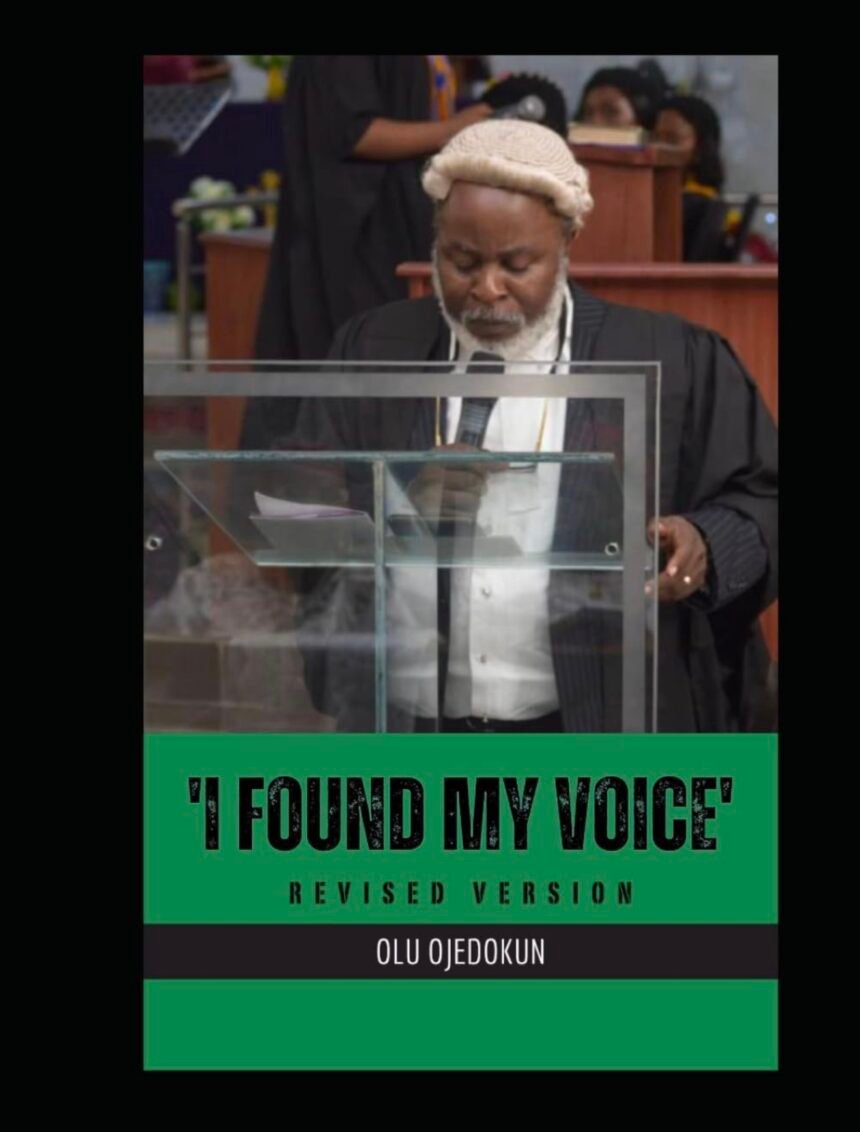
THE QUESTION THAT IS NIGERIA: By Olu Ojedokun
In 1960 whilst at the Nigerian College of Arts, Science and Technology my father Olasupo Aremu Ojedokun rebuffed the counsel of his cousin Mathew Oladejo Alamu Ojedele who pleaded with him:
“Ema loo Eko, ani ema lo ekoo.”
He joined other students to demonstrate against the Anglo-Nigerian Defence Pact. The response they received from the police encountered on their way to Lagos was unexpected brutality, it manifested itself in stifling fumes from the teargas they fired.

It seems I had picked up the mantle of my father and carried it with me through secondary school into my university experience, living in the shadow of anti-authority struggles. This also mirrors my spiritual life, where I have experienced the lows of the valleys and the heights of mountains. I have collapsed into the depths of despondency so many times but God has been faithful on each and every occasion, making a pathway of escape for me and I have come out more formidable. There was a time when no one gave me a life chance of success and here I am today defying that expectation all because of what the Lord has done. I am therefore reminded of the Christian chorus:
“My lifetime. I will give God my lifetime.
And if I give God my lifetime, He will take care of me.
He will never, never let me down,
If I give God my lifetime.”
I solemnly believe my narrative does not differ from that of Nigeria where there is no doubt that many men and women of integrity have vacated the scene of governance and left it to all shades of characters. The space of our governance has been left to those who are after their bellies to plunder at will with no shame at all. But more fundamentally, the voice of the Church for the most part remains eerily silent causing the absence of a prophetic voice that speaks to the nation in times of despair. In very many cases the Church, which I am part of has been relegated into a messy and unseemly compromise with power. The reality is that many in the Church are content to focus on greed, increasing materialism, personality worship and the trappings of power.
The Church in Nigeria is in danger of being consigned into a multinational business with branches in the world’s major cities. And yet, there are many rays of hope, where Nigerian Churches are prepared to fund, partner and sacrificially give to worthwhile projects in the United Kingdom. Today I throw down a challenge to the church that is in Nigeria and will be glad for them to prove me wrong.
I contrast this with South Africa during the heydays of Apartheid when the Church spoke ‘Truth to Power’ as evidenced by, Desmond Tutu’s words before the Eloff Commission set up to investigate the South African Council of Churches on 20th November 1981, stated:
“I want to say that there is nothing the government can do to me that will stop me from being involved in what I believe is what God wants me to do. I do not do it because I like doing it. ………………. I cannot help it when I see injustice. I cannot keep quiet. I will not keep quiet, for as Jeremiah says, when I try to keep quiet God’s word burns like a fire in my breast. But what is it that they can ultimately do? The most awful thing that they can do is to kill me, and death is not the worst thing that can happen to a Christian.”
The current climate in Nigeria presents a ‘Kairos’ moment for the Church; however, many Christians appear to be smeared with dubious activities. If stories constantly circulating in the Nigerian press are to be believed then it appears that the hallmark of many ‘Christians’ today does not in fact manifest itself and consist of being salt and light in/of respective communities.
Yet the scripture they are meant to hold with reverence and believe to be inerrant states:
“If any man be in Christ he is a new creature”.
It is also sad that some of the traits described above are not limited to Nigeria but have assumed a global dimension.
However, it will be a wrong and a gross misrepresentation of the many Nigerian Christians who manifest the grace and love of Christ to take the above as the common narrative that dominates the landscape. For every Christian that betrays their profession, there are many who by the power of God live exemplary and sacrificial lives attempting to bring, truth and grace into many situations they face and encounter. There are many acting as the salt and light of their communities and therefore any brush that sweeps away born again(s) or characterises them together as charlatans would be misleading and unfortunate.
The difficulty we face is that the Church has been slow to recognise that beyond the ‘propagation’ of the gospel there is the need for Churches to realise their role in initiating social action is part of the same propagation. We must look beyond the rhythm of periodic feeding of the hungry and destitute, the seasonal visits to orphanages or the periodic missions into parts of the hinterland. What I have in mind is integral mission in Nigeria one that allows the Church to assume its prophetic role and to ‘Speak Truth to Power’. Simply put, I draw from Justin Thacker, formerly of the Evangelical Alliance UK’s, quotation to illustrate my point:
‘Integral Mission: Jesus Style does not deny that evangelism and social action are distinct activities – on occasions, they may be – but it does say that the nature of the integration does not reside in the fact that we enact the two alongside each other, or that we find appropriate connections between them. Rather, it argues that the integration that is relevant is that we respond as whole people to the whole person or person before us.’
The scripture used by Justin in the illustration of the above point states:
“So he came to a town in Samaria called Sychar, near the plot of ground Jacob had given to his son Joseph. Jacob’s well was there, and Jesus, tired as he was from the journey, sat down by the well. It was about the sixth hour. When a Samaritan woman came to draw water, Jesus said to her, “Will you give me a drink?” (His disciples had gone into the town to buy food.) The Samaritan woman said to him, “You are a Jew and I am a Samaritan woman. How can you ask me or a drink?” Jesus answered her “If you knew the gift of God and who it is that asks you for a drink, you would have asked him and he would have given you living water.” (John 4:5-10)
The question I venture to ask is when Jesus voluntarily engaged a social outcast like the Samaritan woman in face-to-face conversation, was he performing a ‘political action’ in challenging the political taboos of his society? It has been advanced that Jesus responded not as simply the evangelist, nor the social reformer, but as Jesus the Christ, or the Integral Missionary. We see in that text, the whole of Jesus responding in love to the whole of this woman’s needs, and we see him doing it in word and in deed. This woman clearly had social, emotional and psychological needs, but Jesus met them by openly talking with her. She also had spiritual needs, to know him as a saviour, and Jesus clearly communicates both her need and his ability to meet it. He neither neglects any aspect of who she is, nor any aspect of his responsibility towards her. By his words and his actions he communicates God’s love into the whole of her life and both evangelism and social reform are communicated together.
I suggest that the Nigerian Church must fully appreciate the aspect of integral mission that brings the vastness of its resources, both material and spiritual to deliver wholeness to the soul and is capable of reforming and transforming society. The
continued inability of the Church to fully grasp and understand its integral mission in Nigeria could have the following implication, as Ramachandra argues:
“Integral mission flows out of an integral gospel and integrated people. There is a great danger that we transform the mission of the church into a set of special ‘project’ and ‘program’, whether we call them ‘evangelism’ or ‘socio-political action’, and then look for ways to integrate these methodologically. Rather, the mission of the church is located in the adequacy of faithfulness of its witness to Christ. Our core-business is neither the take-over of the world’s systems nor the maximising of church membership. Moreover, we need to remember that the primary way the church acts upon the world is through the actions of its members in their daily work and their daily relationship with people of other faiths. A congregation with huge social welfare projects or many ‘church planting’ teams may be far less effective in secular society than congregations which have none of these things but train their members to obey Christ in the different areas of civic life which they are called.”
The missing link in Nigeria remains the Church for whilst the Church has a mandate to prepare people for eternity and is driven by proclamation evangelism, church planting and personal discipleship it must also balance it with passion for the vision to:
“….feed the hungry, clothe the naked, provide shelter for the refugees, and loose the chains of injustice.”
Today Nigeria presents a distorted but legalised distribution of power brought about by a warped social system, backed by strong-willed and corrupt political class. Yet, we stand at a moment of great challenge and opportunity. All around Nigeria and its diaspora are voices being reclaimed, breaking out in rhythms, chorusing in high decibels with one sound, that of change. Nigerian people want simple things: An economy that serves the efforts of those who work hard, a national security policy that addresses the threat of Boko Haram and makes our cities, towns and villages safer, a politics that is centered on bringing people together across the various divides to work for our common good. This is the minimum we demand, the basic request we make for it is the change that the Nigerian people are entitled to.
The reality, however, is that our nation is at war with a confounding enemy whose name is corruption, our economy is in turmoil from the excesses of the recurrent expenditure and the abuses prevalent in our governance. The healthcare system is broken and only accessible to those who can travel abroad. On healthcare I am struck by how almost all our elected and ‘selected’ leaders fly abroad every year for treatment. Government schools fail to provide opportunities to many of our children. Across the land, families are paying record prices to fill up their shopping baskets and many Nigerians worry whether they will be able to raise their offspring in safety and security.
But these challenges were not bound to happen, they are the consequence of flawed policies and failing leadership. As the world has transformed, the thinking of our leaders has remained ossified in time with the absence of new thinking. The first few years of this new century should have been our moment, the time when our leaders turned adversity into opportunity, launching us to the next phrase of our development. This should have been the time when bold and visionary thinking challenged conventional wisdom and took us down a pathway of development and innovation.
Instead, our history is cluttered with white elephants and corruption on a monumental scale. I imagine what Nigeria could have achieved if we were united and worked together. The last half-century of our independence has been a failure of our leadership rather than that of Nigerian people. I believe that we can change course and that we must, and I project into the future an optimism that seems foolhardy but comes from the hope that after darkness emerges light – ‘Post tenebras spero lucem’. This is certainly not the first time our nation has faced grave crises of confidence but each time, our people have found the strength to call out together and address our challenges. This moment cannot be different, and this time demands more urgency. Working together we can restore some sanity to our body politic, we can perfect our federation and work towards a more worthwhile union by asking unthinkable questions of ourselves. But to bring about profound change we must be prepared to countenance some of the ideas I am expounding in the chapters to come.
To develop my narrative further I proceed into some background of the Nigerian chaotic economic planning and a series of questions using anecdotes to prise them open. I am aware that the implementation of medium-term “development plan” has been the major framework, which Nigeria has relied upon to restructure the economy since independence. Four national development plans were launched between 1962 and 1985. The First National Development Plan, 1962 – 1968 sought to put the economy on a fast growth path, by giving priority to agricultural and industrial development, as well as the training of high level and intermediate manpower. The Second National Development Plan, 1970-1974, was launched after the civil war, primarily to undertake reconstruction and rehabilitation of the infrastructure damaged during the war.
The Third National Development Plan, 1975-1980, was designed under a more favourable financial condition of huge oil revenues, which accrued to the nation from the mid-1970s. It emphasised diversification, balanced development and indigenisation of the economy. However, a significant portion of the plan was not executed because of unanticipated financial and executive capacity constraints. Thus, many key projects were carried over into the Fourth National Development Plan, 1981-1985. The execution of the fourth plan was also adversely affected by the unexpected collapse of the international oil prices soon after its inception. Thus, the volatility of the oil sector largely determined economic policy direction as well as the financial capacity to execute public investment programmes.
The adoption of the Structural Adjustment Programme (SAP), initially for two years (July 1986-June 1988), was the major response to the dwindling oil resources, macroeconomic policy distortions and the increasing need to diversify the productive base of the economy. The economy witnessed a number of policy reversals between 1988 and 1989 in an attempt to cushion the adverse effects of the belt-tightening measures implemented in 1986 and 1987. Consequently, some of the gains of economic adjustment in those two years were gradually eroded. From the start of the 1990s, the government shifted the instrument of economic transformation from the five-year plans to the three-year rolling plans, as they were more flexible and amenable to periodic reviews. However, there was no appreciable improvement in the performance of the economy since the commencement of the rolling plans thus necessitating further economic reengineering for sustained growth.
In the early 2000s, a comprehensive economic reform programme was initiated to fast- track economic growth. Central to the reforms was the Medium-Term Expenditure Framework (MTEF), 2003 – 2005, which provide a macroeconomic framework to strengthen fiscal management and improve the planning and budgeting of public expenditure to curtail abuse and mis- allocation of resources. What became apparent was during the Babangida and Abacha regimes all pretentions of following a development plan were abandoned.
The powerful and narrow sectional interests have been the bane of Nigeria. I understand that when the initial plans for Nigeria’s principal container port, the Tin Can Island Port which handles about 5.75 million tons of cargo each year was laid, it included rail lines, however, by the time the port was completed the rail lines had been expunged! What modern nation builds a seaport without and rail links? The other port at Port Harcourt, a transhipment port located 66 kilometres from the Gulf of Guinea along the Bonny River in the Niger Delta, handles about 815,000 tons of cargo each year and has a railway connection but it is not the commercial nerve centre. Thankfully Major General Buhari’s administration was able to connect the port rail to the Lagos Ibadan rail, an error now addressed.
When the old Western Region built 24-storey Cocoa House at one time tropical Africa’s tallest building, all the materials and cement used to build, it came via rail links because the road network could never have coped. Yet, when we built the Federal Capital Territory Abuja with a land area of 713 kilometres square we relied entirely on road links from Lagos to Abuja to transport all the materials needed, the limited road network was never going to be able to cope with the multiplier effects of so much traffic. Today we wonder why we do not have any good roads. The limited rail infrastructure we have, we have allowed it to be degraded through years of neglect of both the rolling stock and allowed the right-of-way to seriously reduced the capacity and utility of the system.
Nigeria with the largest road network in West Africa and the second largest south of the Sahara, roughly 108,000 km of surfaced roads in 1990 has had a history of poor maintenance. In 2004, Nigeria’s Federal Roads Maintenance Agency (FERMA) began to patch the 32,000-kilometre federal roads network, and in 2005, FERMA initiated a more substantial rehabilitation. However, this has not kept pace with over use by the powerful interests who we allowed to lay siege to the Nigerian economy. What of electricity? Have you wondered why most of the funds invested in the sector make no difference? It is the powerful interests that benefit from lucrative generator sales that conspire to make nothing work. The stark analysis of the sector reveals Nigeria had 5,900 MW of installed generating capacity, however, the country was only able to generate 1,600 MW because most facilities have been poorly maintained. The country has proven gas reserves and around 8,000 MW of hydro development has been planned.
The same extends to the scandal of the refineries where most of the refineries are not working or under utilised because of sabotage by powerful interests. It simply pays the few entrenched interest that Nigeria does not work, they thrive and get rich on the misery of the many.
Whilst Chief Asiodu’s own central thesis of the problem with Nigeria traces it to the Murtala/Obasanjo purge of the Civil Service in 1975.He suggests that before purge, from after the civil war Nigeria grew at 11.5 percent per annum. That if we had sustained 10 percent per annum for 20 more years, today the per capital income of Nigeria would not be less than 20,000 dollars. He makes a comparison with Malaysia that is reputed to have borrowed palm oil technology from Nigeria and is now so far ahead of us. He claims that many countries overtook us because, we destroyed the civil service; we abandoned the plan of 75 years which was the emphasizing of capital and intermediate products, agro-allied industry, petrochemical, which would have given us a very serious developmental pyramid.
I suggest we need a government that makes it its fundamental objective to govern in the interest of the many and not the privileged and powerful few. This would mean challenging and taking on the powerful interests that have ground our nation to a halt. But we need a process that compels our government to take on these interests. It would require an active imagination, which allows us to think outside the box and contemplate the unthinkable. I propose a process, which allows the powerful interests to render a full and honest account of their crimes and receive amnesty on the basis that a degree of restitution is made. The next chapter grapples with the details of such a process one that needs to be free of government manipulation and interference.
Whilst this book presents this as a choice, a way forward, the reality is the Nigerian situation is unsustainable it cannot go on as before and time is fast running out for the present crop of leaders. I have carefully considered the option of a truth and reconciliation process because I want my nation to avoid a schism that would make that of Ghana a kindergarten play, the process I offer remains the last hope for a peaceful resolution of the peculiar mess we find ourselves in, the risk is to ignore it and the peril that may follow.
Click here to purchase your copy:
https://www.amazon.com/dp/B0CFCYYXPL/ref=cm_cr_arp_d_btm?ie=UTF8