


By Okoi Obono-Obla
The Yakurr Migrations and Settlement
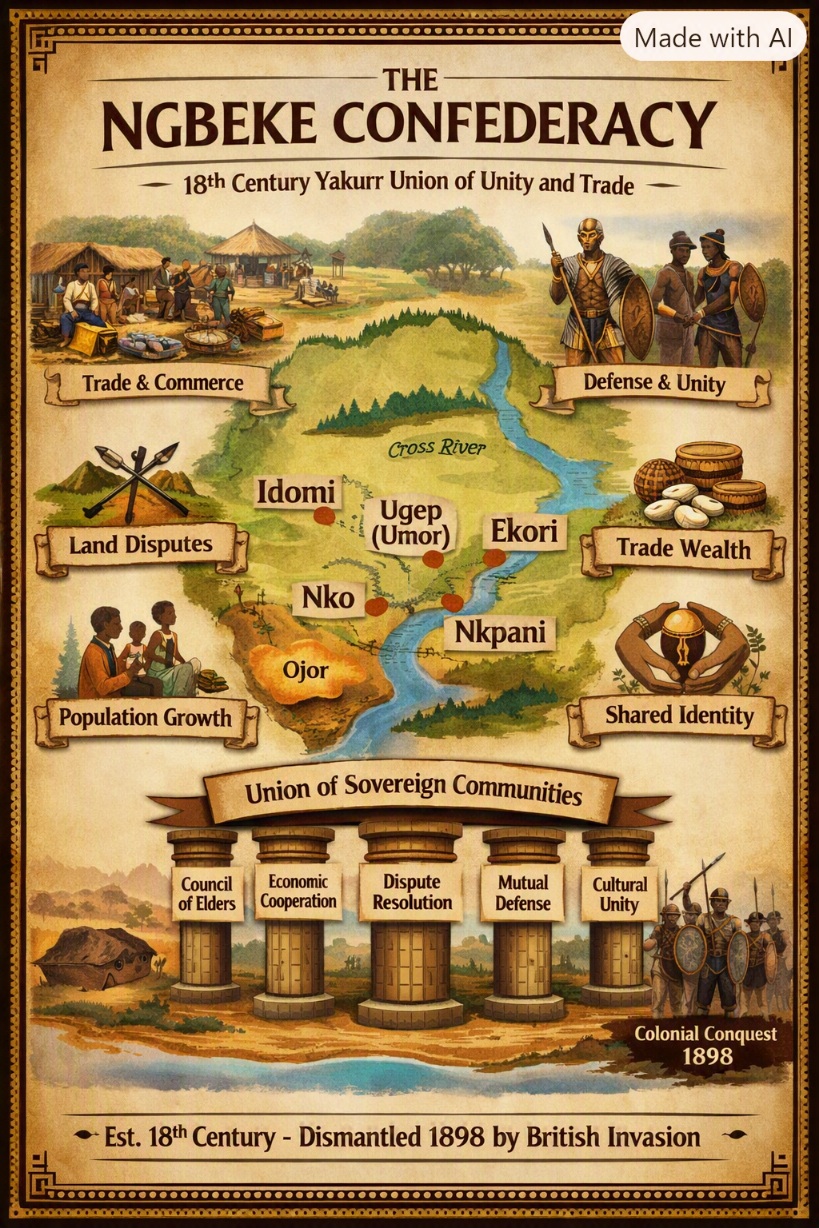
After the three waves of migration, which took the shape of three-pronged movements, namely Umor – Mkpani – Idomi; Nko; and Ekori, the Yakurr established the following five communities in the post-migration environment:
Idomi[Ilomi]
Ugep[Umor]
Ekori
Nkpani[Mkpani]
Nko

It is noteworthy that by the time these communities were founded in their present locations, one member of the Yakurr group that left Lekanakpakpa – Ojor – was already lost and had settled in its present location in Ojor, Akamkpa Local Government Area of Cross River State. The consequence of this separation was the loss of elements of their Yakurr heritage, including language. Today, the Ojor people speak a language known as Lubila, which is classified as an Upper Cross River language.
The Yakurr are mercantilist in nature, and this informed the deliberate choice of the present location of these five communities close to the lucrative Cross River trading routes.
All these communities organically developed into independent and autonomous communities with their own unique traditional systems of political governance. However, in the course of this development, incessant conflicts arose, caused by growth in population which resulted in constant conflicts over land. Land, as a factor of production, has always been dear to the hearts of the Yakurr people. Politics, as I have posited elsewhere based on the theory of David Easton, is all about the struggle for the authoritative allocation of values and scarce resources and the mechanism for sharing these resources within the community, which involves who gets what, when, and how.
The location of these communities along the lucrative Cross River trading routes was strategic and led to the development of a wealthy class of traders known as Yasu, as well as external trading interests.
The Emergence of the Ngbeke Confederacy
In the 18th century, Ekori, Umor, Ilomi, Nkpani and Nko decided to unify their respective systems of traditional political governance under one umbrella. This loose political arrangement, a sort of confederation, was birthed and known as the Ngbeke Confederacy.
What is a Confederacy? A confederacy is a union of sovereign and autonomous political units that come together for purposes of common interest – such as mutual defense, economic cooperation, and dispute resolution – while retaining their individual independence and internal self-governance. Unlike a federation, power in a confederacy resides primarily in the constituent communities, with the central authority exercising only those powers expressly delegated to it.
The development of a wealthy merchant class was one of several factors that led to its conceptualization.
According to the eminent and pioneer Yakurr historian, Dr. Otu Abam Ubi, the decision that precipitated the formation of the Ngbeke Confederacy was driven by a combination of internal pressures and external opportunities. It was essentially a constitutional experiment to stabilize their society after migration and to harness new sources of power.
Other factors include:
1. Land Disputes: As the Yakurr expanded into the Cross River region, territorial acquisition created disputes over land allocation. A confederal system offered a way to mediate these conflicts fairly across settlements.
2. Population Growth: Rapid demographic expansion increased pressure on resources. Ngbeke provided a framework for collective management of land, food, and security.
3. Trade Wealth: The rise of a wealthy trader class from Cross River commerce demanded political recognition. Ngbeke allowed economic elites to convert their influence into structured political authority.
4. Unity and Identity: Having been displaced by the conflict in Lekanakpakpa that led to the disintegration of Akpa, the Yakurr sought a system that would bind Ugep, Ekori, Nkpani, Nko, and Idomi together, reinforcing a shared identity and reducing internal rivalry.
5. Defense Needs: Migration trauma and external threats made collective security essential. Ngbeke enabled coordination of defense across settlements.
However, by 1898, when British expeditionary forces deployed in the Niger Delta Protectorate to pacify the local people who were stubbornly resisting colonization took on Ekori and Nkpani and launched attacks from the Cross River at Ekori Waterside, one of the Yakurr communities that lies on the bank of the Cross River, the assault resulted in the dismantling of the Ngbeke Confederacy and the imposition of colonial rule.
Conclusion
The Ngbeke Confederacy remains a remarkable example of indigenous statecraft and constitutional ingenuity in pre-colonial Nigeria. It demonstrated the Yakurr capacity to evolve from fragmented migrant settlements into a sophisticated political union that managed internal conflicts, regulated wealth from commerce, and provided collective security. Although dismantled by British colonial conquest in 1898, which marked the end of Yakurr political independence, the spirit of Ngbeke endures in oral tradition as a powerful symbol of unity, resilience, and resistance, and as a historical foundation for contemporary Yakurr identity.
Footnotes
Otu Abam Ubi, The Yakurr of Cross River State: A History, [Calabar: University of Calabar Press, 1995], pp. 23-41.
O. Obono-Obla, “Land Tenure and Communal Conflict in Yakurr: A Political Economy Approach,” Unpublished Manuscript.
David Easton, A Framework for Political Analysis [Englewood Cliffs: Prentice-Hall, 1965].
National Archives, Enugu: CALPROF 5/1, Report on the Ekori-Nkpani Patrol, Niger Delta Protectorate Expeditionary Force, 1898.
References
Easton, David. A Framework for Political Analysis. Englewood Cliffs, NJ: Prentice-Hall, 1965.
Ubi, Otu Abam. The Yakurr of Cross River State: Migration, Settlement and Inter-Group Relations. Calabar: University of Calabar Press, 1995.










Nice one and very interesting to read. Weldon Chief 🙏❤️❤️
Sir am completely compelled to ask this questions.
Why were there so many deaths in Ekori when Mgbeke was established.
Why is every goat bought from Ekori to Mkpani must be covered or be lost to death.