
By Okoi Obono-Obla
When war or conflict hits a community, it results in massive movement and flight from such a beleaguered community or country. It is in the normal course of human biology and conduct that the panic and confusion which such a precarious situation engenders causes families or communities to flee in splinters, moving in different directions. The possibility of such families or communities splintering and moving into different directions and even into other countries forever is always there.
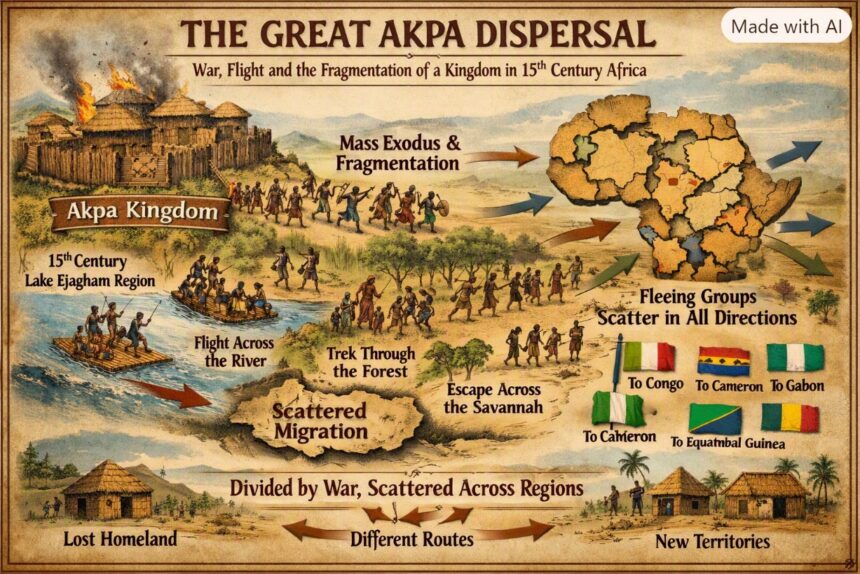
This is precisely what happened when the Akpa Kingdom in the Lake Ejagham region of what is today the South-West Province of Cameroon collapsed.
I am envisioning what happened in the first quarter of the 15th century, when all the present countries in Africa, except Ethiopia, did not exist. Africa then was made up of kingdoms, chiefdoms, principalities and empires without any clearly defined boundaries as we know them today. The countries as we know them today were the aftermath of the Berlin Conference convened in 1884-1885 by the Prussian Chancellor Otto von Bismarck, where European powers such as France, Germany, Denmark, Belgium, Spain, Portugal and the United Kingdom balkanized and shared the territories in Africa in an equitable and amicable manner to prevent conflicts among themselves.

In the early 15th century, Africa was in great turmoil and there was massive insecurity. These convulsions caused disintegration, and also most of these chiefdoms and kingdoms in Africa were internally passing through a period of evolutionary change resulting in state formation.
History shows this pattern clearly. War does not just displace people; it permanently divides the same people. For instance, the collapse of the Old Oyo Empire in the 19th century after internecine wars forced Yoruba families to flee in different directions to found new settlements like Ibadan and Abeokuta. Similarly, in 1994, the Rwandan crisis forced over two million people of the same stock to scatter into DR Congo, Tanzania and Burundi within weeks, with many families permanently separated across different countries. In modern times, the Syrian civil war has left members of one family living permanently in Lebanon, Turkey, Germany and Syria.
This universal law of war-induced migration is what explains the Akpa experience.
The Akpa Kingdom comprised many groups that are today in the present Cross River, Abia, Akwa Ibom, Rivers and Bayelsa States of Nigeria, such as the Abua (Rivers State): Ejagham, Ofutop,Ojor; Nsofang; Mbembe(Okum clan), Olulumo, Biase, Ekuri, Ikom, Yakurr, Ogbia(Bayelsa State) and others. Some are today in the Democratic Republic of Congo, Cameroon, Equatorial Guinea and Gabon.
So the Yakurr group that moved out of Akpa splintered into three groups and in three waves of migration. I shall explain this in my subsequent edition.