By Okoi Obono-Obla
Abstract
This paper examines the anthropological character of Ugep culture, interrogating whether it is accurately described as matriarchal or matrilineal. Drawing on mythical foundations, ritual practice, festivals, and historical instances of female leadership, the paper argues that Ugep presents a matrilineal ethos mediated by patriarchal structures.
Keywords: Ugep, Yakurr, Matriarchy, Matrilineality, Yose, Mma Esekpa, Leboku, Janenboku
1. Introduction

The historical, cosmological and cultural tapestry of the Ugep people of Yakurr is popularly rooted in matriarchy. This characterization derives from the centrality of the mother in descent, identity and spiritual well-being. However, a closer examination reveals a more complex social order that challenges a simple matriarchal label.
2. The Paradox of Male Dominance in a Matrifocal System
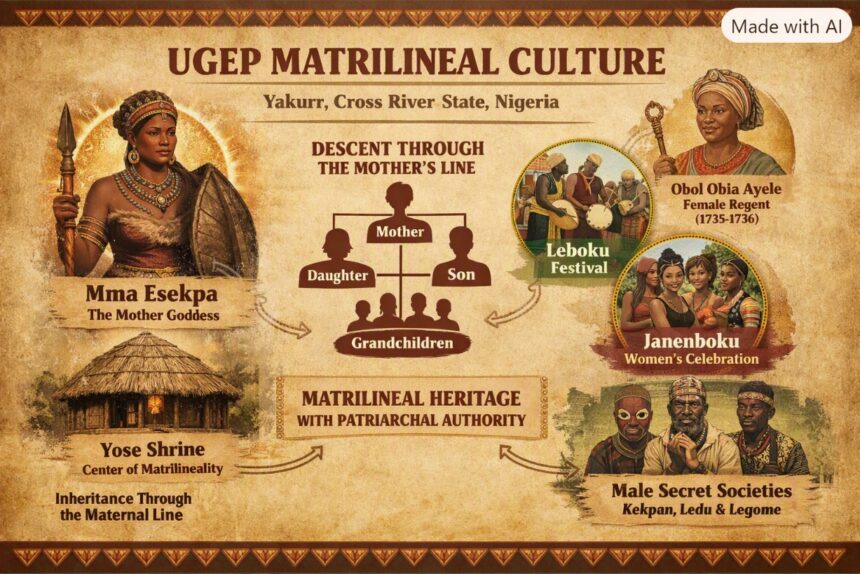
The difficulty in classifying Ugep as matriarchal becomes evident when its institutions are juxtaposed. Alongside matrilineal institutions, there exist powerful socio-cultural institutions exclusively reserved for men, from which women are strictly excluded. These include the Kekpan, Ledu, and Legome societies. Membership in these societies confers significant political, judicial and spiritual authority.
This paradox is deepened by the organization of the very institution that symbolizes Ugep matrilineality. The Yose shrine is the fertility cult that promotes the reproductive health and well-being of women and serves as the locus of Ugep matrilineality. Yet, paradoxically, the priesthood of this profoundly female-centered shrine is presided over by men. Even the spiritual locus of womanhood is thus mediated by male ritual authority.
3. Conceptual Clarification: Matriarchy versus Matrilineality
In anthropological theory, there is a clear distinction between the two concepts. A society is considered matriarchal when women are institutionally entrusted with positions that involve the exercise of supreme political power.
Matrilineality, on the other hand, is a system in which descent, inheritance, and group membership are traced through the mother’s line. A society can be matrilineal without being matriarchal. This distinction is central to understanding Ugep.
4. The Mythical and Historical Centrality of Women
The centrality of women in the affairs of Ugep comes to the fore when we examine both its foundation myth and its political history.
Mythically, the very foundation of Ugep is intertwined with the myth of Mma Esekpa, who is said to be the female goddess who is the source of power and indeed the acme of its formation. She is the spiritual force whose efficacy guarantees success in whatever war is waged to safeguard and protect Ugep’s territorial and corporate integrity. In Mma Esekpa, the female principle is not merely reproductive but martial, protective and foundational.
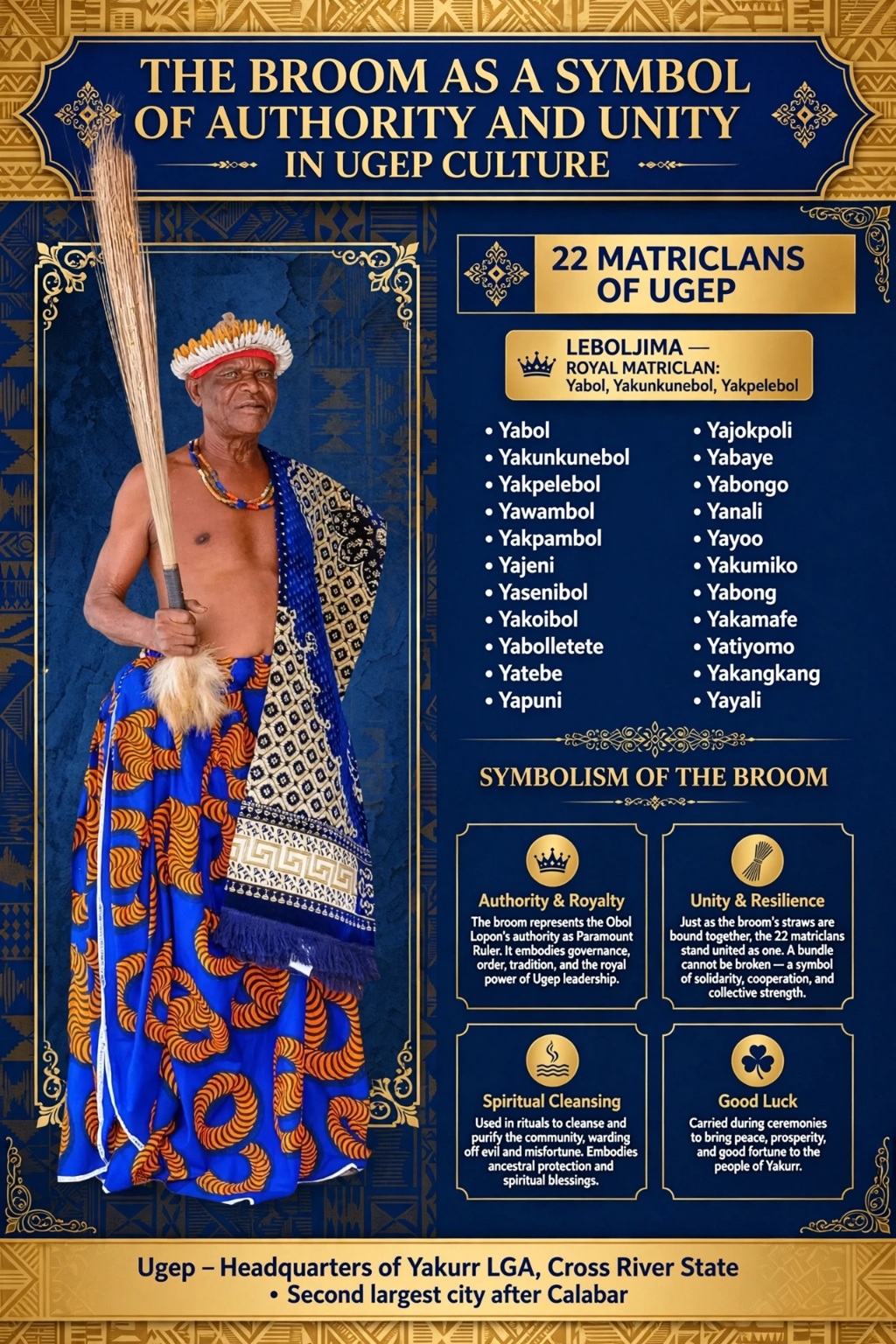
Historically, this principle found expression in political leadership. In 1735, a woman, Obol Obia Ayele, assumed the leadership of Ugep as Regent. A regent is a person who rules a polity temporarily when the substantive ruler is unable to do so. She remained on the throne for one year until 1736, when her regency ended and she stepped aside for Obol Esukpa, who was coronated as the Obol Lopon of Ugep. Her regency occurred after the reign of Obol Ejah, who ruled between 1710 and 1735.
Significantly, Ugep oral tradition is silent on why Obol Obia became Regent and why she stepped aside after only one year. This silence itself is instructive. It suggests that her regency was a contingent, crisis-driven intervention to preserve the throne, rather than an institutionalized pathway for female succession.
5. Ritual Affirmation of Women: The Leboku and Janenboku Festival
Yet, the ritual calendar of Ugep glaringly demonstrates the special place of women in the society from time immemorial, long before international law began to recognize women’s rights and set aside a day to celebrate International Women’s Day.
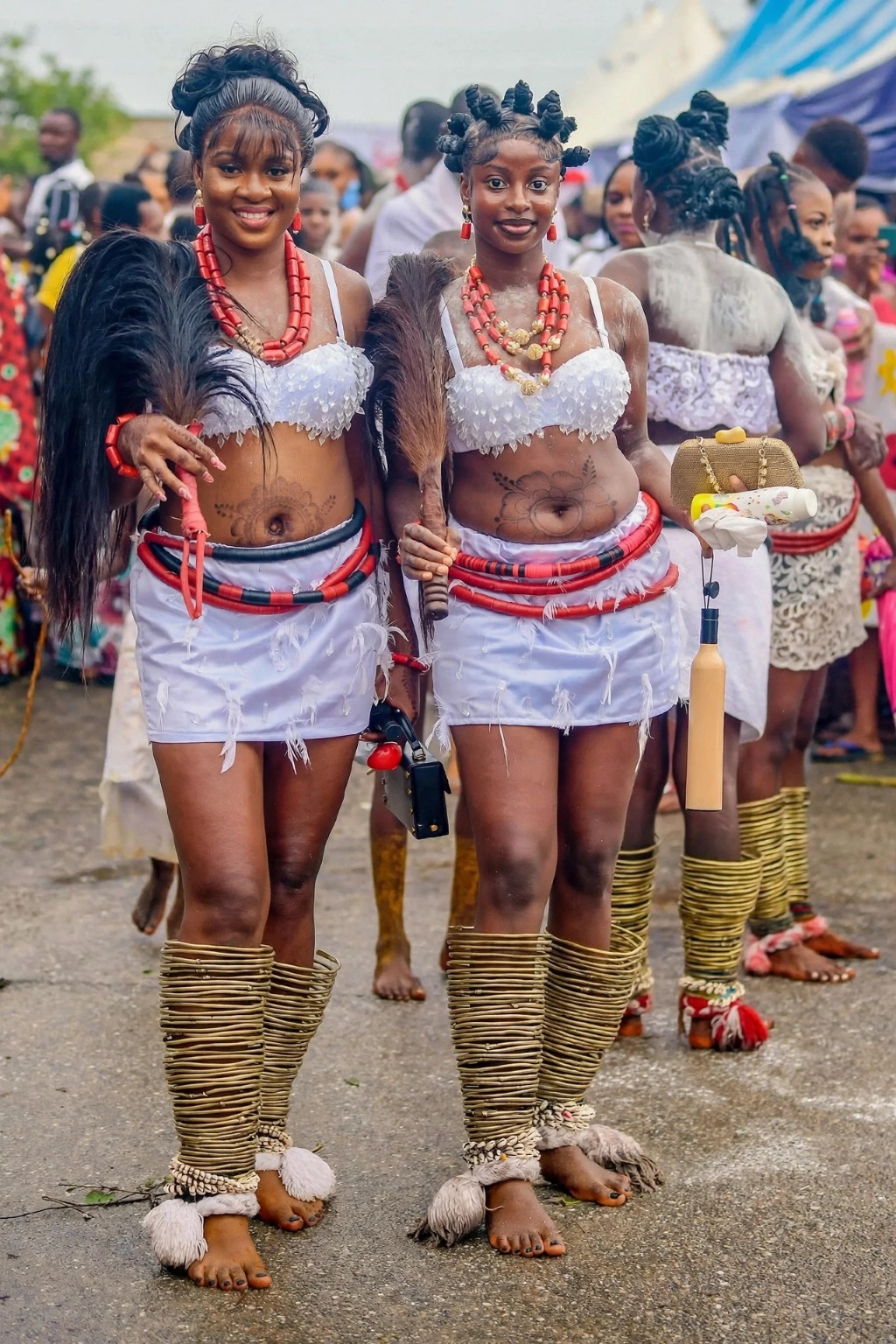
This is most evident during the Leboku New Yam Festival. Within Leboku, a special day is set aside to celebrate and honour young women. This day is known as Janenboku — the Women’s Festival. During Janenboku, the maiden daughters of the land are celebrated for their chastity, beauty, industry and role as bearers of the future. The entire community pauses to honour them, underscoring that without the woman, there is no continuity of the patriclan or the matrilineal blood. Janenboku therefore provides strong ritual evidence of a matrifocal worldview.
6. The Limits of Female Power: The Patriclan Test
If Ugep were a true matriarchy, this ritual centrality would be reflected in all spheres of political power. However, it is not. The conundrum becomes more confounding when we examine patriclan organization. Women are excluded from assuming the position of Obol Kepon — the King of the Patriclan — even though women by birth belong to the patriclan known as Kepon. If the system were truly matriarchal, membership in the patriclan should qualify women for its highest stool.
7. Conclusion
The evidence suggests that describing Ugep as a matriarchal culture in the strict political sense is anthropologically implausible. What exists in Ugep is a robust matrilineal system whose mythical charter is female, embodied by Mma Esekpa and Yose, and whose cultural calendar ritually affirms women through Janenboku, but whose executive political and ritual power is largely exercised by men.
The one-year regency of Obol Obia Ayele proves that women could exercise supreme power, but the tradition’s silence on her emergence and exit suggests it was an exception that proves the rule. The exclusion of women from the Obol Kepon stool and from the Kekpan, Ledu and Legome societies demonstrates the structural limits of that power.
Therefore, Ugep is best classified not as a matriarchy, but as a matrilineal society with a dual-sex power structure — a society where cosmological legitimacy, ritual honour and identity come from the mother, but where executive authority is negotiated and predominantly held by men.
REFERENCES
Forde, D. (1964). Yakö Studies. Published for the International African Institute by Oxford University Press.
Erim, E. O. (1981). The foundation of Ugep: An analysis of oral tradition. *Journal of the Historical Society of Nigeria, 11*(1/2), 29-44.
Erim, E. O. & Ugot, B. U. (1996). The Leboku Festival of Ugep: A celebration of new yam. University of Calabar Press.
Richter, U. B. (1980). Matrilineality and the position of women among the Yakurr: A re-examination. *Anthropos, 75*(3/4), 542-561.
Schneider, D. M. & Gough, K. (Eds.). (1961). Matrilineal Kinship. University of California Press.
Ubi, A. O. & Odey, M. O. (2015). Matrilineal inheritance and patrilineal authority among the Yakurr of Cross River State, Nigeria. *Lwati: A Journal of Contemporary Research, 12*(3), 45-62.
Oral Interview: Elders of Ugep Traditional Council, Ugep. Interview on the regency of Obol Obia Ayele and the role of Mma Esekpa. Conducted 2024-2025.