By Suleyman A. Ndanusa, PhD, OON
Every so often, particularly when Nigeria enters another season of political reflection, we return to one of our favourite national questions: What kind of leaders does Nigeria really need?
The answers usually come quickly.
“We need good people.”

“No. Nigeria has had good people. What we need are strong leaders.”
Then someone, usually with the confidence of having settled the matter permanently, says: “Forget individuals. What Nigeria needs are strong institutions.”
Unfortunately, the argument does not end there.
Someone else immediately asks the inconvenient question: And who will build these strong institutions if not good leaders?
At which point we have travelled full circle and returned to where we started.
Perhaps the problem is not that any of these positions is entirely wrong. It is that each is incomplete.
Nigeria needs good people. Nigeria needs strong leadership. And Nigeria certainly needs strong institutions.
The more interesting question is how the three relate to one another.
For many years, our political conversation has placed enormous faith in finding the “right person.” We search for the honest man, the incorruptible woman, the courageous governor, the reforming minister, the exceptional regulator or the transformational president.
There is nothing inherently wrong with this. Character matters enormously in public life.
But our experience should by now have taught us that being a good person and being a good leader are not necessarily the same thing.
We have seen people enter public office with excellent reputations and leave with those reputations badly bruised. We have watched respected professionals, accomplished technocrats and apparently decent people enter government amid great public expectation, only for Nigerians eventually to ask what happened to the person they thought they knew.
Sometimes the explanation is moral failure.
But not always.
Sometimes a perfectly decent person simply discovers that running a ministry, state or country requires considerably more than decency.
An honest pilot who cannot fly the aircraft is still a danger to the passengers.
Leadership requires integrity, certainly, but also competence, judgement, courage, political intelligence, coalition building, execution capacity and the ability to convert intentions into outcomes.
Goodness is therefore necessary.
It is simply not sufficient.
This is where the argument for strong leadership becomes compelling.
Nigeria undoubtedly needs leaders capable of taking difficult decisions, confronting entrenched interests and insisting that government works.
But here again, language matters.
Nigeria needs strong leaders, not strongmen.
The distinction is more than semantic.
A strongman builds the system around himself.
A strong leader builds the system beyond himself.
The strongman demonstrates power by making himself indispensable. Files wait for him. Decisions wait for him. Institutions wait for him. Everybody learns that nothing important happens until “Oga” gives the instruction.
It can look remarkably efficient for a while.
The strong leader does something less dramatic but ultimately more consequential. He creates rules, processes, capabilities and institutions that progressively reduce the need for his personal intervention.
One makes himself stronger than the institution.
The other makes the institution stronger than himself.
Nigeria’s experience provides an interesting laboratory for this distinction.
We have all encountered the phenomenon.
A new chief executive arrives at a public institution.
Within months, things begin to change. Staff suddenly rediscover punctuality. Files that previously required archaeological excavation begin moving. Revenues improve. Contractors become careful. Telephone calls from powerful people lose some of their magical properties. Nigerians begin saying, “At last, we have found the right person.”
Then his tenure ends.
A successor arrives.
Slowly, sometimes rapidly, the old habits return.
The files resume their leisurely journeys. Rules become negotiable again. Performance declines. The institution that supposedly had been “transformed” begins looking suspiciously familiar.
We then start searching for another exceptional Nigerian to rescue it.
There is something fundamentally wrong with this model of governance.
If an institution works only when an exceptional person heads it, we have not yet built an exceptional institution. We have merely enjoyed an exceptional individual.
We rented excellence for the duration of someone’s tenure.
That distinction is crucial.
It takes us directly into the institutional question.
One of the great insights of institutional economics is actually quite simple: people respond to incentives and constraints.
Douglass North gave intellectual force to the idea that institutions the formal and informal rules governing society shape economic and political behaviour.
In everyday Nigerian language, we might simply say, people study the environment and behave accordingly.
Put reasonably decent people inside a system where competence is secondary to connections, political loyalty determines advancement, rules are selectively enforced, procurement can be manipulated, regulators can be captured, sanctions are uncertain and proximity to power provides insurance against consequences, and something predictable begins to happen.
Behaviour adjusts.
The uncomfortable truth is therefore that weak institutions do not merely permit bad people to behave badly. They can gradually teach good people how to behave badly too.
That may explain something about our recurring national disappointment.
We sometimes assume that Nigeria’s principal governance challenge is that the wrong people keep entering government.
Perhaps part of the problem is that the system itself has become remarkably skilled at converting different kinds of people into remarkably similar political behaviour.
New personalities arrive.
The incentives remain.
After some time, the outcomes begin to look familiar.
This is why strong institutions matter.
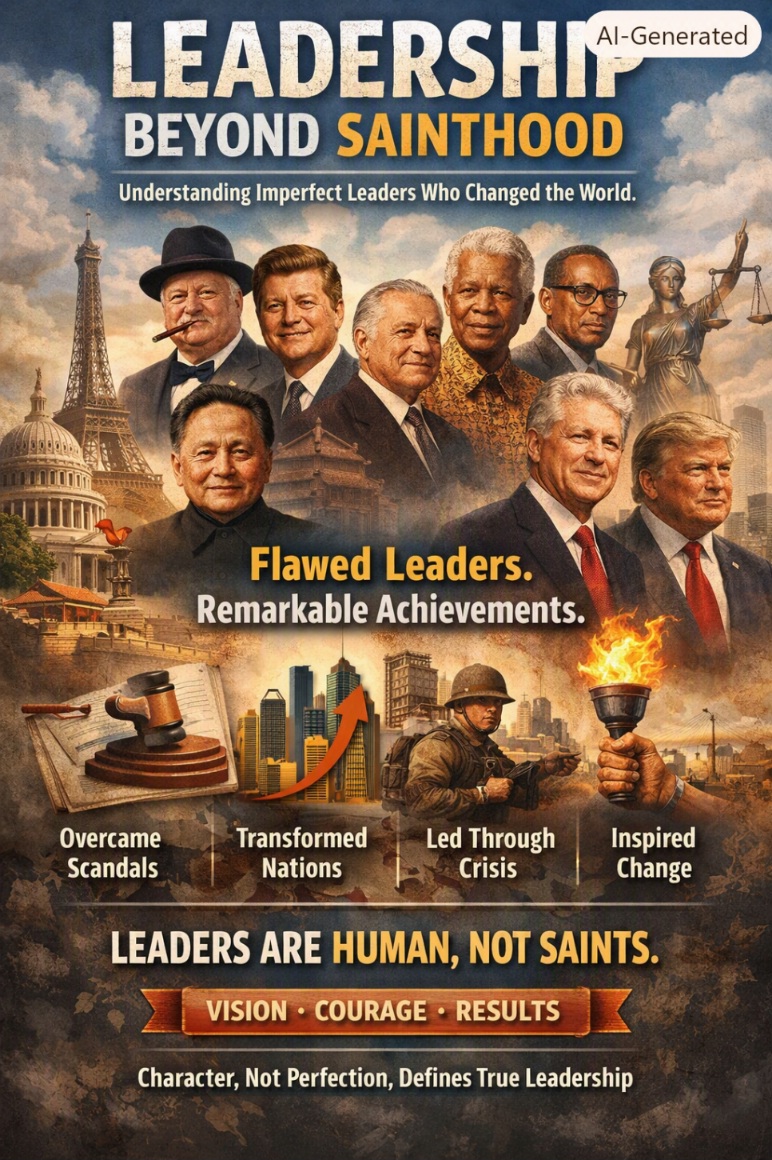
Their purpose is not to create saints.
Their purpose is to make sainthood unnecessary for ordinary government to function.
No serious country can base its development strategy on the hope that every four or eight years Providence will send it an unusually honest, brilliant and courageous human being.
There simply aren’t enough saints to fill all the vacancies in government.
Successful societies contain the same human raw materials found everywhere else: ambitious people, generous people, selfish people, patriotic people, opportunists, geniuses, mediocrities and occasionally people who should never have been allowed near public money.
The difference is often institutional.
Good systems make productive behaviour easier and misconduct harder. They reward competence, create transparency, enforce consequences and limit the amount of damage any single individual can inflict.
This suggests that perhaps Nigeria has been asking the wrong question.
We repeatedly ask:
How do we find good people to govern us?
A more consequential question might be:
How do we build a system in which good people can succeed, ordinary people have incentives to behave properly, and bad people are prevented from doing extraordinary damage?
But then comes the objection with which we began.
Who builds the institutions?
People do.
Institutions do not descend from heaven carrying enabling Acts, operating manuals and five year strategic plans.
Human beings build them.
Political leaders provide direction. Legislatures enact laws. Civil servants develop procedures. Judges interpret rules. Regulators enforce standards. Professionals build organisational cultures. Citizens create expectations and demand accountability.
So yes, Nigeria needs good people to build good institutions.
But that is only the beginning.
The ultimate achievement comes when those institutions become powerful enough to constrain even the people who created them.
And therein lies perhaps the hardest test of leadership.
It is relatively easy for a leader to create an institution that restrains his enemies.
The real test is whether he will create one capable of restraining his friends and eventually himself.
A leader who genuinely strengthens the judiciary must contemplate the possibility that judges will someday rule against his government.
A leader who builds an independent regulator must accept that the regulator may sanction his political allies.
A leader who establishes transparent procurement must accept that his preferred contractor may lose a tender.
A leader who strengthens anti-corruption institutions must live with the possibility that those institutions may investigate people sitting around his own cabinet table.
That is why institution building requires something greater than administrative competence.
It requires political self restraint.
The institution building leader voluntarily converts some of today’s discretion into tomorrow’s rules.
And that is where strong leadership and strong institutions cease to be competing ideas.
Building strong institutions is itself one of the highest expressions of strong leadership.
The apparent chicken and egg problem therefore begins to disappear.
The chicken and the egg may continue their ancient argument. Nigeria has more urgent matters requiring attention.
What matters is the sequence.
Good people must become capable leaders. Capable leaders must build strong institutions. Strong institutions must establish incentives and constraints that encourage better behaviour. Better behaviour must gradually improve the environment from which future leaders emerge.
That is the virtuous circle.
Unfortunately, there is another circle with which Nigerians are rather more familiar.
Weak institutions create distorted incentives. Distorted incentives encourage patronage and rent seeking. Patronage weakens merit. Impunity erodes accountability. Poor leadership then further weakens institutions.
The vicious circle completes itself.
And a country can remain trapped inside it for decades while periodically changing the names on office doors.
This is why leadership is particularly important during institutional transition.
Weak institutions rarely wake up one morning and decide to reform themselves.
The beneficiaries of weak institutions usually have little incentive to strengthen them. Reform therefore requires leaders willing to confront interests that profit from opacity, discretion and institutional weakness.
That requires courage.
It requires competence.
It requires political skill.
But most importantly, it requires leaders prepared to build systems that will eventually reduce their own freedom of manoeuvre.
History offers useful lessons.
Lee Kuan Yew’s achievement in Singapore was not merely that he was a formidable leader. Had Singapore’s success depended entirely upon his personal presence, his achievement would have been considerably smaller.
His greater legacy was helping build administrative, meritocratic and anti corruption systems capable of reproducing reasonably competent government beyond his own tenure.
That distinction deserves emphasis.
A good leader governs well.
A great leader makes good governance reproducible.
And perhaps this is where the conversation becomes particularly important for Nigeria.
Political seasons naturally focus our attention on personalities.
We examine résumés. We discuss character. We calculate political alliances. We study ethnicity, religion, geography and party arithmetic. We listen to speeches and admire manifestos, some of which, one suspects, may occasionally have been read more carefully by those who wrote them than by those whose photographs appear on their covers.
But perhaps our political interrogation should go further.
When someone asks Nigerians for the privilege of exercising power, we should not ask only:
Are you a good person?
Nor merely:
Are you strong enough to lead?
We should increasingly ask:
Which institutions will be stronger when you leave office than when you entered?
What currently depends upon personal discretion that you will convert into rules?
Which appointments will become genuinely merit based?
Which institutions will become more professionally independent?
Which public processes will become transparent enough that even your successor will find them difficult to reverse?
Which systems will prevent corruption rather than merely producing dramatic speeches about fighting it?
And perhaps most importantly:
What will continue working after you have gone?
That question changes the meaning of political legacy.
A road may deteriorate.
A building may eventually require renovation.
But a well designed institution can reproduce good outcomes across generations.
Nigeria therefore certainly needs good people.
Character remains indispensable.
Nigeria needs strong leaders too. Weak leadership cannot undertake the difficult work of institutional transformation.
But neither good people nor strong leaders should be the final destination.
Good people are the starting point.
Strong leadership is the bridge.
Strong institutions are the destination.
And ultimately, the institutions must become strong enough that Nigeria does not need an extraordinary Nigerian sitting in every important office merely to produce ordinary competence.
Perhaps that is the country we should now aspire to build:
A Nigeria in which good leaders can do extraordinary good, but bad leaders cannot do extraordinary damage.
For me, therefore, the ultimate measure of leadership should not simply be how much a president, governor, minister or chief executive personally accomplished while occupying office.
There is a more demanding question:
What continued to work well after you left?
And an even more profound one:
Did you leave behind a government that needed you less than when you arrived?
Perhaps when we begin judging leadership by those questions, the old Nigerian argument between good people, strong leaders and strong institutions will finally lose much of its mystery or polemics.
We need all three.
But history may ultimately reserve its highest judgement for those good people who became strong leaders and then used their strength to build institutions strong enough to survive them.
God bless Nigeria.
“Suleyman A. Ndanusa, PhD, OON, is an economist, lawyer, strategic studies scholar, and public policy thinker and practitioner with extensive experience in financial markets, regulation, governance, national Security and development