By Okoi Obono-Obla
The Fallacy of the Hamitic Theory and the Phenotypic Diversity of Africa
The Hamitic theory was a pseudo-scientific theory propounded by European ethnographers and anthropologists who thronged into Africa at the beginning of colonialism after 1885. It was used to weaponize racism to justify the colonization of Africa on the grounds that the continent needed to be exposed to European Christianity and civilization for its emancipation from darkness.
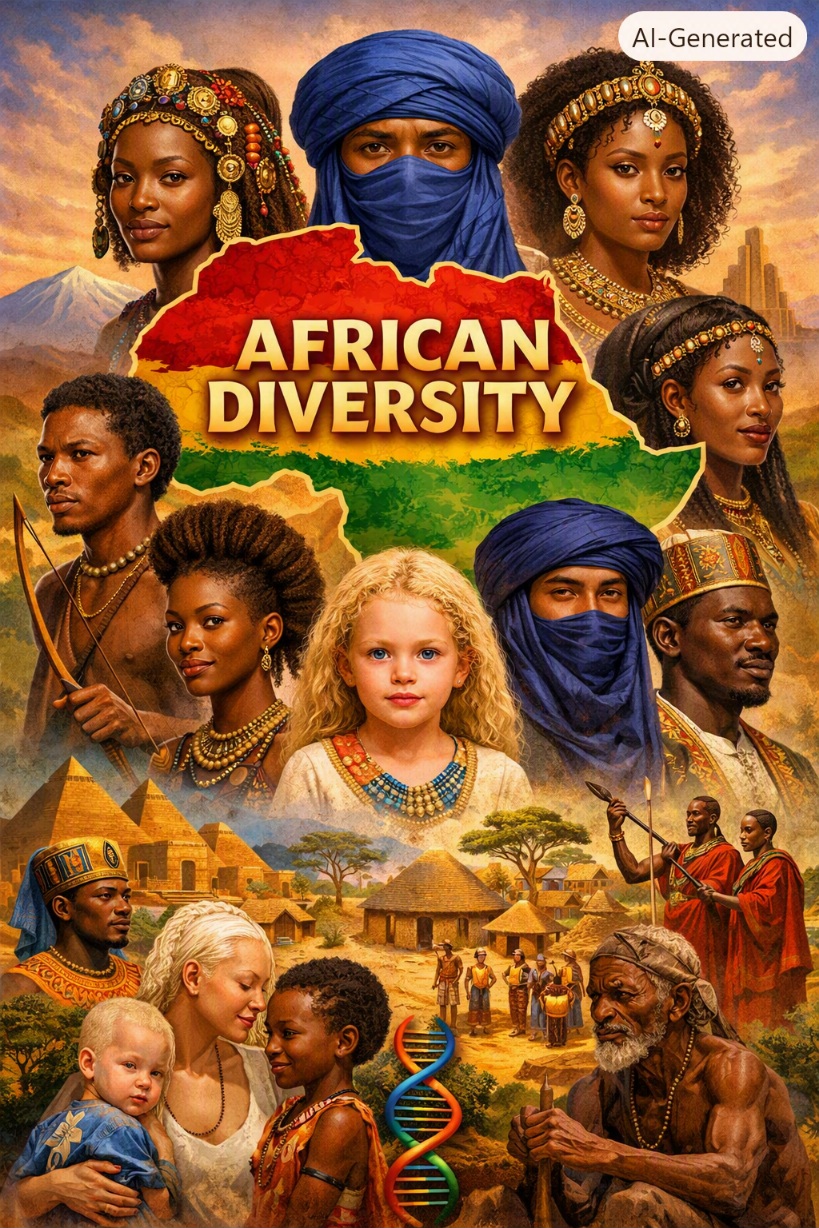
The phenotype and diversity of Africa confounded European scholars, and in the confusion in which they found themselves over the staggering diversity of the continent, they invented the Hamitic theory, which later turned out to be a complete charade.
This theory led to many African ethnic groups that have no linkage to whites or Caucasians being branded as Hamitic peoples, who were then rated higher in the pecking order contrived by European scholars and colonial administrators. For instance, the Tutsi, who are historically an authentic African people with links to the Nilotic peoples of Sudan, Uganda, Kenya and even Ethiopia, were wrongly branded as Hamitic and placed higher than their Hutu cousins, with whom they had lived together and intermarried for millennia. Even some groups in Ethiopia, such as the Amharic people, were branded as Hamitic simply because their features differ from those of some other ethnicities in Ethiopia. The Fulani, who are also an authentic African group, were pigeonholed into that same category.
However, despite the pseudo-linkage of the Fulani to an Amazigh, Middle Eastern, or Arabic origin, they are of even more authentic African ancestry. Linguistically, they are classified as belonging to the Atlantic branch of the Niger-Congo language family, much more so than the Kanuri and Hausa, who are categorized as Afro-Asiatic.
Even then, the Berber or Amazigh connection is a pseudo-anthropological narrative that holds no water, because the Amazigh themselves have populations who look typically West African. Even though some Amazigh people could pass for white, amazingly, some of the clans within the same Amazigh people, such as the Tuaregs, are equally dark and black.
This same diversity exists everywhere in Africa. Even among the dark-skinned people of Nigeria, there are very light-skinned people. In my own family, I had aunties who were very light-skinned and had blue eyes, even though my family had no history of intermarriage with white people. My own father was equally light-skinned and could pass for mixed-race in all ramifications, but his parents were dark-skinned. How does one explain such an amazing phenomenon?
The truth is that it has been scientifically proven that Africa has the most phenotypic diversity anywhere in the world. In other words, Africa has different shades of people — light, brown, dark, black, and even Mongoloid-like, such as the San people of the Southern African region. From ancient times, historians such as Herodotus described Ethiopians as dark-skinned people and even traced the ancestry of the ancient Egyptians to Puntland (Somalia) and Ethiopia.
Conclusion
In sum, the Hamitic theory was not science but a colonial invention designed to deny Africa its own history and diversity. It collapsed in the face of linguistic, historical, and now genetic evidence which affirms that Africa, as the cradle of humankind, naturally contains the widest range of human phenotypes. The light skin, blue eyes, and varied features found within indigenous African families are not evidence of foreign admixture, but proof of Africa’s original and authentic genetic diversity.