By Okoi Obono-Obla
From Tribes to Nations: Reclaiming African Ethnic Nationalities
What is a Tribe?
The European colonialists, scholars, missionaries, and ethnographers who thronged to Africa in the 19th century—after the continent was balkanized and shared among European powers such as Germany, Portugal, Spain, the United Kingdom, Denmark, France, and Belgium—arrived at a resolution during the Berlin Conference of 1884/1885, convened at the instance of German Chancellor Otto von Bismarck. The purpose of the conference was to settle disagreements over how Africa, brimming with vast natural resources, would be divided among them. At the time, European economies, driven by the peak of the Industrial Revolution, faced stagnating markets and urgently needed new territories both for raw materials and for exports to sustain their industries.
After the conference, European administrators faced the daunting task of engineering and cobbling together more than 40,000 African political entities—including kingdoms, chiefdoms, and empires—into a manageable number. These entities often lacked clearly defined boundaries, with some ethnic groups straddling vast territories. Ultimately, Africa was carved into about 50 countries, with little regard for their histories or anthropological makeup. By then, Africans did not identify themselves as “tribes.” They knew themselves by the names their ancestors had taught them. For example, the Yakurr people of Cross River State call the Efik people Yafil, the Ibibio people of Akwa Ibom State Yabibi, and the Agwagwune people of Biase Local Government Area Yakunkune. Clearly, it was not European colonialists who taught the Yakurr people who the Efik, Ibibio, or Agwagwune were.
In their bid to govern the territories they had acquired, European ethnographers, scholars, and missionaries—fascinated yet bewildered by Africa’s diversity—began to create the concept of “tribes.” Some were widely known, while others were newly invented. Established groups were merged and renamed, while others were arbitrarily labeled according to colonial convenience. Many of these so‑called “tribes” numbered between 50,000 and 100,000 people or more. It was therefore incongruous—literarily, sociologically, and anthropologically wrong—to refer to such large populations as tribes.
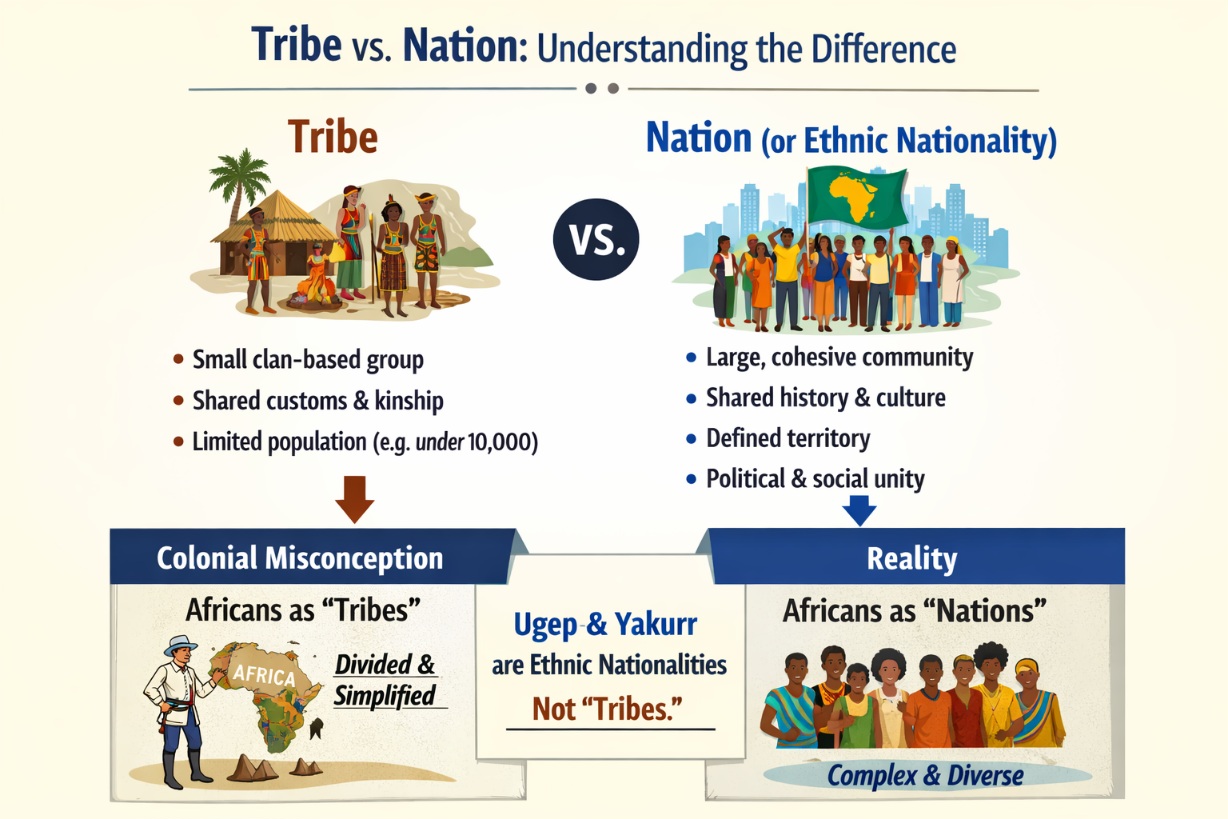
A tribe, in its natural sense, is a small group of people from the same clan who share customs, traditions, kinship, or consanguinity, but not necessarily the same language. Language alone does not determine origin or blood ties. Languages often evolve when diverse groups interact, trade, intermarry, and blend cultures, leading to new linguistic forms that are admixtures of earlier tongues.
Thus, European colonial administrators were mistaken when they began labeling every African group as a “tribe.” Their intention was to portray Africa as a dark and savage continent devoid of civilization, thereby justifying colonialism under the old international law. Many African kingdoms and chiefdoms were adjudged bona vacantia—territories deemed abandoned and therefore claimable.
In reality, however, these African groups were not tribes but nations.
The Meaning of Nation
A nation is a large community of people united by shared history, culture, language, or descent, often inhabiting a particular territory and possessing a sense of collective identity. Unlike a tribe, which is small and kinship‑based, a nation embodies political, social, and cultural cohesion on a broader scale. By all standards—population, organization, and cultural depth—many African societies were nations in the true and ordinary meaning of the word.
The Yakurr and Ugep Question
The mistake made by European powers at the Berlin Conference continues to haunt Africa long after colonialism formally ended. One of the readers of my article Ugep and the Yakurr Perspective asked a follow‑up question: “Please enlighten us on Ugeb and Yakurr. Are Ugeb and Yakurr communities not the same people, and why is Ugeb considered a tribe while other Yakurr communities are called ethnic?”
My answer is clear: Ugep, by present demographics and realities, is not a tribe. Conversely, Yakurr, by present demographics and realities, is not a tribe either, but rather an ethnic nationality.
What is an Ethnic Nationality?
An ethnic nationality refers to a distinct community of people bound together by shared ancestry, culture, language, traditions, and historical consciousness, often within a defined territory. Unlike a tribe, which is usually small and kinship‑based, an ethnic nationality encompasses a larger population with political, social, and cultural cohesion. It is closer in meaning to a nation, which represents a people united by common identity and collective destiny.
Thus, Ugep and Yakurr should not be reduced to “tribes.” They are ethnic nationalities—organized societies with histories, institutions, and identities that qualify them as nations in their own right.
Conclusion
The colonial mischaracterization of African peoples as “tribes” was not only inaccurate but also damaging, as it diminished complex societies into simplistic categories. Recognizing African groups as ethnic nationalities and nations restores dignity to their histories and identities, correcting a distortion that has lingered since the Berlin Conference.