

30 April, 2026.
Why the North’s Survival Demands a Radical Shift in Leadership
The Arewa Development Agenda is neither a fiction nor a figment of imagination. It is an existential necessity. But under the current political structure, it remains an impossibility—not because the resources are lacking, not because the people are incapable, but because the leadership has failed.
For decades, Northern Nigeria has been in steady decline. Today, the region that once produced giants now produces poverty, illiteracy, and insecurity at staggering scales. The question is no longer whether Arewa faces an existential threat—it does. The question is whether the North has the will, the leadership, and the unity to confront it.
The Evidence is Overwhelming
Northern Nigeria is now the epicenter of Nigerian poverty. According to the World Bank, an estimated 139 million Nigerians live in poverty, with the majority concentrated in the North. Over 80% of the Northern population has been pushed into what activists describe as “permanent, irreversible economic bondage.” Eight of the ten poorest states in Nigeria are in the North. Sokoto State has a poverty headcount exceeding 90%.
The human capital crisis is even more alarming. Over 60% of Nigeria’s 10.5 million out-of-school children are in the North. The Almajiri system has become a factory for street begging and child labor. Northern Nigeria accounts for more than 60% of the country’s maternal and child mortality. In some areas, maternal mortality ratios exceed 1,000 deaths per 100,000 live births. One-third of children under five are stunted due to chronic malnutrition.
The security situation has been formally declared a “polycrisis” by the Arewa Defence League. There has been a “near-total collapse of state control over violence.” Over 6 million illicit weapons are in circulation, fueling banditry that has claimed over 13,000 lives in the North-West in a decade. More than 3.5 million people have been forced from their homes. Boko Haram persists as Africa’s deadliest extremist group.
And yet, the North has ruled Nigeria for 47 years since independence—more than any other region. As one analyst starkly asked: “What did we do with power when we had it?” The answer is painful. Instead of reforming systems, Northern leaders “reinforced inefficiency” and preserved “structures that benefited a few at the expense of millions.”
The Leadership Vacuum
The tragedy of the North is not that it lacks resources or capable people. The tragedy is that it has no recognized leadership with the will and authority to drive change.
The Arewa Consultative Forum, historically the closest thing the North had to a collective voice, is paralyzed by a bitter power struggle. The crisis has escalated to the point where police sealed the ACF national headquarters in Kaduna. At a time when the North faces its most serious crisis, its leaders are fighting over offices and money.
Professor Jibrin Ibrahim captured it best: the North now occupies an “uncomfortable interregnum” where “the old is dying and the new cannot be born.” Northern leaders are increasingly conducting governance from Abuja—a “symbolic withdrawal of responsibility from the very spaces leaders are meant to serve.”
No One is Safe
A common mistake is to frame this as a problem that only affects the poor or remote villages. It does not.
Supply chains are collapsing. Banditry has made farming impossible in many areas, driving food inflation to record highs. No sane investor puts money into a region where kidnapping and banditry operate with impunity. Many wealthy Northern businessmen have already relocated their families and capital to Lagos or abroad.
The rich are now prime targets for kidnapping. No wealthy family, politician, or business owner sleeps peacefully, knowing their children could be taken at any moment.
The political elite are sitting on a volcano. A hungry, uneducated, and radicalized youth population is not a voting bloc; it is a recruitment pool for insurgents. The “precariat”—the mass of unemployed, restless youths—are already being used as political thugs. But these thugs are becoming harder to control. The elite are creating a Frankenstein’s monster that will eventually turn on its masters.
The existential threat is that no one is safe—not even the powerful. Even if the elite lack compassion for the poor, they should be terrified enough for their own wealth, families, and power to demand urgent action.
The 2027 Opportunity
The 2027 elections represent the most viable vehicle for change. INEC has scheduled presidential elections for January 16, 2027, with party primaries set for April to May 2026. The new Electoral Act 2026 introduces mandatory electronic transmission of results and direct primaries—tools that can increase transparency.
The question is whether 2027 will be “another round of ethnic arithmetic and empty political drama” or a moment where citizens demand a concrete “Arewa Development Blueprint” and hold candidates accountable.
The North cannot afford to recycle the same faces and expect different results. The region needs leaders with competence, character, and a genuine commitment to development—not politicians who treat power as a “meal ticket.”
A New Coalition is Already Emerging
The pieces of an alternative leadership structure are already falling into place—not in the paralyzed formal institutions, but in a decentralized coalition of credible voices with moral authority.
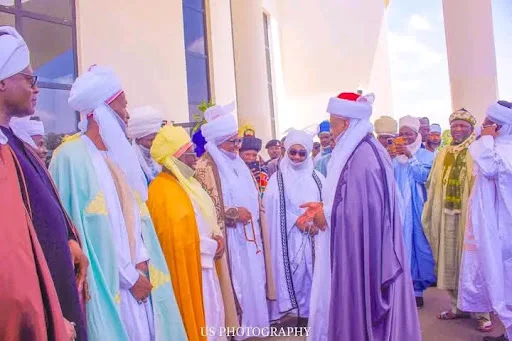
At the second Liberty Symposium in June 2026, a high-powered coalition of traditional rulers, federal ministers, media tycoons, and academics signed off on a framework built on truth over denial, productivity over dependency, merit over mediocrity, unity over fragmentation, and leadership over rhetoric. Participants included the Emir of Kano, Muhammad Sanusi II, and the Minister of Information, Mohammed Idris Malagi.
Former Sokoto Governor Attahiru Bafarawa launched the “Arewa Cohesion for Peace, Unity and Development Initiative”—explicitly a non-partisan platform. The Northern Traditional Rulers Council, led by the Sultan of Sokoto, is actively coordinating with governors, security chiefs, and community leaders. The Ulama possess “unparalleled respect and unmatched legitimacy” and are being urged to guide the ordinary masses through this crisis. A youth-driven movement called “Arewa 100% Focus” is emerging. The Northern Patriots are mobilizing civil society and demanding the recall of lawmakers who have betrayed the region.
This is not a fantasy. This is a coalition waiting to be unified.
Countering the Campaign Against Unity
The new movement must recognize that it is entering a proxy war. A coordinated campaign is being waged to divide the North along ethnic and religious lines.
The “Hausa Zalla” movement is challenging the long-standing Hausa-Fulani identity construct. The internal conflict between the Izala and Darika movements is escalating. These divisions are being exploited by those who benefit from a fragmented North.
The battle is being fought on the terrain of perception, and the media is the primary battleground. Influencers, bloggers, and community leaders are now the powerful “gatekeepers of truth.” A headline can either “calm a community or set it ablaze.” The rise of AI and deepfakes has been identified as a serious emerging threat.
The movement must deploy trusted influencers and media professionals to counter divisive narratives and promote storytelling that “humanises the other.” The Ulama must speak out against the exploitation of ethnic and religious identity for political gain.
The Indispensable Ingredient: Sustained Public Pressure
All of this—the blueprints, the coalitions, the electoral strategies—will amount to nothing without one critical ingredient: sustained, unrelenting pressure from the public.
History teaches us a painful lesson: leaders do not change because they want to. They change because they are forced to. The Northern political elite have had decades to act. They have chosen not to. They will not suddenly develop a conscience. They will only respond when their comfort, their power, and their survival are threatened by a populace that refuses to be silenced.
This is where the real work begins. The movement cannot be confined to a few intellectuals writing op-eds or a handful of activists holding protests. It must be a decentralized, informal, and multi-layered revolution of consciousness that makes it impossible for the elite to ignore, bribe, or destroy.
The Student Movements
Northern universities and tertiary institutions must become the engines of this awakening. From ABU Zaria to UNIMAID, from BUK to ATBU, students must organize, educate, and agitate. They must demand that their institutions produce not just graduates, but citizens who understand that the North’s survival depends on their active participation. History shows that student movements have toppled governments and forced transformative change. The North’s students must reclaim that legacy.
The Educated Class
The professionals—the doctors, lawyers, engineers, academics, and civil servants—must break their silence. For too long, the educated class has been complicit in the region’s decline, either through active participation in corrupt systems or through passive acceptance of the status quo. They must become the architects of the new Northern narrative, using their expertise to articulate clear alternatives and their influence to hold leaders accountable.
The Social Media Influencers
In today’s Nigeria, the battle for public opinion is fought on digital platforms. Influencers, bloggers, and content creators have become the new gatekeepers of truth. They must be mobilized to counter divisive narratives, expose corruption, and amplify the voices of those demanding change. A single viral post can reach millions; a coordinated digital campaign can shift the national conversation. The movement must invest in training and equipping these digital warriors.
A Coalition of the Willing
But the most potent force will be a coalition of the willing—ordinary Northerners who are hungry, angry, and enlightened. These are the people who have seen their children go hungry, their siblings killed by bandits, their futures stolen by a system that serves only the powerful. They are tired of being used as voting fodder and forgotten until the next election cycle.
These hungry and angry but enlightened Northerners must lead this movement. But here is the crucial insight: the movement must be structured in a way that makes it immune to elimination. It cannot have a single leader whose assassination or bribery would collapse it. It cannot have a central treasury whose corruption would starve it. It cannot have a single headquarters whose closure would silence it.
Instead, the movement must be decentralized and informal. Hundreds and thousands of different groups—student chapters, professional associations, community forums, youth collectives, women’s groups, religious circles, digital platforms—must spring up across the North. Each must share the same core ideology: that the North cannot survive without a radical shift in leadership and a commitment to genuine development. But each must operate independently, with its own leadership, its own resources, its own strategies.
This is the model that makes silencing the movement nearly impossible. Bribe one group? A hundred more will rise. Arrest one leader? A thousand will take their place. Shut down one platform? A dozen more will emerge. The elite cannot negotiate with a movement that has no single negotiator. They cannot co-opt an ideology that is owned by millions.
This is how change happens. This is how the North will be saved.
A Realistic Path Forward
The Arewa Development Agenda is not a figment of imagination. It is a survival imperative. But it requires a clear strategy.
First, convene a summit of traditional rulers, Islamic clerics, business leaders, academics, and civil society to formally launch a “Northern Development Compact.” Develop a clear “Arewa Development Blueprint” with specific targets in education, health, security, and economic development. Train and deploy influencers to counter divisive narratives.
Second, launch a massive voter education campaign focused on the Blueprint. Engage communities through traditional and religious institutions. Use social media and local radio to reach the grassroots. Organize town hall meetings across all Northern states.
Third, engage with political parties to ensure their candidates commit to the Blueprint. Mobilize voters to reject candidates who cannot articulate a clear development agenda.
Fourth, establish a “Northern Development Watchdog” to monitor the performance of elected officials and continue to use public opinion and media pressure to hold leaders accountable.
The Choice is Ours
The Arewa Development Agenda is neither a fiction nor a figment of imagination. It is a necessity. But it will not happen by accident. It will not happen through the current political structure. It will only happen if the people of Northern Nigeria—the clerics, the traditional rulers, the business leaders, the academics, the youth, and the ordinary men and women—demand it.
The evidence is clear: the North faces an existential crisis. The current political leadership has failed by every measure. No one is safe. The 2027 elections offer a critical opportunity. A new coalition of credible leaders is already emerging.
The question is not whether the Arewa Development Agenda is possible. The question is whether we have the courage, the unity, and the will to make it happen.
The alternative is unthinkable: a region that once produced giants, reduced to a footnote in history. A region with the largest population in Nigeria, reduced to permanent poverty and insecurity. A region that has held power for 47 years, with nothing to show for it.
As Governor Uba Sani warned: “If we don’t take serious action, we may soon not have a region called Northern Nigeria.”
That is not a figment of imagination. That is a prediction waiting to be proven wrong—or fulfilled.
The choice is ours. The time is now.
Mohammed Bello Doka can be reached via bellodoka82@gmail.com
Abuja Network News













Leave a comment