By Okoi Obono-Obla
Ben Across Cultures: Hebrew and Yakurr Connections
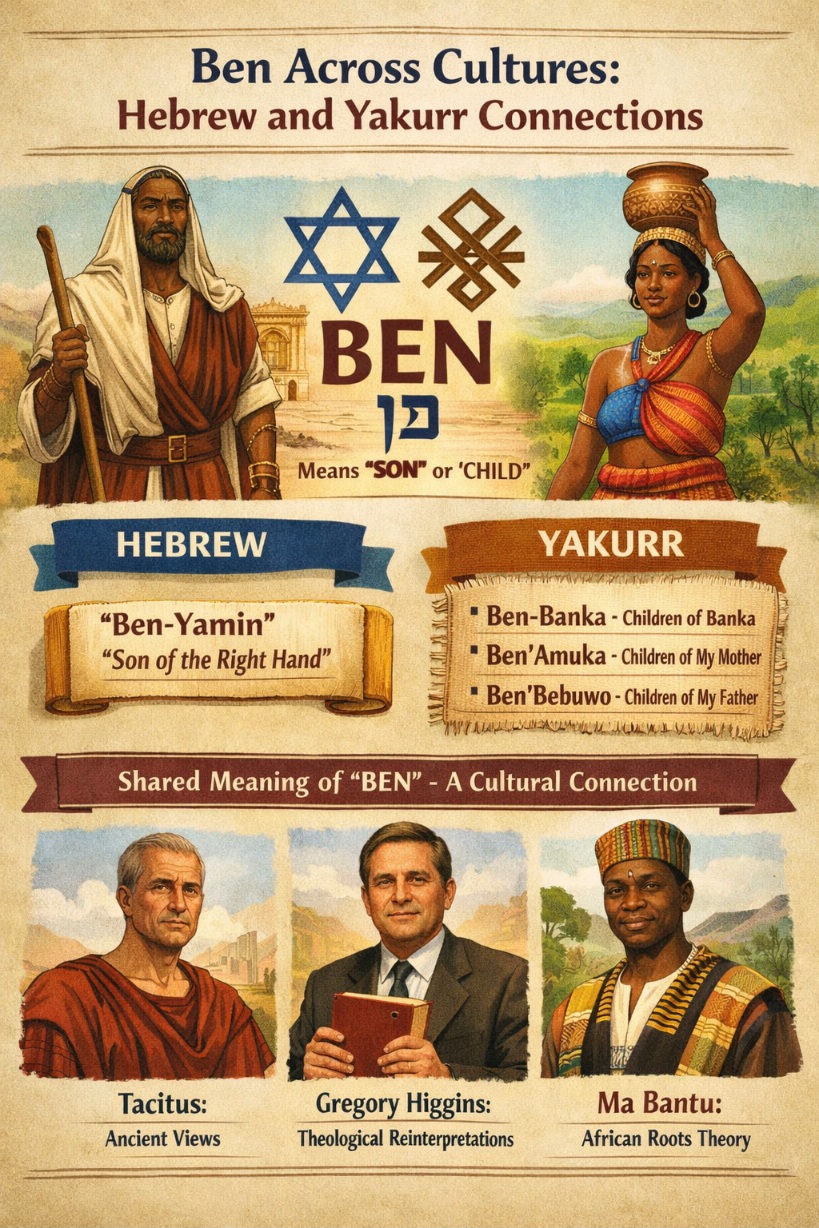
In the Bible, the Hebrew word Ben (בן) translates as “son,” “child,” or “descendant.” Because ancient Israelites did not use surnames, Ben was placed before a person’s name to denote lineage (e.g., “son of [Father’s Name]”). Beyond direct family ties, it carried deeper cultural significance. For example, Benjamin means “son of the right hand.”
Among the Yakurr people of Cross River State in Nigeria, the same word Ben also means “child” or “children.” For instance, there is a popular matriclan known as Ben-banka, meaning “children of Banka.” Similarly, Ben’amuka means “children of my mother,” a way of referring to members of the matriclan. On the other hand, Ben’bebuwo means “children of my father,” referring to members of the patriclan. Twins are referred to as Ben-Yapo, meaning “two children.” This linguistic parallel is striking and raises questions about possible cultural or historical connections between the Yakurr and the Hebrew people.

Some may wonder how the Yakurr could share such a linguistic feature with the Hebrews, who today are often perceived as white people. But were the Hebrews of the Bible truly white? Ancient historians and modern scholars have debated this question.
Tacitus
– In his Histories (Book V), Tacitus described the Jews as a people with unique customs, often portrayed negatively.
– He claimed Moses instituted practices deliberately opposed to Roman norms, such as Sabbath rest and dietary laws.
– Tacitus reflected the Flavian-era Roman hostility toward Jews after the Jewish War, portraying them as stubborn and alien. Yet, he acknowledged their distinctiveness and resilience.
Gregory Higgins
– Higgins, a modern theologian, explored biblical narratives in The Tapestry of Christian Theology.
– He highlighted how figures like Moses and Jacob have been reinterpreted across theological traditions, sometimes framed as non-European or marginalized identities.
– His work emphasizes that biblical figures should be understood in diverse cultural contexts, challenging Eurocentric portrayals.
Ma Bantu
– Afrocentric scholars like Ma Bantu argue that the Hebrews had African roots, possibly linked to Bantu or Kemetic (Egyptian/Nubian) civilizations.
– Genetic studies (e.g., haplogroup E1B1A) and cultural parallels are cited to support this theory.
– This scholarship challenges Eurocentric narratives, suggesting the Israelites were part of a broader African historical continuum.
Conclusion
The shared use of Ben in both Hebrew and Yakurr traditions is more than a linguistic coincidence; it invites deeper reflection on the interconnectedness of human cultures. While definitive historical links remain debated, the resonance of this word across continents underscores the richness of cultural memory. Scholars from Tacitus to Higgins and Ma Bantu remind us that the identity of the ancient Hebrews is not a settled matter—it is a field of ongoing debate shaped by history, theology, and cultural politics.