By Okoi Obono-Obla
Yakurr History: Migration, Federation, and Cultural Evolution:
In the history of mankind, no group can lay claim to exclusive homogeneity, as human beings have continually migrated from one place to another due to climate change, environmental disasters such as desertification, earthquakes, tsunamis, drought, wars, famine, persecution, conflict, or simply in search of new opportunities to sustain life. As people migrated, they encountered and interacted with new groups, settled in new places, intermarried, and created new languages, identities, and cultures. Over time, these interactions gave rise to evolving and emerging communities.
The Yakurr people are no exception to this historical reality. They cannot claim homogeneity even in their language (Lokaa), customs, traditions, or culture. The dialectical differences and slight variations in cultural practices between communities testify that, upon migrating to their present location, they met indigenous groups and mingled with them—borrowing words, customs, and traditions which they adopted and adapted. Thus, the history of the Yakurr reflects the broader human story of migration, adaptation, and cultural fusion.
Dr. Otu Abam Ubi categorized the people we know today as Yakurr into four broad groups:
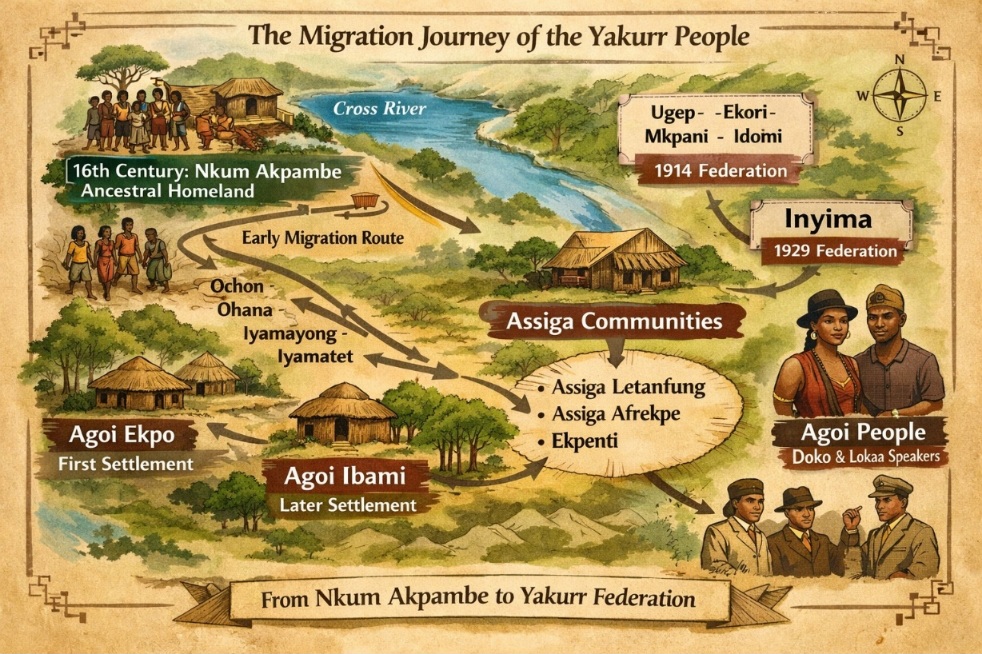
– Ugep, Ekori, Mkpani, Nko and Idomi as one group
– Agoi Ekpo, Agoi Ibami, Ekom Agoi, and Itu Agoi as the second group
– Assiga Letanfung, Assiga Afrekpe Legana, and Ekpenti as the third group
– Inyima as the fourth group
The second and third groups (Agoi and Assiga) were federated into the Yakurr group (Ugep, Ekori, Idomi, Nko and Mkpani) in 1914, when the Federation of Nigeria was born. Later, in 1929, the colonial authority federated the fourth group, Inyima, into Yakurr. These federations further illustrate the dynamic and evolving nature of Yakurr identity, shaped by both internal interactions and external political structures.
The Agoi Migration and Language
According to Dr. Ubi, by the middle of the 16th century, the people of Yala Akpambe paternity in the present Ikom Local Government Area migrated to an area on the Upper Cross River and settled at a point known as Nkum Akpambe. Therefore, the ancestral homeland of the Agoi people is the area known as Nkum Akpambe, located at the bend of the Cross River opposite the Nta and Nselle areas, where Nkum Akpambe settled.
From there, the Agoi migrated through Ochon, Ohana, Iyamayong, and Iyamatet in the present Obubra Local Government Area of Cross River State to Agoi Ekpo, a hilly terrain they found safe and convenient, where they built a settlement. Subsequent migrations led to the founding of Agoi Ibami.
Today, the Agoi are bilingual. They speak Doko, classified as part of the Upper Cross River language—a variant of the Benue-Congo branch of the larger Niger-Congo African language family. They also speak Lokaa, the language of the Yakurr people, reflecting their integration into the broader Yakurr cultural identity.
Conclusion:
The Yakurr story is a microcosm of humanity’s larger narrative: migration, interaction, and cultural evolution. Their diversity in language, customs, and traditions is not a weakness but a testament to resilience, adaptability, and the richness of human experience. The federations of 1914 and 1929 highlight how Yakurr identity was consolidated through both cultural mingling and colonial administrative decisions. The Agoi migration and bilingualism further demonstrate the dynamic interplay of indigenous heritage and adopted traditions. Ultimately, the Yakurr people embody the universal truth that human societies are defined not by rigid homogeneity, but by the evolving fusion of cultures that continue to shape identity today.