By Okoi Obono-Obla
Ugep stands today not merely as a settlement but as one of the most historically and culturally significant urban centers in Nigeria. Its evolution from a compact community to a recognized city reflects a remarkable journey of demographic growth, traditional leadership, and sociopolitical transformation.
In 1935, the eminent British anthropologist Professor Daryll Forde of the School of Oriental and African Studies, University of London, was commissioned by the Colonial Office, London, to conduct an anthropological study of the Yako people. He estimated the populations of the Yakurr villages as follows:
Umor (Ugep) – 10,900; Ekori – 7,100; Mkpani – 4,400; Nko – 2,600; and Idomi – 1,900.
Forde observed that “Umor had, by 1935, become exceptionally large for a single compact community.” This early recognition underscored Ugep’s rapid expansion and its emerging urban character even under colonial administration.

Please note that Ugep is not a village.
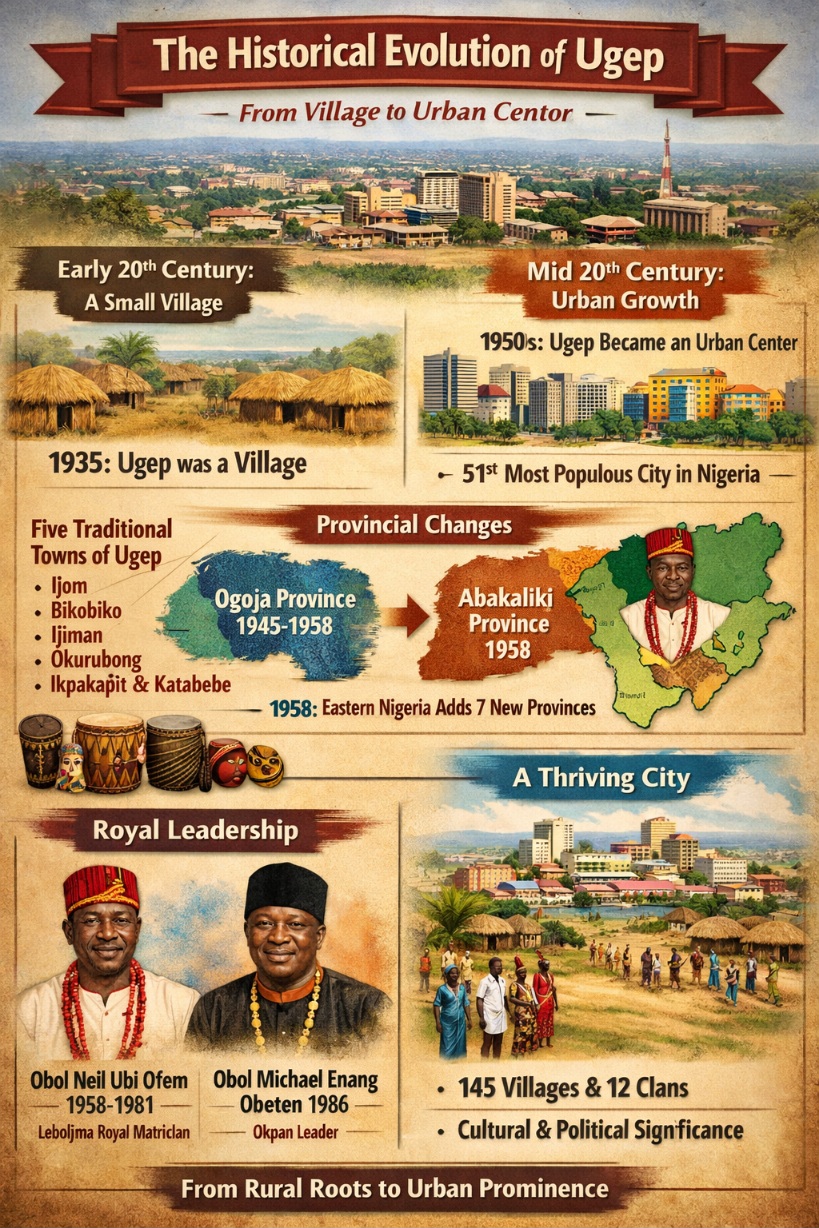
Ugep is ranked as the 51st most populous city in the Federal Republic of Nigeria.
Ugep is made up of five traditional towns: Ijom, Bikobiko, Ijiman Okurubong, Ikpakapit, and Katabebe.
It also comprises 12 clans, and within Ugep there are 145 villages officially gazetted in the Laws of Cross River State.
Ugep attained urban status in the 1950s, as classified by the government of the defunct Eastern Nigeria.
Therefore, while Ugep may have been considered a village in 1935 — about ninety years ago — she has long since surpassed that level.
Thus, describing Ugep as a village today is incorrect from literary, sociological, demographic, and geographical perspectives.
In 1958, when the Eastern Nigeria Government appointed Provincial First Class Chiefs for the 12 provinces of Eastern Nigeria, Obol Neil Ubi Ofem of Ugep was appointed First Class Chief to represent Abakaliki Province in the Eastern Nigeria House of Chiefs. Abakaliki Province is now part of present‑day Ebonyi State (excluding the old Obubra Division).
Between 1945 and 1958, Ugep and Obubra Division were part of Ogoja Province. At that time, the provinces in Eastern Nigeria were Ogoja, Calabar, Owerri, Onitsha, and Port Harcourt. In 1958, the Government of Eastern Region created seven additional provinces, bringing the total to 12.
Obol Neil Ubi Ofem, a member of the Leboljima matriclan (Royal Family) of Ugep, passed away in 1981. During his time, however, the Obol Lopon of Ugep was Obol Michael Enang Obeten, who died in 1986. He was not a member of the Leboljima but an Okpan, appointed to appease the gods after the Royal Family suffered misfortunes: the inexplicable deaths of two brothers, Obol Ubi Mbui and Obol Etim, who were appointed one after the other but died in quick succession within three years.
Conclusion
The historical trajectory of Ugep demonstrates her transformation from a village in the early 20th century into a recognized urban center by the mid‑20th century. Her political significance, traditional leadership, and demographic strength firmly establish Ugep as a city of cultural and historical importance in Nigeria — a testament to her enduring legacy and growt