By Okoi Obono-Obla
Fiat Justitia Ruat Caelum: The Purport of Section 225A and the Nigerian Political Elite’s Contempt for the Law:
Constitutional Framework
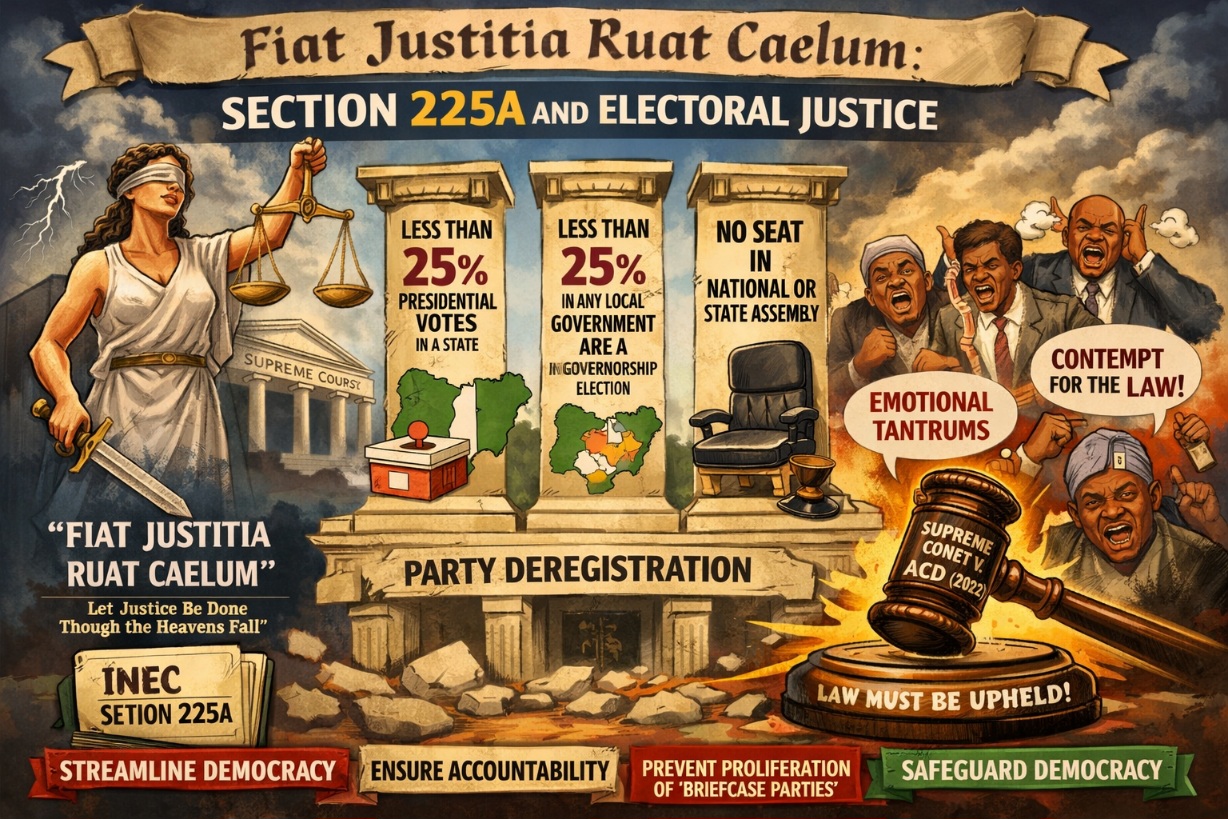
INEC is empowered by Section 225A of the Constitution of the Federal Republic of Nigeria, 1999 (as amended) to cancel or withdraw the certificate of registration or deregister any political party that fails any of the following thresholds:
1. Failure to win at least 25% of the votes cast in a presidential election in a State of the Federation;
2. Failure to win at least 25% of the votes cast in any Local Government Area in a State during a governorship election;
3. Failure to win a legislative seat in either the State House of Assembly or the National Assembly.

These thresholds must be construed disjunctively, not conjunctively. Thus, Section 225A can be activated when a political party fails any one of the three conditions set out therein.
Judicial Authority:
The Supreme Court in INEC v. Advanced Congress of Democrats (ACD) & Ors (2022) affirmed that INEC’s powers under Section 225A are constitutional and enforceable. The Court held that the provision is disjunctive, meaning failure to meet even one threshold is sufficient to justify deregistration.
In that case, the apex court upheld INEC’s deregistration of several political parties that failed to win seats or meet electoral thresholds, stressing that the Constitution empowers INEC to streamline Nigeria’s political space. The decision reinforced that deregistration is not punitive but regulatory, ensuring that only viable parties remain on the register.
Accordingly, those who argue that Section 225A cannot be invoked against the African Democratic Congress (ADC) because it won a seat in the House of Representatives in the 2023 general elections, or because elected members defected to the ADC in 2025, miss the constitutional point. The fact remains that ADC failed to secure 25% of votes cast in the presidential election or 25% of votes cast in a governorship election in any State during the 2023 general elections. That failure alone was sufficient to trigger Section 225A, as affirmed by the Supreme Court’s interpretation.
Therefore, when INEC failed to act in 2023 after the general elections, the Court was right, upon being approached, to declare accordingly.
The Wider Problem: Contempt for the Law:
A deeper problem in Nigeria is the strong aversion of the political elite to obeying the law. Too often, they treat the law with contempt, disdain, or even scorn. When they fail to obey the law and reality later confronts them, they are quick to become sentimental, throwing emotional tantrums or castigating the judiciary for applying the law strictly, without regard to emotionalism, sympathy, or moral suasion.
Yet the principle remains timeless: justice must be done even if the heavens fall — Fiat justitia ruat caelum.
Purport of Section 225A:
The purport of Section 225A is to safeguard Nigeria’s democracy by:
– Streamlining democracy: Ensuring only parties with genuine grassroots support remain registered.
– Preventing proliferation: Curtailing “briefcase parties” that exist only in name.
– Strengthening accountability: Compelling parties to prove relevance through measurable electoral performance.
– Affirming judicial independence: Courts apply the law as written, not as wished, regardless of political sentiment.
Conclusion:
The Supreme Court’s decision in INEC v. ACD (2022) underscores that failure of any single threshold is enough to justify deregistration. INEC’s duty is constitutional, and the judiciary’s role is to enforce the law without sentiment. This ensures that Nigeria’s democracy remains viable, credible, and accountable.