By Eneojo Herbert Idakwo
Nothing affects the average Nigerian more directly than the price of food.
A rise in petrol prices may be debated. Exchange-rate reforms may dominate economic discussions. Infrastructure projects may inspire optimism about the future. But food prices confront citizens every single day.
From urban households in Lagos and Abuja to farming communities across Benue, Kebbi, Niger, Kaduna, Kogi, Plateau, and Oyo States, the cost of feeding a family remains one of the most important measures by which governments are judged.

This reality explains why agriculture occupies a central position in the economic agenda of President Bola Ahmed Tinubu.
Three years into his administration, the government is pursuing what it describes as a broad agricultural transformation strategy aimed at increasing food production, strengthening rural economies, improving farmer productivity, expanding agricultural infrastructure, and ultimately reducing the pressure on household food budgets.
The challenge is enormous.
Nigeria must feed a rapidly growing population while confronting insecurity, climate variability, inadequate storage systems, poor rural infrastructure, and years of underinvestment in agricultural modernization.
The question now is whether the reforms being implemented can produce results substantial enough to stabilize food prices and strengthen national food security.
Agriculture and the Nigerian Economy
Agriculture remains one of Nigeria’s most important economic sectors.
Millions of Nigerians depend directly or indirectly on farming, livestock production, fisheries, processing, transportation, and agricultural trade.
Beyond employment, agriculture contributes significantly to:
- Food security
- Rural livelihoods
- Industrial raw materials
- Export potential
- Economic diversification
Yet despite its importance, the sector has struggled for years with structural challenges that limited productivity.
Smallholder farmers often face:
- Limited access to financing
- Poor mechanization
- Inadequate irrigation
- Weak storage facilities
- Poor road access
- High transportation costs
- Insecurity in farming communities
These constraints have repeatedly undermined efforts to achieve food sufficiency.
As a result, food inflation became one of the most persistent economic pressures facing Nigerian households.
The Food Inflation Crisis
By the time the Tinubu administration assumed office in 2023, food prices were already under pressure.
The subsequent economic reforms, particularly fuel subsidy removal and exchange-rate adjustments, further increased transportation and production costs across the agricultural value chain.
Food became more expensive to grow.
More expensive to transport.
And more expensive to sell.
The consequences were felt nationwide.
Families adjusted consumption patterns.
Businesses in the food sector struggled with rising costs.
Farmers faced higher input expenses.
Food inflation emerged as one of the most visible indicators of economic hardship.
The administration acknowledged these realities and identified food security as one of its most urgent priorities.
The Government’s Agricultural Response
The Tinubu administration’s agricultural strategy appears built around a simple objective:
Increase production while reducing the barriers that prevent farmers from reaching their full potential.
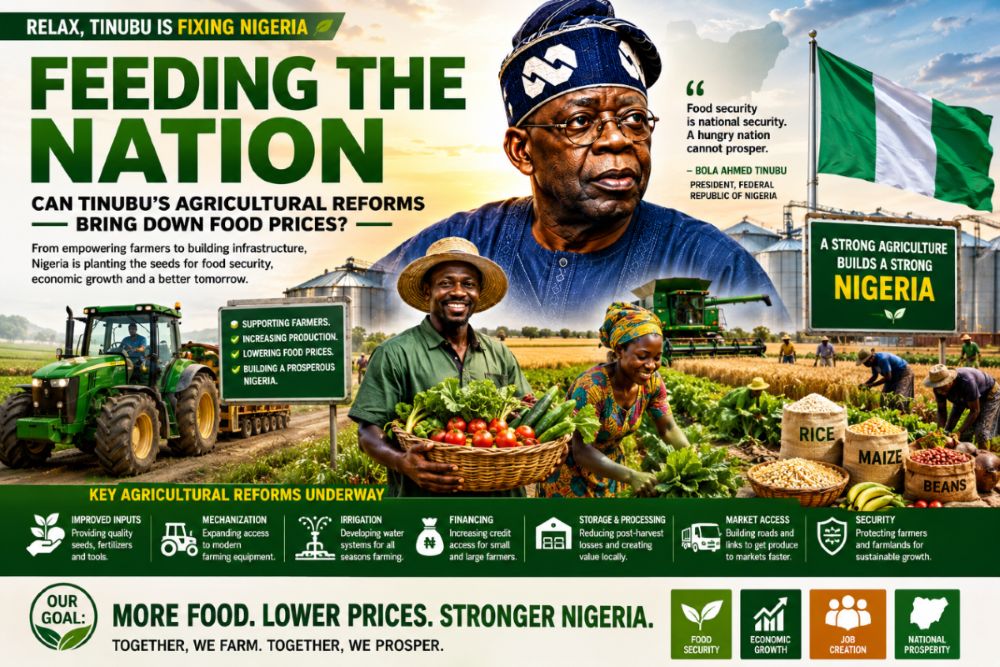
To achieve this, the government has focused on several key areas:
- Improved seed distribution
- Fertilizer support
- Mechanization programs
- Irrigation expansion
- Agricultural financing
- Market access improvements
- Development of agricultural corridors
Officials argue that increasing productivity remains the most sustainable solution to food inflation.
Rather than relying primarily on imports, the administration seeks to strengthen domestic agricultural output and build more resilient supply chains.
The long-term goal is to ensure that food becomes more abundant, affordable, and accessible.
Supporting the Nigerian Farmer
At the heart of the agricultural reform agenda is the farmer.
For decades, many Nigerian farmers have operated under difficult conditions with limited support systems.
Small-scale producers often struggle to obtain:
- Quality seeds
- Modern equipment
- Affordable credit
- Extension services
- Access to large markets
The government believes that addressing these challenges is essential for improving productivity.
Agricultural intervention programs have therefore sought to expand access to improved farming inputs and strengthen support mechanisms across various agricultural zones.
The administration argues that when farmers are empowered, national food production increases and rural economies become more vibrant.
Mechanization and Productivity
One of the recurring limitations of Nigerian agriculture has been low mechanization.
Many farmers continue relying on manual tools and traditional farming practices that limit productivity and output.
Mechanization has therefore become a major component of current agricultural policy.
Government officials believe that modern equipment can:
- Increase efficiency
- Expand cultivated land
- Improve yields
- Reduce labor bottlenecks
- Enhance competitiveness
The transition toward greater mechanization is viewed as essential if Nigeria hopes to meet future food demand and compete effectively within regional agricultural markets.
Opening Agricultural Corridors
A significant element of the administration’s strategy involves the development of agricultural corridors.
The idea is straightforward.
Agriculture does not end at harvest.
Farmers require roads, storage facilities, transportation systems, processing centers, and market access.
Without these connections, food may be produced but still fail to reach consumers efficiently.
Agricultural corridors seek to integrate production zones with commercial markets, reducing waste and improving distribution.
Supporters believe these corridors can:
- Strengthen supply chains
- Reduce transportation costs
- Improve rural development
- Encourage private-sector investment
- Expand employment opportunities
If implemented successfully, such corridors could transform agriculture from a subsistence activity into a more commercially driven sector.
The Security Challenge
No discussion of Nigerian agriculture can ignore the issue of insecurity.
For years, farming communities in several regions have faced threats from banditry, terrorism, kidnapping, and communal conflicts.
These security challenges have:
- Reduced cultivation
- Increased production costs
- Forced displacement
- Limited access to farmland
- Disrupted food supply chains
The administration’s broader security strategy is therefore closely linked to its agricultural agenda.
Government officials argue that improving rural security remains critical to expanding agricultural productivity and stabilizing food prices.
Without safe access to farmland, even the best agricultural policies may struggle to achieve their intended outcomes.
Climate and Modern Agriculture
Nigeria’s agricultural future is also increasingly shaped by climate realities.
Flooding, drought, irregular rainfall patterns, and environmental degradation continue affecting farming communities.
These challenges require adaptation and innovation.
The administration has emphasized:
- Irrigation development
- Climate-resilient farming methods
- Water resource management
- Improved agricultural planning
Supporters argue that long-term food security depends on building a farming sector capable of adapting to changing environmental conditions.
Are Food Prices Beginning to Respond?
One of the most closely watched indicators remains food inflation.
In his third anniversary address, President Tinubu stated that food prices had largely moderated from their peak levels experienced during the most difficult stages of economic adjustment.
While many households still face affordability challenges, government officials argue that increased production efforts and improved supply conditions are beginning to generate positive effects.
The administration remains committed to ensuring that food prices continue moving toward greater stability.
However, officials acknowledge that lasting results require sustained effort rather than short-term interventions.
Beyond Food Security
The significance of agricultural reform extends beyond feeding the population.
Agriculture offers opportunities for:
- Job creation
- Rural industrialization
- Export growth
- Youth employment
- Poverty reduction
- Economic diversification
A productive agricultural sector can reduce dependence on oil revenues while creating broader participation in economic growth.
For this reason, the administration increasingly presents agriculture as both a social necessity and an economic opportunity.
The Road Ahead
Three years into the Tinubu administration, agriculture remains one of the most important battlegrounds in the struggle for economic recovery.
The stakes are high.
Food affordability affects public confidence more directly than almost any other economic indicator.
If food prices stabilize and productivity expands, the benefits will be felt across every segment of society.
If agricultural constraints persist, pressure on household incomes will continue.
The administration believes that investments in farmers, mechanization, irrigation, security, agricultural corridors, and market access are laying the foundation for long-term food security.
Whether these efforts ultimately succeed will depend on consistency, implementation, security improvements, and sustained support for those who feed the nation.
For now, Nigeria’s agricultural future remains a work in progress.
But it is increasingly clear that in the vision of President Bola Ahmed Tinubu, the journey toward national prosperity begins in the farm fields of rural Nigeria.
Because a nation that cannot feed itself cannot fully secure its future.