By Okoi Obono-Obla
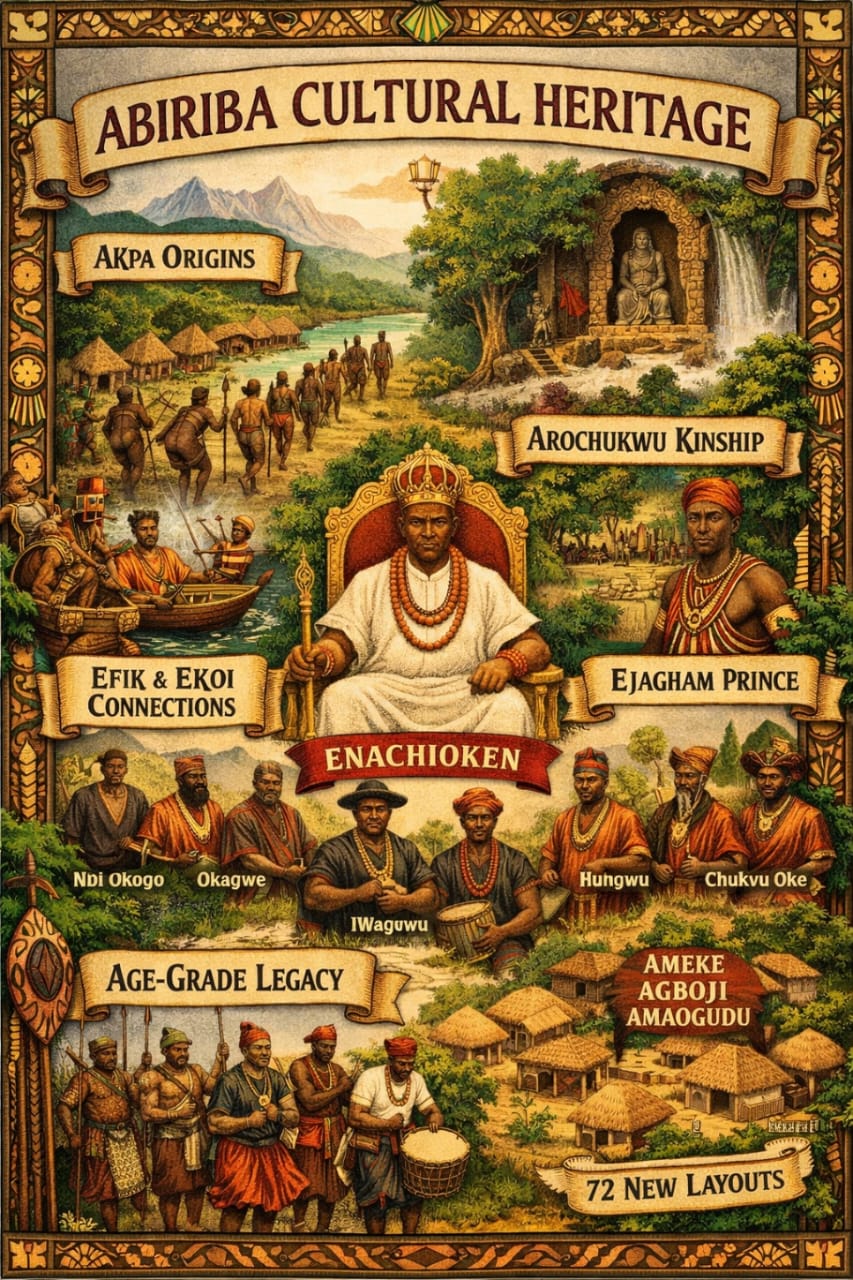
The Abiriba people trace their ancestry to both the Igbo and Efik of Calabar. They migrated centuries ago from the upper Cross River area under the leadership of Nnachi Oke, from whom the royal title Enachioken (“The Monarch”) originates. Initially, they occupied a small territory, which expanded after routing the neighboring Nkporo people. Known for their warlike nature, the Abiriba quickly established dominance in the region.
Unlike the origins of many other Igbo groups, the history of the Abiriba is supported by evidence linking them to the Bahumono and Yakurr tribes of the Ekoi in the Cross River basin, as well as to the people of Arochukwu. At Ekoi, disputes among the seven families under Ukpaghiri prompted migration first to Ena and later to Akpa.
Life in Akpa proved difficult due to hostilities with neighbors. After Ukpaghiri’s death, Mbiriba led his group to Usukpam, but constant conflict forced further movement. Eventually, Otusi branched off downstream and founded Arochukwu, while Mbiriba advanced to Udara‑ebuo. Oral tradition recalls that Udara‑ebuo was inhospitable, plagued by scarcity of water and overrun by monkeys, which became the people’s main food source. Mbiriba died there, leaving his son Ifa Mbiriba to continue the journey.
Ifa Mbiriba later settled at Uruanta and Agboha, a fertile and naturally fortified area. From Mbiriba’s name, the community derived the name Abiriba (from “Ebiri‑Aba”).
Several leaders established key settlements:
– Oko Ogo founded Ndi Okogo, where the Chief’s Palace (Agboezi) now stands.
– Nwagu Ifa founded Okagwe and later Agboji.
– Ngwu founded Ihungwu.
– Chukwu Oke founded Amogudu.
The capital, Ameke, derives its name from the market day Eke. The paramount ruler of Abiriba continues to bear the title Enachioken.
Frequent conflicts with neighboring Item and Amogudu communities led to the creation of a standing army through the age‑grade system, which originated in Amogudu. This system became central to Abiriba’s defense and social organization.
The kingdom eventually grew into three principal clans: Ameke, Agboji, and Amaogudu.
– Ameke developed into 10 villages, later 11 by 1941.
– Agboji comprised two villages: Amabia and Amagbo.
– Amaogudu consisted of four villages: Umuechukwu, Amamba, Ogbu, and Udanta.
Each village contained numerous compounds, forming the social and cultural fabric of the community. In modern times, Abiriba has expanded further, with 72 new layouts spread across the three clans.
Connections Beyond Abiriba:
The Abiriba and Arochukwu people are deeply intertwined. Oral tradition recalls that Otusi, branching from the same lineage as Mbiriba, founded Arochukwu. The term Nwajim — used between Abiriba and Arochukwu — reflects this kinship. Interestingly, Arochukwu itself is said to have been founded by Osim, an Ejagham prince from present‑day Akamkpa. This reinforces the idea that Abiriba and Arochukwu are not isolated Igbo subgroups but part of a wider Ejagham–Igbo cultural synthesis.
The Efik of Calabar also appear in Abiriba traditions. Their role as coastal traders and cultural intermediaries likely influenced Abiriba society, especially in language, trade, and ritual practices. The matrilineal system of Abiriba mirrors that of many Ekoi–Ejagham groups, showing continuity with Cross River traditions rather than purely Igbo patriarchal norms.
The concept of Akpa is central not only to Abiriba but also to Yakurr, Bahumono, Etung, and Okuni traditions, all of which recall living in Akpa before dispersal. Beyond southeastern Nigeria, the Jukun, Idoma, and other Kwararafa peoples of north‑central Nigeria also claim descent from Akpa, linking Abiriba’s story to a much wider ancestral hub that stretches into Cameroon.
The Age‑Grade System:
One of Abiriba’s most distinctive institutions is the age‑grade system, which began as a standing army to defend against Item and Amogudu neighbors. Over time, it evolved into a social, political, and economic structure that organizes community labor, enforces discipline, and sustains cultural identity. This system remains a hallmark of Abiriba society and is a living testament to their resilience and adaptability.
Conclusion:
The Abiriba story is not just about migration but about integration and cultural fusion. Their ties to Arochukwu, Efik, and Ejagham traditions reveal a layered identity rooted in Akpa. The age‑grade system, matrilineal inheritance, and shared oral histories all point to a people who embody both Igbo and Cross River heritage. Their history reflects resilience, migration, and adaptation, situating Abiriba as a vital link between southeastern Nigeria, the Cross River basin, and the broader Kwararafa traditions of north‑central Nigeria.