
By Okoi Obono-Obla
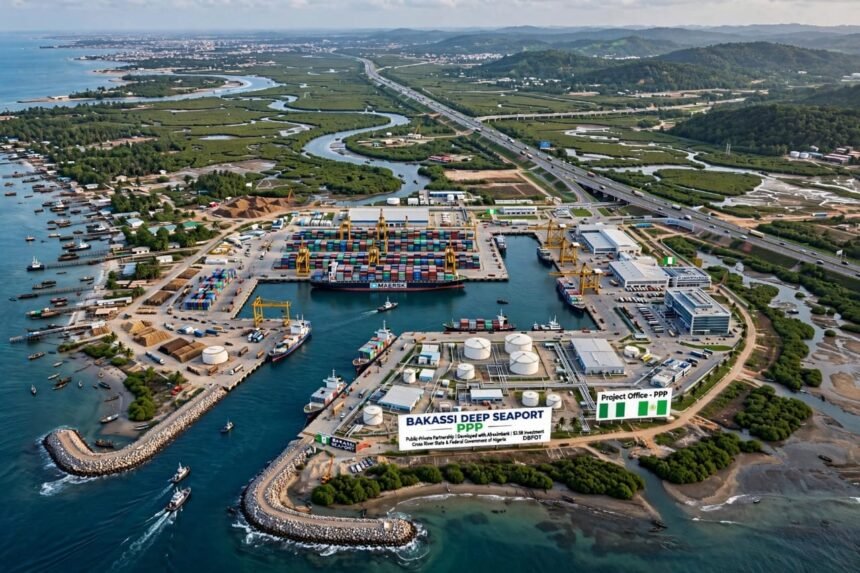
Many respondents to my article lauding the laying of the foundation stone for the Bakassi Deep Seaport have raised the issue of how the project will be funded. They have expressed deep reservations and scepticism about the multi-billion-dollar project and compared the hype surrounding it to that of the Super Highway conceived by Governor Ben Ayade, whose foundation stone was laid by President Buhari with much pomp and pageantry, but which has since fizzled out and now lies abandoned.
However, the conceptualisation of the Bakassi Deep Seaport and that of the Super Highway are two different things.
Unlike the Super Highway, whose PPP financing was never clearly structured or secured, the Bakassi Deep Seaport has a formalised Public-Private Partnership (PPP) framework. That framework was formalised in February 2025, and it is the foundation upon which the funding of the project rests.
One of the key institutions involved in the project is the African Export-Import Bank (Afreximbank). Afreximbank is not a conventional private investor; it is a multilateral development finance institution acting as financier and financial adviser to the project. The Government of Cross River State secured its commitment in September 2024, when the Infrastructure Concession Regulatory Commission announced that $3.5 billion in funding had been secured from the Bank.
It is important to distinguish between the figures in circulation: the overall project value is put at $3.5 billion, while the initial funding approval is put at $2.27 billion. The two figures do not mean the same thing, and they should not be used interchangeably.
The Bakassi Deep Seaport is therefore a PPP investment. It is an arrangement that will require the government and the private investors, who have collectively formed a collaboration and partnership, to work together on the basis of the agreement they have signed to fund and complete the project. After completion, the public component will allow the private component to manage and run the investment for an agreed period in order to recover its investment.
In conclusion, the scepticism is understandable, given the sad fate of the Super Highway. But the two projects are not on the same footing. The Super Highway stalled because its financing was never clearly structured or secured. The Bakassi Deep Seaport, by contrast, has a formalised PPP framework, a defined project value of $3.5 billion, an initial funding approval of $2.27 billion, and a financing commitment from Afreximbank secured since September 2024. That is why there is a stronger basis to believe that this project will not go the way of the Super Highway.