

By Okoi Obono-Obla
The ruling of October 30, 2026 by Judge Beryl A. Howell of the United States District Court for the District of Columbia is a welcome restoration of legal common sense.
From the beginning, this matter was a simple Freedom of Information Act application — Aaron Greenspan asking American agencies whether they hold certain decades-old records and whether those records can be released under American law.
Yet, in the hands of political spin doctors and opposition megaphones in Nigeria, it was dressed up as something it never was: a criminal trial, an extradition plot, a final judgment on President Bola Ahmed Tinubu.

Judge Howell has now put the case back in its proper perspective.
By rejecting the bid for open-ended discovery against President Tinubu and DCI Group over extraneous allegations of cyberattacks, by denying the attempt at summary judgment and the irregular amicus intrusion, the court affirmed a basic principle: a FOIA proceeding cannot be converted into a fishing expedition or a political theater.
The court reminded all that FOIA is about two narrow questions — adequacy of search and justification for withholding — not about criminal liability, not about repatriation, not about 2027 election propaganda.
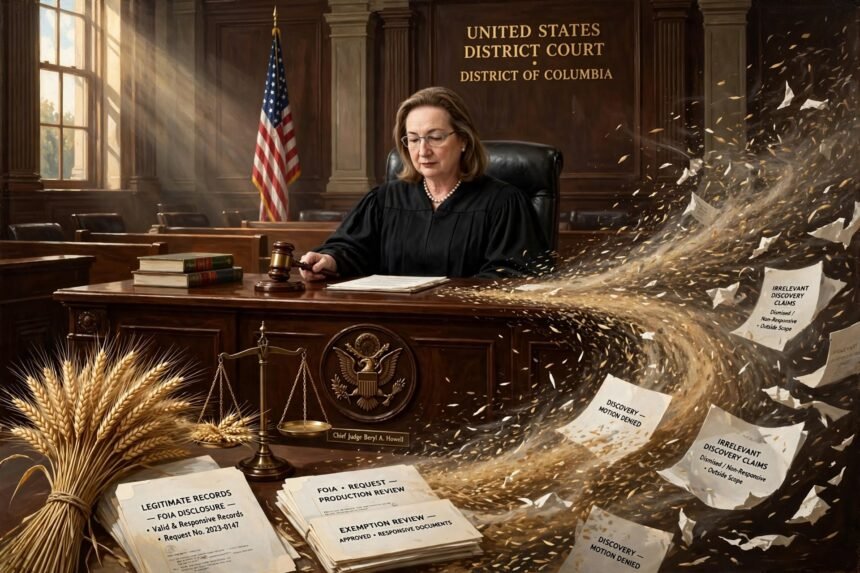
This is jurisprudential clarity at its finest. The wheat is the legitimate question of public records disclosure under American statutory exemptions. The chaff is the desperate attempt to hang onto straws, to weaponize a routine disclosure procedure and drag the respected US judiciary into the murky waters of Nigerian partisan politics.
The substantive dispute over FBI and DEA redactions will continue, as it should, under the law. But the attempt to use an American courtroom as an extension of a Nigerian campaign rally has failed.
The law has spoken, and it has spoken clearly.
HOWELL SEPARATES THE CHAFF FROM THE WHEAT
By Okoi Obono-Obla
The ruling of October 30, 2026 by Judge Beryl A. Howell of the United States District Court for the District of Columbia is a welcome restoration of legal common sense.
From the beginning, this matter was a simple Freedom of Information Act application — Aaron Greenspan asking American agencies whether they hold certain decades-old records and whether those records can be released under American law.
Yet, in the hands of political spin doctors and opposition megaphones in Nigeria, it was dressed up as something it never was: a criminal trial, an extradition plot, a final judgment on President Bola Ahmed Tinubu.
Judge Howell has now put the case back in its proper perspective.
By rejecting the bid for open-ended discovery against President Tinubu and DCI Group over extraneous allegations of cyberattacks, by denying the attempt at summary judgment and the irregular amicus intrusion, the court affirmed a basic principle: a FOIA proceeding cannot be converted into a fishing expedition or a political theater.
The court reminded all that FOIA is about two narrow questions — adequacy of search and justification for withholding — not about criminal liability, not about repatriation, not about 2027 election propaganda.
This is jurisprudential clarity at its finest. The wheat is the legitimate question of public records disclosure under American statutory exemptions. The chaff is the desperate attempt to hang onto straws, to weaponize a routine disclosure procedure and drag the respected US judiciary into the murky waters of Nigerian partisan politics.
The substantive dispute over FBI and DEA redactions will continue, as it should, under the law. But the attempt to use an American courtroom as an extension of a Nigerian campaign rally has failed.
The law has spoken, and it has spoken clearly.