
By Okoi Obono-Obla
In the decade between 1893 and 1905, British forces in what would become Southern Nigeria fought a series of short, sharp wars that were always called “punitive expeditions” in official dispatches. The language changed very little from place to place.
1. Benin – 1897
At the end of the 19th century, the Kingdom of Benin had retained independence during the Scramble for Africa, and the Oba exercised a monopoly over trade that the Royal Niger Company considered a threat.

Two justifications were advanced together:
a) Obstruction of free trade. Deputy Commissioner Captain Henry Galway had negotiated the Gallwey Treaty of 1892 to allow free passage of goods. Consul-General Macdonald considered the Oba’s continued demand for customs duties a hostile act and violation of the treaty.
b) Human sacrifice and barbarity. After Consul Richard Burton visited in 1862 he described Benin as a place of “gratuitous barbarity which stinks of death” – a narrative publicized in Britain to increase pressure for annexation.
c) Attack on a British column. In November 1896 Acting Consul-General James Robert Phillips decided to visit Benin City without waiting for approval from London. On 4 January 1897 at Ugbine village near Gwato his party was ambushed.
The party consisted of nine Europeans and about 230-240 African carriers and labourers. Seven out of nine white members including Phillips himself were ambushed and killed. Only two Britons survived. Most of the porters were also killed.
The response was the Benin Expedition of 9-18 February 1897, a force of 1,200 men under Sir Harry Rawson. The official result: Eight members of the punitive force were recorded as being killed in action; the number of military and civilian casualties amongst the Benin people was not estimated but is thought to have been very high. Contemporary British reports said hundreds of warriors died in failed attacks and “many more men, women, and children will also die after the British burn villages”. Other summaries put the toll as “over a thousand men and women were massacred” and the city burnt down.
2. Arochukwu – 1901-1902
The Anglo-Aro War (November 1901 – March 1902) followed the same script but on a larger scale in Igboland.
Allegations against the Aro:
High Commissioner Sir Ralph Moor gave four reasons to London:
To put a stop to slave dealing… to abolish the Juju hierarchy of the Aro tribe, which by superstition and fraud causes much injustice… The power of the priesthood is also employed in obtaining natives for sale as slaves and it is essential to finally break it; to open up the country… to civilization
The Aro Confederacy, through trade, kinship and the oracle of Ibini Ukpabi, stretched from the Cross River to the Niger. It opposed missionaries and colonial penetration. Just before the war, Aro forces led by Okoro Toti sacked Obegu, a British ally, which resulted in 400 people dying.
The Expedition:
The attack had been planned since September 1899 but delayed for lack of manpower. On November 28, Lt. Col. Arthur Forbes Montanaro led 87 officers, 1,550 soldiers and 2,100 carriers in four axes of advance to Arochukwu from Oguta, Akwete, Unwana and Itu.
Arochukwu was captured on December 28 after four days of fierce battles in and around the city, and the Ibini Ukpabi shrine was allegedly blown up.
Casualties: British losses are listed as ∼700–800 killed or wounded and Aro losses as “Heavy” – never officially counted. Guerilla fighting continued at Bende, Afikpo (1902-1903) and Ezza (1905).
3. Ekori and the Yakurr – 1898
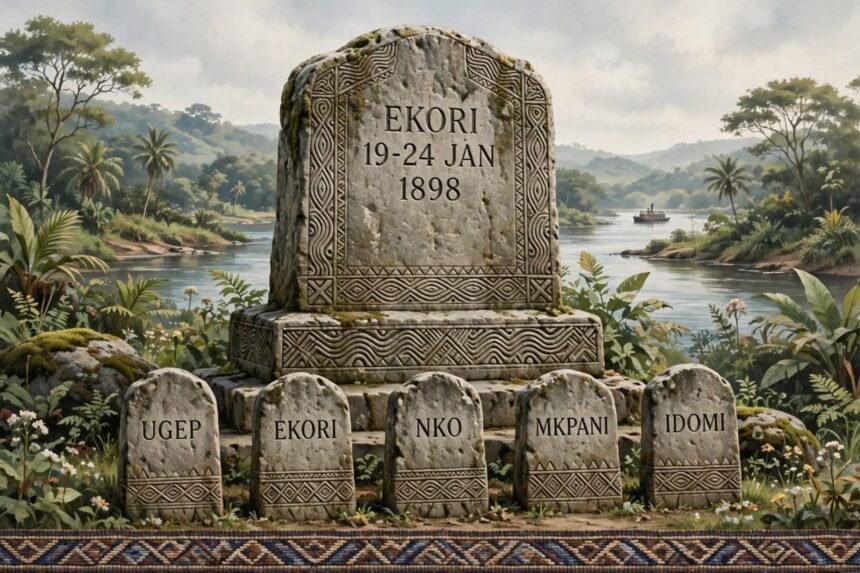
Ekori is the least known of the three because it was not a kingdom but one of five compact settlements of the Yakurr – Umor (Ugep), Ekori, Mkpani, Idomi and Nko – who had formed the Ngbeke Confederacy to enhance unity, security and trade on the Cross River.
As historian Otu Abam Ubi documents and a Unilag reconstruction repeats: The British punitive expedition of 1898, which was in fact an imperial conquest of Yakurr, did not allow the confederacy to succeed.
The Yakurr account places the pretext in the same family as Benin and Aro: that Ekori people had killed carriers or traders carrying goods to Ekori – in your note, 19 carriers/traders.
This fits the documented pattern for the Cross River in the 1890s:
In 1893 at Okurike, a group of five traders from the Afikpo people, paddling their canoe, laden with goods, on the river past Okurike, had been attacked, killed and beheaded, leading Macdonald to take gunboat Beecroft and 150 men to demand surrender.
In 1896 the Consul at Calabar dispatched an expedition under Captain Runpell to subdue Ediba for similar reasons.
The 1898 Yakurr expedition is therefore not an anomaly but the application of the same legal-moral formula used for Benin and Aro: allegation of murder of traders/carriers + allegation of human sacrifice/slavery + allegation of blocking legitimate trade = justification for military occupation, burning, and imposition of a Resident, and later confiscation of art and tribute.
Conclusion: A Formula
Whether the toll was 7 Europeans at Gwato, 400 dead at Obegu, 19 carriers on the road to Ekori, or 5 traders at Okurike, the administrative response was identical. A small incident on a trade route became evidence of a system – Long Juju, human sacrifice, or “obstruction” – that had to be destroyed to “open up the country to civilization.” The casualty figures on the Nigerian side were, as the British themselves wrote at Benin, never estimated.