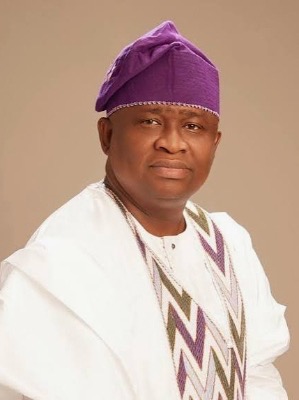



By Otunba (Dr) Abdulfalil Abayomi Odunowo
The Ogun State Government’s suspension of Oba Akintunde Akinyemi, the Eselu of Iselu Kingdom in Yewa North Local Government Area, raises troubling issues about fairness, consistency, due process, and the regard that should be accorded to traditional institutions in Yorubaland.
In a letter dated 20 October 2026 and signed by the Commissioner for Local Government and Chieftaincy Affairs, Hon. Ganiyu Hamzat, the State Executive Council relied on Section 52(1) of the Ogun State Obas and Chiefs Law, 2021. The decision came after complaints alleging overtly partisan political activity, some of which were reportedly publicised by the monarch himself. The suspension remains in force pending investigation. Oba Akinyemi was instructed to leave the palace, stop presenting himself as Eselu, and discontinue the use of any crown, ileke, beaded staff, irukere, or other insignia of office.
Traditional rulers are expected to remain politically neutral, uphold the dignity of their stools, and serve as fathers to all subjects regardless of political affiliation. That expectation is both well founded and deeply rooted. In pre-colonial Yoruba society, Obas held legislative, executive, and judicial powers within systems of checks and balances grounded in lineage and custom. Under colonial indirect rule, and later through successive post-independence constitutions, their formal political authority was steadily reduced, even as the expectation of non-partisanship remained. The 2021 Ogun law preserves that arrangement: partisan politics is regarded as contrary to customary law and is prohibited by statute because it can erode the dignity of the institution and disturb peaceful coexistence among subjects with different political loyalties.

Even so, that expectation must be enforced evenly and without favour. Public records indicate that, in recent months, a number of traditional rulers and councils in Ogun State have openly declared political preferences. In July 2026, the Ijebu Traditional Council of Obas, made up of 56 monarchs, unanimously endorsed the All Progressives Congress governorship candidate, Senator Olamilekan Adeola (Yayi), and his running mate, while also supporting Governor Dapo Abiodun’s bid for the Ogun East senatorial seat. The declaration was made at the Awujale’s Palace in Ijebu-Ode, and the Orimolusi of Ijebu-Igbo, Oba Lawrence Jaiyeoba Adebajo, spoke for the council. The late Awujale, Oba Sikiru Adetona, was also publicly cited as having expressed support for Adeola’s governorship ambition.
In August 2026, Awori traditional rulers, under the leadership of the Olota of Ota, Oba (Prof.) Adeyemi AbdulKabir Obalanlege, again affirmed support for Senator Adeola as their preferred 2027 governorship candidate, citing equity for Ogun West. Other monarchs publicly associated with that position included the Oloja Eku of Igbesa, Oba Abdulazeez Akinde, among several others. Earlier still, in March 2026, coronet Obas and traditional leaders in Ogun West publicly backed President Bola Tinubu’s re-election and Adeola’s governorship aspiration.
On the other side of the political divide, the Osile of Oke-Ona Egba, Oba (Dr.) Adedapo Adewale Tejuoso, in August 2026 received leaders and candidates of the Peoples Democratic Party, bestowed royal blessings on them, and announced the conferment of chieftaincy titles on several PDP standard-bearers, including the party’s governorship candidate.
These were public, documented actions. They show that political involvement by traditional rulers is not unusual. The relevant question, then, is whether the same standard has been enforced across the board. Why should one Oba be subjected to immediate suspension, exclusion from the palace, and deprivation of the symbols of office, while other comparable public endorsements appear not to have drawn similar consequences?
More fundamentally, was the action against Oba Eselu based strictly on proven breaches of the 2021 law, or were the questions he raised about local political developments also a factor in the decision?
These are legitimate questions, and the Ogun State Government, especially the Ministry of Local Government and Chieftaincy Affairs, ought to answer them openly. Government certainly has the authority to regulate recognised traditional institutions, but that authority must be exercised lawfully, fairly, proportionately, and with due regard for due process. An Oba is not above the law. But neither should the throne be exposed to selective administrative punishment.
Traditional institutions existed long before today’s political parties, and they will remain after the present administrations that now wield authority over them. Their lasting worth lies in their ability to remain above temporary partisan struggles.
I therefore call for a clear public explanation of the specific allegations against Oba Eselu, the exact legal basis and procedure followed under the 2021 law, and the standards applied in similar cases involving other traditional rulers. This matter goes beyond a single monarch. It touches on the dignity of the Yoruba traditional institution, equality before the law, and the duty of government to show that justice does not depend on whose political interests have been offended.
Respect for the throne must go hand in hand with accountability. Accountability must be matched by fairness. And fairness must never be surrendered to political convenience.
By Otunba (Dr.) Abdulfalil Abayomi Odunowo
October 25, 2026