
By Okoi Obono-Obla
Lagos was the headquarters of the opposition from 1999 to 2007, when Asiwaju Bola Ahmed Tinubu was Governor of Lagos State and the Peoples Democratic Party was the governing party at the federal level. At one point, overwhelmed by hubris, PDP National Chairman Chief Vincent Ogbulafor boasted in 2008 that the PDP would govern Nigeria for 60 years.
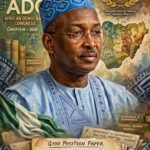
The opposition had rugged and shrewd leaders such as Muhammadu Buhari and Bola Ahmed Tinubu. They went back to the drawing board and came up with a strategy to outwit the PDP and make its leaders eat their words.
From 2007 to 2015, Tinubu operated from his political bunker in Ikoyi, Lagos, like a general, studying the political map of Nigeria to plot how the PDP would be defeated through the formation of a broad-based national party. The result was the All Progressives Congress, formed in 2013 from the merger of the Action Congress of Nigeria, Congress for Progressive Change, All Nigeria Peoples Party and a faction of the All Progressives Grand Alliance.

Nigeria revolves around Lagos to a large extent. Lagos was the capital of the Colony of Lagos and, from 1906, the capital of the Protectorate of Southern Nigeria. After the amalgamation of the Colony of Lagos and the Protectorates of Northern and Southern Nigeria on 1 January 1914, it became the capital of Nigeria. It remained so until 12 December 1991, when the Federal Capital was officially moved to Abuja.
Lagos remains the economic capital of Nigeria and one of the largest economies on the continent; if it were a country, its GDP would rank among the top 10 in Africa. It is a miniature Nigeria, with all its mosaic complexities reflected in it. With an estimated metropolitan population of over 16 million people, it has the largest voting population in the country and is therefore a political powerhouse and a swing state that can determine where the presidential pendulum swings.
Since 1999, no party other than those with a progressive bent and with the imprimatur of Asiwaju Bola Tinubu has had real traction in Lagos. That family has held the state continuously: Alliance for Democracy from 1999 to 2007, Action Congress and Action Congress of Nigeria from 2007 to 2013, and APC from 2013 to date. The foundation was laid in 1999 when Tinubu held sway until 2007 and ensured his protégé Babatunde Fashola succeeded him. The APC structure, buoyed by control of 20 Local Government Areas and 37 Local Council Development Areas, remains well-oiled.
President Tinubu’s economic reform agenda has had more impact in Lagos given its status as a metropolis hosting big tech businesses, headquarters of multinational oil corporations, headquarters of banks and other financial institutions, and ports. The decisions to float the national currency, remove subsidy on petroleum products, and reform tax administration have resulted in positive reviews by the World Bank, IMF and rating agencies. That review helps businesses in Lagos trade internationally, attract foreign direct investment, and enables business people to use cards issued by Nigerian banks abroad.
What INEC Has Now Published for 2027
The question of whether INEC has published candidates is now settled. INEC clarified that the final lists of presidential and National Assembly candidates were published on September 12, 2026, before the Supreme Court judgment delivered 13 days later. The final governorship list followed in early October, with a deadline of October 24, 2026 for parties that believe they were wrongly omitted to notify the Commission.
The September 24, 2026 Supreme Court judgment in INEC v. Zenith Labour Party upheld Section 77(5)-(7) of the Electoral Act 2026, which makes submission of party membership registers mandatory. INEC said it relied on that judgment when preparing the final governorship list, which is why some governorship candidates like Pantami and Adebutu were omitted.
Presidential – 18 candidates. INEC’s final list features 18 presidential candidates and their running mates. The list includes President Bola Tinubu of the APC with Kashim Shettima, former Vice President Atiku Abubakar of the ADC with Rotimi Amaechi, and Peter Obi of the Nigeria Democratic Congress with Rabiu Kwankwaso, and Seyi Makinde of the APM. The election is scheduled for January 16, 2027.
Governorship Lagos – 17 candidates. INEC published a final list of 17 governorship candidates for Lagos. The list includes Hamzat Obafemi of the APC, Adedeji Doherty of the PDP and Gbadebo Rhodes-Vivour of the ADC. Hamzat, who currently serves as Deputy Governor, is listed as the APC candidate, while Rhodes-Vivour, who contested the 2023 election under Labour Party, is now listed as ADC. Other names on the full PDF include candidates of NDC and other parties.
National and State Assemblies. The September 12 publication also covers the 3 Senate seats and 24 House of Representatives seats for Lagos, and the 40-member State House of Assembly. INEC’s House of Representatives final list already shows constituency-level contests, such as Surulere II.
Permutation: How Will Parties Stand?
Presidential in Lagos: In 2023, Peter Obi won Lagos with 582,454 votes to Tinubu’s 572,606. The factors that gave a fillip to the Obidient movement were youth mobilisation in Eti-Osa, Oshodi-Isolo, Alimosho and Surulere, urban discontent over cost of living, and the novelty of a credible third force.
In 2027, that vote is now split. Obi is in NDC, Atiku in ADC, Makinde in APM. If the opposition remains in three major blocs, APC has a structural advantage in Lagos despite its narrow loss in 2023. If there is a tactical alliance or one candidate steps down, Lagos becomes competitive again. Turnout will decide it.
Governorship: This is solid ground for APC. The progressive family has never lost Lagos since 1999. Even in 2023 when Labour won the presidential vote in Lagos, APC won 38 of 40 Assembly seats because it had polling-unit agents everywhere. Hamzat as APC candidate inherits that structure. Rhodes-Vivour in ADC must prove his 2023 Labour base will follow him to ADC, which is not automatic. The ADC governorship candidate may show flashes but faces an organizational gap. The PDP is broken, and even remnants are sympathetic to the President’s interest, as your earlier analysis noted.
State and National Assemblies: Presidential coattails matter. The candidate who wins Lagos at the presidential level on January 16 tends to pull Senate and House of Representatives candidates with him. For the State Assembly, incumbency and ward-level organisation are decisive. Unless NDC and ADC field candidates and fully fund agents in all 13,500+ polling units in Lagos, APC is likely to make a near clean sweep, as it did before.
In short, Lagos remains a miniature Nigeria and a political powerhouse. It was the opposition headquarters that produced the strategy that ended PDP’s 60-year boast. With INEC’s final lists now published, the battle lines are drawn: Tinubu/APC vs Atiku/ADC vs Obi/NDC for president, and Hamzat vs Rhodes-Vivour vs Doherty for governor. Whether Obi can re-enact 2023 in Lagos depends on whether his new NDC has the same organizational oil and labour sympathy that Labour had in 2023.