By Otunba (Dr.) Abdulfalil Abayomi Odunowo
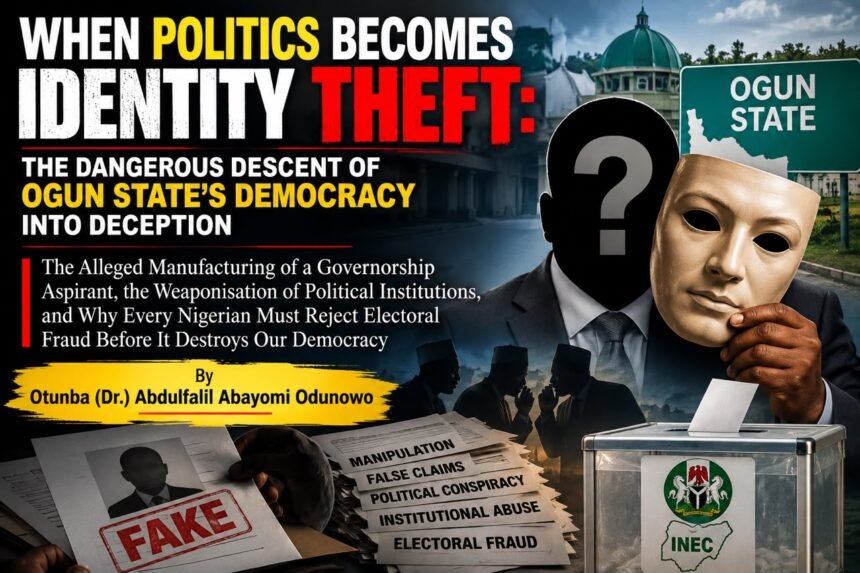
The Alleged Creation of a Governorship Aspirant, the Use of Political Institutions as Weapons, and Why Nigerians Must Resist Electoral Fraud Before It Ruins Our Democracy
Silence can no longer be mistaken for neutrality. At this point, it amounts to surrender.
When the quest for power becomes so shameless that a citizen’s name, identity, and legal personality can allegedly be used without his knowledge or consent, every conscientious Nigerian has a duty to speak plainly, openly, and without partisan bias.

The issue before us is neither minor nor nuanced. It is basic and profound:
How does someone become a supposed governorship aspirant in the records of a major political party and before the Independent National Electoral Commission without ever buying a form, attending a primary, or instructing a lawyer?
That is the troubling question at the centre of the controversy involving Mr. Topa Olusegun Peter, a PDP chieftain and the Baale of Olorunsogo, Ilara, in Imeko-Afon Local Government Area of Ogun State.
According to reports in national newspapers, Mr. Peter has publicly and firmly denied ever purchasing a governorship nomination form, taking part in any primary, or authorising any lawyer to pursue the PDP ticket for 2027 on his behalf. Yet only days before that denial, a lawyer who said he was acting for him had written to INEC seeking an explanation for why his name was left off the list of candidates.
This is far more than a procedural dispute. It is a striking contradiction that goes to the heart of electoral credibility. It requires an immediate, independent, and transparent investigation.
Let me state this plainly: political fraud, impersonation, the fabrication of candidacies, and the distortion of democratic institutions are unacceptable. They are unacceptable whether they are carried out by the APC, the PDP, the Labour Party, the ADC, or any other organisation. Democracy cannot endure when deceit is normalised as a tool of political contest.
A Citizen’s Identity Must Never Be Turned into a Political Tool
The gravest aspect of this matter is not simply the reported disagreement over a form. It is the possibility that the name and legal personality of a Nigerian citizen were used in service of an agenda he neither approved nor understood.
If he did not buy the nomination form, then who did?
If he did not sign a declaration of intention, whose documents were submitted?
If he did not take part in a primary, what records were created to suggest that he did?
If he did not brief a lawyer, who gave instructions to the lawyer acting in his name?
And if a candidacy was invented, who stood to gain politically?
These are not empty rhetorical flourishes. They are questions that go to the core of whether our electoral system still depends on voluntary participation or whether it has drifted into organised manipulation.
A candidacy must be real. Legal representation must be properly authorised. Once political identities can be taken over at will, democracy has already been damaged.
Claims of Cross-Party Inducement Must Be Examined, Not Ignored
Mr. Peter has alleged that some officials of the All Progressives Congress approached him with an offer connected to a position under the PDP. He specifically mentioned the APC chairman in Imeko-Afon Local Government Area, Mr. Ramoni Adebolu, and referred to later promises involving money, a vehicle, and a future appointment. The reported mention of Senator Solomon Adeola, widely known as Yayi, adds another layer of political seriousness.
These are still allegations. They have not been independently verified. There is no public evidence showing that Senator Adeola authorised, knew about, or took part in any improper arrangement. Everyone named is entitled to a response and to the full protection of due process.
Still, the gravity of the allegations makes silence from institutions indefensible. If the claims are false, the evidence should show that they are false. If they are true, the law should uncover those responsible, regardless of political influence, wealth, or closeness to power. No one should be beyond investigation.
Politics Must Not Become a Project of Destroying Opponents
Politics should be a competition of ideas, ability, and character: who can provide better education, healthcare, infrastructure, jobs, and security. Too often, however, it has collapsed into a struggle defined by sabotage, inducement, litigation, and the deliberate weakening of opponents.
Since when did the capacity to destabilise a rival party become a qualification for leadership?
When did manipulating the electoral process become more prized than presenting a credible development agenda?
When did the dignity and rights of ordinary citizens become expendable in the race for office?
Any political party that cannot win public trust through verifiable performance has no moral basis for seeking victory through deception. Success achieved by corrupting the process does not create legitimacy. It degrades the office and insults the electorate.
This Crisis Goes Beyond Party Politics
Some people will try to wave this away as just another chapter in the long-running contest between Nigeria’s major parties. That would be a grave error. The issue extends far beyond the PDP and the APC.
Today, the alleged victim is a PDP member. Tomorrow, it may be an APC member. The next day, it could be any independent-minded citizen whose identity is deployed as a weapon in a political conflict. What is really at stake is every Nigerian’s right to political association, personal dignity, and lawful participation in democratic life.
Political disagreement is legitimate. Political competition is necessary. Political deceit is indefensible. Loyalty to a party does not mean excusing wrongdoing. In some moments, true loyalty requires the courage to challenge it.
INEC and the Parties Must Reveal the Documentary Truth
This dispute is a direct measure of institutional openness. INEC must review the relevant nomination records without delay. Reports indicate that the legal correspondence claimed forms were bought on 12 May 2026, that a primary was held on 27 May, and that the individual’s name appeared on the PDP membership register. Mr. Peter’s public denial calls the basis of those assertions into question. Both versions cannot remain standing without resolution.
INEC must determine what documents were filed, who filed them, when they were filed, and on whose authority. The PDP must produce its nomination records and give a clear explanation of what it recognises as its valid primary process. The lawyer identified in the reports, Mr. Anderson Asemota, must have the opportunity to explain the basis on which he claimed to be acting. Professional confidentiality should be respected, but a genuine dispute over authorisation cannot simply be ignored.
If the evidence gives rise to a reasonable suspicion of criminal conduct, law-enforcement agencies must investigate. If professional misconduct is established, the appropriate disciplinary bodies must act. If forgery, impersonation, or deliberate fabrication is proven, the full weight of the law must follow, without political favour.
The Safety of Mr. Peter and His Family Must Not Be Overlooked
Beyond the electoral questions, there is also a human dimension. Mr. Peter has expressed concern about his own safety and that of his family. Although published reports do not establish any specific threat or identify who may be responsible, those concerns deserve proper assessment by the security agencies. No Nigerian should have to fear for his safety because he publicly denied involvement in a political arrangement. No citizen should be pressured into accepting an identity, political role, or legal representation he rejects. At the same time, those accused must also be protected from intimidation and prejudgment. Justice is meant to establish the truth, not replace one form of political pressure with another.
A Direct Test for Ogun State’s Political Leadership
Ogun State has produced many of Nigeria’s most distinguished intellectuals, administrators, professionals, and leaders. Its political culture should reflect seriousness and democratic maturity. In 2027, the people of Ogun deserve a contest rooted in competence and development, with clear answers on unemployment, roads, education, healthcare, agriculture, industrialisation, and security. They do not deserve an electoral atmosphere overshadowed by allegations of manufactured aspirants and opaque political dealings.
I therefore call on the leadership of the APC, the PDP, and every other political party in Ogun State to condemn, without qualification, any proven attempt to manipulate candidate nominations through deception. Those whose names have arisen in this controversy should address the allegations directly and support a credible investigation. The reputation of any political organisation cannot matter more than the integrity of the electoral process.
Power Without Integrity Is a National Threat
We must reject the corrosive idea that any method is acceptable so long as it delivers victory. That belief has already done deep harm to Nigeria. It has fostered impunity, weakened institutions, eroded public confidence, and pushed principled citizens away from political engagement. If we keep excusing political dishonesty simply because the alleged wrongdoers belong to parties we favour, we will eventually wreck the democratic order we claim to protect.
The controversy in Ogun State offers both a clear opportunity and a clear duty to draw a firm moral and institutional line. Let the allegations be investigated. Let the documents be scrutinised. Let the lawyer explain his purported instructions. Let those accused respond. Let INEC and the relevant political party account for the nomination records. And let anyone found culpable face the full consequences of the law.
No political ambition, no matter how powerful its backers may be, can justify the impersonation of a citizen, the invention of a candidacy, or the corruption of democratic institutions. Nigeria cannot construct a credible democracy on manufactured consent. Ogun State cannot build a respectable political future on deception. A victory won by corrupting the process is not a democratic triumph. It is an attack on democracy itself.
History will judge our generation not only by who won elections. It will also judge whether we had the courage to defend the truth when political convenience urged silence.
The moment to defend democratic integrity is not after an election has already been compromised. It is when we first recognise credible warning signs that the process itself is under threat.
Otunba (Dr.) Abdulfalil Abayomi Odunowo
Convener Ijebu Lokan fun itesiwaju Ijebu movement. Ijebu-Ode, Ogun State
18 October 2026
Note: The 15 October legal claim and 17 October public denial were reported by The Punch, The Guardian, Platform Times, and Nigerian Tribune. Allegations involving named APC officials remain unproven. This piece calls for a rigorous investigation; it does not pronounce guilt.