By Great Imo Jonathan
Nigeria stands at a crossroads between a future built on prudence, productivity, and integrity, and a continuation of waste, debt, and excuse. When the two leading political figures of this era are placed side by side on character, competence, and capacity, the contrast is clear. Peter Obi represents the leadership Nigeria needs to survive and thrive.
*1. Character and Integrity*
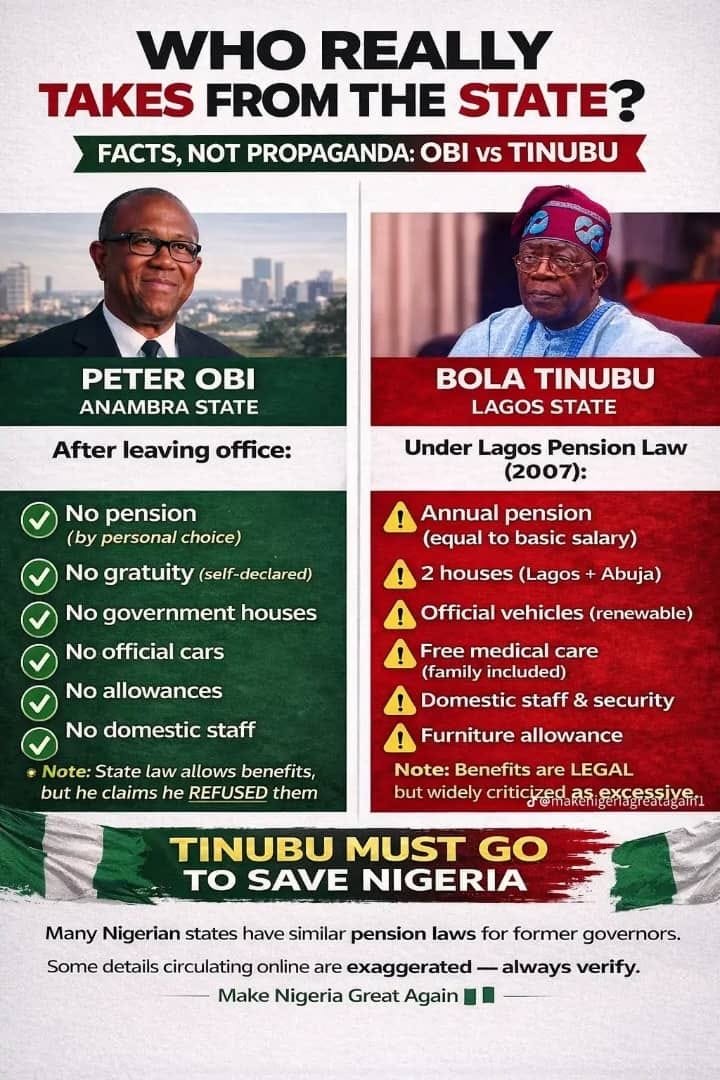
Leadership is character first. Peter Obi has built his public life around a simple, verifiable principle: public money is public trust. As Governor of Anambra State, he left office without converting state assets to personal property and without a trail of corruption cases. His lifestyle is modest, his public declaration of assets has been consistent, and his name has never been synonymous with primitive accumulation. Nigerians know what he owns and how he earned it.
*2. Background and Business Experience*
Obi is not a career politician who discovered business after power. He is a businessman who was invited into politics. As Chairman of Next International, and as a former Chairman of Fidelity Bank, he understands trade, banking, supply chains, and the real economy. He built businesses, met payroll, managed risk, and competed in the market. That experience matters because Nigeria does not need a political accountant to share oil rents; it needs a producer who knows how to create wealth, cut waste, and grow the private sector.
*3. Education and Exposure*
Peter Obi combines local and global education with real-world exposure. A graduate of the University of Nigeria, Nsukka, he has complemented his degree with executive education at Harvard Business School, London School of Economics, Columbia, Cambridge, and IMD Switzerland. This gives him a rare mix: he understands Onitsha Main Market and Wall Street. He can speak to the small trader and the IMF with equal clarity.
*4. Prudence and Fiscal Discipline*
This is Obi’s greatest distinction. At a time when states were borrowing to pay salaries, Anambra under Obi left over N75 billion in savings — N27 billion in cash and over $156 million in domiciliary investments, verified by the bank statements he published. He did not borrow a kobo for eight years. He cut the cost of governance, refused to inflate contracts, and invested in measurable needs. While the current administration under Bola Tinubu has pushed Nigeria’s debt profile beyond sustainable limits, removed subsidies without a production cushion, and increased the cost of governance through a bloated convoy and budget, Obi’s record shows that you can govern without borrowing Nigeria into bankruptcy.
*5. Courage to Do the Right Thing*
Prudence requires courage. Obi had the courage to tell Anambra people that he would not share money at the expense of building schools and hospitals. He had the courage to return unspent budgetary allocations instead of looting them through last-minute contracts. He has the courage today to say the difficult truth to Nigerians — that we must stop consuming what we do not produce, that fuel subsidy is organized crime that must end but only after production and refineries are fixed, and that we cannot continue to defend an exchange rate system that rewards cronies.
*6. Accurate Data and Deep Knowledge of Nigeria’s Problems*
Peter Obi does not govern by guesswork. He governs by numbers. He can tell you the number of out-of-school children, the exact poverty rate in the North, the yield per hectare of rice in Nigeria versus Vietnam, the number of megawatts generated, and the cost per child for basic healthcare. He doesn’t read speeches written by aides who don’t understand the economy. He speaks from data. His diagnosis of Nigeria’s crisis — low productivity, high waste, weak human capital, and a lack of competitiveness — is accurate because it is data-driven.
*7. Clear, Actionable Plans*
Finally, knowledge without a plan is noise. Obi’s plan is consistent and has been consistent for over a decade:
– *From Consumption to Production:* Industrialize through SMEs, agriculture, and export-led manufacturing.
– *Human Capital First:* Massive investment in education and health as the true engine of growth, not roads that lead nowhere.
– *Pull People Out of Poverty:* Support smallholder farmers and artisans with credit, market access, and technology.
– *Rule of Law and Securing the Nation:* Unite the country and secure it through proper policing, not through rewarding banditry.
– *Cut Waste to Fund Growth:* Oronsaye Report implementation, reducing cost of governance, and blocking leakages.
In summary, Bola Tinubu represents the old politics of entitlement, extravagance, and trial-and-error economics. Peter Obi represents the new Nigeria of frugality, statistical governance, production, and moral clarity.
Nigeria does not need a boss. It needs a prudent manager, an honest custodian, and a visionary builder. That is why Peter Obi is far better for Nigeria.
Great Imo Jonathan