
By Otunba (Dr) Abdulfalil Abayomi Odunowo
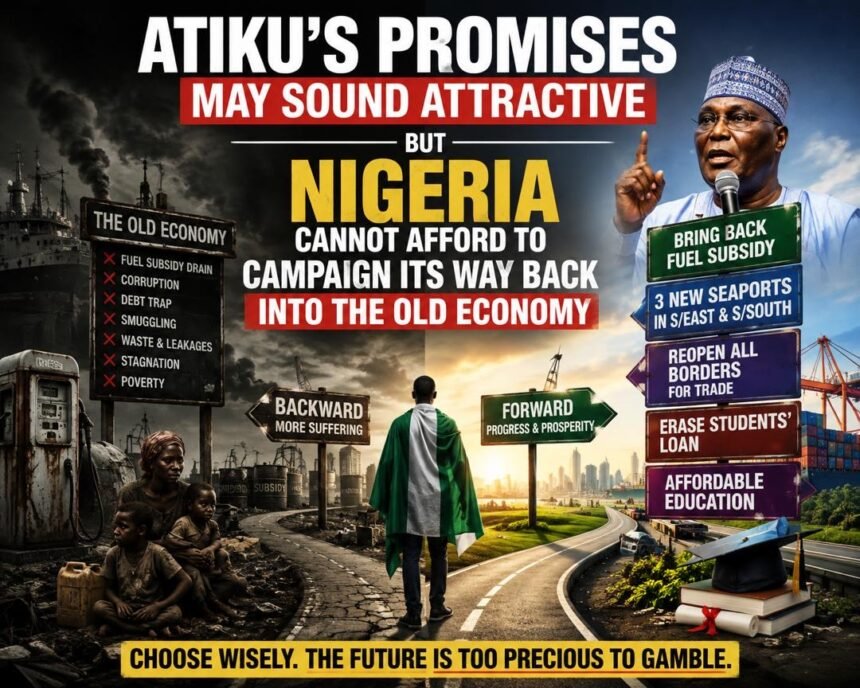
Nigerians are living through genuine economic hardship. In that kind of climate, any politician offering cheaper petrol, free education, debt cancellation, and unrestricted borders will, naturally, command attention.
Elections, though, have to be about more than crowd-pleasing promises. The key questions are both simpler and tougher: How will these promises be financed, and what becomes of the economy after the applause fades?
On petrol subsidy

It is perfectly legitimate to argue that the way subsidy was removed imposed severe hardship, and that stronger social protection ought to have come with the reform. It is just as legitimate to interrogate the old subsidy regime itself. For years, Nigerians were told that enormous volumes of petrol were being consumed and subsidised, even as allegations of inflated figures, dubious payments, smuggling, and weak accountability refused to disappear.
So, simply saying “I will bring back subsidy” is not, by itself, a win for ordinary citizens. The real questions still stand:
* What type of subsidy?
* How much will it cost each year?
* Who, exactly, will benefit from it?
* How will fraud and cross-border arbitrage be stopped?
* Where will the money come from?
Nigeria has already paid heavily for the reforms of the past three years. Reversing them without a carefully thought-out alternative risks throwing away the gains after the public has already borne the pain.
There are now measurable signs of macroeconomic stabilisation. Inflation, while still high, has dropped meaningfully from earlier peaks. Foreign reserves have improved. The foreign-exchange market is functioning more orderly. The current account remains in surplus, and domestic refining has reduced reliance on imported petroleum products. These gains have not yet translated sufficiently into better living standards, and that is precisely where the government deserves rigorous scrutiny. Still, the answer cannot be to rebuild the very economic structure that helped produce the original crisis.
On student loans
The promise that beneficiaries will “not pay shishi” is politically attractive. Cancelling existing student loans, however, leaves the bigger question unanswered: How will tertiary education be financed sustainably for the next generation?
A properly designed student-financing system can widen access without forcing government to pay for every student’s education entirely from current revenue. If the present scheme has flaws, then reform it: protect unemployed graduates, make repayment income-contingent, expand scholarships and grants for the poor and exceptional, and increase university funding. Turning every loan into a political giveaway risks wrecking the revolving mechanism meant to support future students.
On reopening all borders
Nigeria should aggressively encourage legitimate regional and cross-border commerce. But simply announcing that “all borders will be reopened” is not an economic policy. The country must, at the same time, confront smuggling, customs leakages, arms trafficking, illegal migration, and the protection of domestic agriculture and manufacturing. The goal should be efficient borders, technology-driven customs administration, faster legitimate trade, and stronger security, not uncontrolled borders.
On three new seaports
Developing additional ports in the South-East and South-South can amount to sound infrastructure policy where commercial viability, connectivity, and cargo demand justify the investment. Ports, however, cannot just be campaign talking points. Serious planning calls for answers to basic questions: Where will they be located? What are the projected cargo volumes? What will they cost? Will they be publicly financed or developed through public-private partnerships? What rail and highway links will connect them to Nigeria’s industrial and commercial centres?
Nigeria should not choose between hardship and populism
President Tinubu’s reforms are not above criticism. Government must explain far more clearly where the fiscal savings from subsidy removal are going. Citizens are entitled to demand transparency, less waste, stronger accountability, and visible improvements in healthcare, education, transportation, electricity, and social protection. If Nigerians were asked to endure painful reforms, then the benefits of those reforms must, eventually, show up in their daily lives.
There is, however, an equally dangerous alternative: promising to reverse difficult reforms simply because elections are drawing near. Nigeria cannot keep reforming, absorbing the pain, abandoning the reform midway, returning to the old system, and then launching yet another crisis-management programme a few years later.
The better conversation for 2027, then, is not:
“Who will bring subsidy back?”
but
“Who has the most credible plan to make energy affordable without recreating an opaque subsidy system?”
Not
“Who will cancel student loans?”
but
“Who can permanently finance quality education for millions of Nigerians?”
Not
“Who will open every border?”
but
“Who can expand regional trade while protecting Nigeria’s security, revenue, and productive economy?”
That is the line between campaign populism and sustainable economic policy.
Nigeria has already paid dearly for economic adjustment. The country should now focus on converting emerging macroeconomic stability into jobs, cheaper food, affordable transportation, reliable electricity, productive industries, and higher household incomes.
The most important lesson is this: we should never again rebuild an economic system simply because we have forgotten why we were compelled to reform it in the first place.
Signed
Otunba (Dr) Abdulfalil Abayomi Odunowo
National Chairman AATSG
Asiwaju Ahmed Tinubu Support Group.
Saturday 29th August 2026.