

By Okoi Obono-Obla
Commission of Inquiry as a Lasting Solution to Communal Conflicts in Cross River State:
Early today, 4 July 2026, my friend Philip Obin shared a distressing message with me on WhatsApp, accompanied by grisly images of a young man who was killed. His words read:
“Let it be on record that today, 4 July 2026, armed persons from Egbor Community in Erei South, Biase LGA, together with their collaborators, invaded the farmland of my community, Urugbam. During the unprovoked attack, Mr. Obong Ikor Obong was shot and killed, while several other persons sustained gunshot injuries. As of the time of this report, the local, state, and federal governments have taken little or no visible action in response to this violent incident. My name is Philip Obin.”
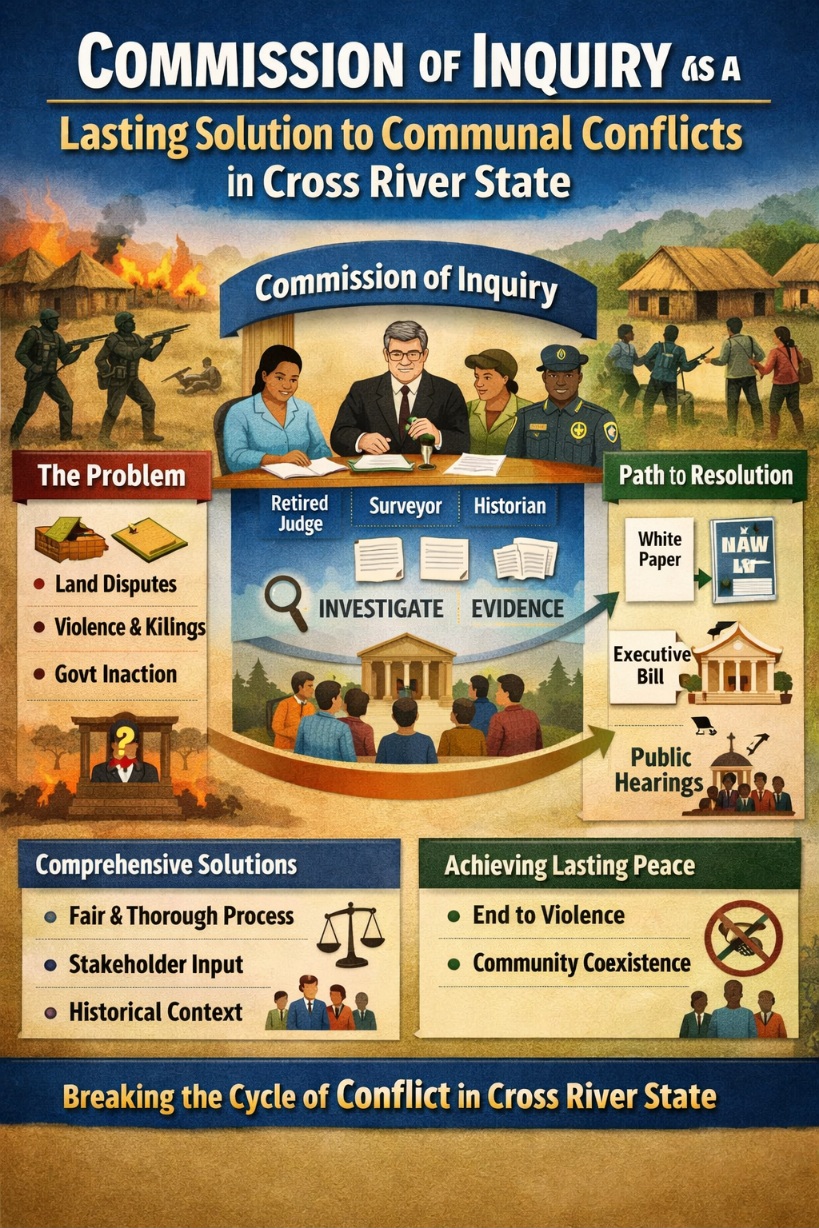
Cross River State has long been rocked by communal conflicts and violence arising from struggles over land rights between communities sharing boundaries in Yakurr, Obubra, Biase, Ikom, and Boki Local Government Areas. It has become imperative that the Government of Cross River State invoke the powers vested in it by law to constitute a Commission of Inquiry, rather than attempting to redraw boundaries that have existed for centuries—long before colonialism and the birth of Nigeria on 1 January 1914.
The Commission should be headed by a retired Judge of the High Court or Court of Appeal. Its membership should include surveyors, security professionals, estate valuers, historians, geographers, and anthropologists. It must be vested with the authority to receive evidence from adversaries and members of the public, and thereafter make recommendations to government. Upon receipt of these recommendations, government should set up a committee of senior civil servants to study the findings and reach a conclusion, which will then be gazetted as a White Paper. This White Paper would represent government’s official position on every communal or inter‑communal conflict that has occurred in the State over the past twenty years, where decisive action has been lacking.
Alternatively, the White Paper can serve as the kernel of an executive bill to be prepared by the Cross River State Government and laid before the Cross River State House of Assembly for passage into law. In carrying out its legislative procedure, the House of Assembly will hold public hearings to gather feedback and inputs from the people of Cross River State, which will then be incorporated into the bill before its passage. This process ensures inclusivity, transparency, and legitimacy in resolving disputes.
Government’s current approach—arbitrarily directing the Surveyor General of Cross River State to delineate or demarcate disputed lands without meaningful deliberations with stakeholders or rightful landowners—cannot resolve the problem. Such a superficial measure is akin to treating cancer with paracetamol. In medicine, every chronic disease requires comprehensive therapy, not surface treatment that inevitably leads to relapse. Likewise, communal conflicts demand deep, structured, and inclusive solutions.
Conclusion
The establishment of a Commission of Inquiry, followed by the issuance of a White Paper or the enactment of an executive bill, offers a credible and lasting framework for peace and justice in Cross River State. It ensures that disputes are resolved through evidence, fairness, and historical context, rather than arbitrary boundary adjustments. Only through such a process can the cycle of violence be broken and communities begin to coexist peacefully.













Leave a comment