Project 2025 Agenda and Healthcare in Nigeria
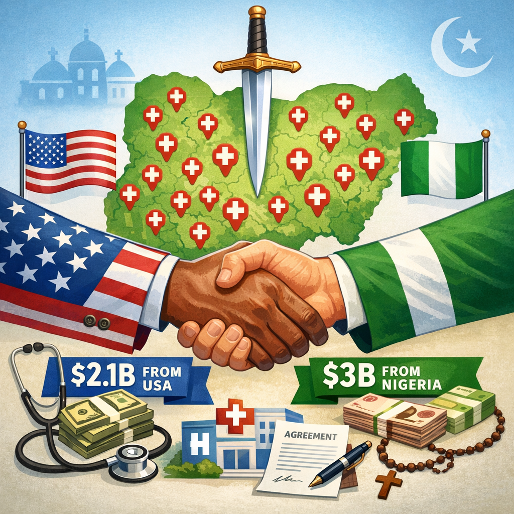
The US and Nigeria signed a five-year $5.1B Memorandum of Understanding (MoU) on December 19, 2025, to boost healthcare and support faith-based facilities in Nigeria. It was stated to advance the “America First Global Health Strategy”. This was touted to represent the largest co-investment any country has made under the global health strategy.
Within this framework of the MOU, the US will provide $2.1B in health assistance while Nigeria will commit $3B in domestic health spending. Of this amount, $200M will be earmarked for 900 Christian faith-based health facilities, which serve over 30% of Nigerians despite being only 10% of the providers.
The MoU explicitly ties US support to:

1. Protecting Christian populations from violence.
2. Alignment with US national interests, with the US President/Secretary of State retaining the right to pause or terminate programs.
This is the clearest articulation now of how “American First” agenda is being operationalized in global health in line with Project 2025.
This was an aftermath to a threat by President Trump on November 1, 2025, in which he stated that if the Nigerian government continues to “allow the killing of Christians” that the US would stop all aid and potentially intervene with “guns-a-blazing”. He also instructed the US department of War (Defense) to prepare for possible action and describing a potential attack as “fast, vicious, and sweet”. This was part of a grand move to redesignate Nigeria as a “country of particular concern” with accusations of severe violations of religious freedom. Subsequently, on December 25, 2025, the US President stated that the US launched a “powerful and deadly strike” against ISIS in northwest Nigeria and with further threats from him of more actions if the killings of Christians should continue. The frivolous allegations that Christians were being slaughtered in Nigeria were countered by many including the Nigerian president and that the terrorist attacks affected both Christians and Muslims in the country.
It is evident that the MoU is a carrot and stick diplomatic game to make the Nigeria government kowtow to the bully by an American President and in line with the Project 2025 agenda.
How “America First” Shaped the MoU
The MoU is not a neutral health-sector investment because it is framed as:
1. Tool to protect American lives by reducing global disease spread.
2. A mechanism to advance US foreign policy priorities, especially religious-freedom-oriented diplomacy.
3. A shift toward bilateral, conditional, interest-aligned aid, not multilateral development assistance.
This is where the link to Project 2025 becomes relevant.
Pros and Cons – Strategic, political and health system impact
The Pros:
1. Strengthens Nigeria’s health system in high-burden area: This will target HIV, TB, malaria, maternal and child health which are all areas where Nigeria faces extreme global burdens.
2. Leverages faith-based providers that already deliver 30% of care: This is especially where those facilities are often the only functional providers in rural and conflict-affected regions.
3. Aligns incentives towards Nigeria increasing domestic spending: The $3B domestic commitment pushes Nigeria toward greater ownership and sustainability. This may create a downward stream of benefit not just the Christian communities but also to the Muslim communities.
4. Enhances disease surveillance and outbreak response: This directly benefits both countries by reducing cross-border health threats. But this may be further enhanced by limits being placed on issuance of US visitors’ visas to Nigerians by primarily reducing the volume of travelers, which could reduce the immediate spread of communicable diseases, but simultaneously hinder the necessary, collaborative, and, for some, critical care-based, cross-border health interactions.
5. Politically stabilizing for US-Nigeria relations: Despite diplomatic friction like religious freedom designations, the scale of the deal signals Nigeria remains a priority partner.
The Cons:
1. Strong religious framing risks sectarian tension: $200M explicitly for Christian facilities may be perceived as favoritism in a religiously polarized country. This can further escalate attacks against Christians and such facilities. Could this then lead to the US implementing further attacks against Nigeria as was threatened by President Trump. This may create consequences that may attract ISIS sympathizers to what they may think as a jihad war as we have seen happened in Iraq, Syria and other places where the US military intervened under the premise of routing out ISIS members.
2. Conditionality tied to US national interest: The US can pause or terminate programs if Nigeria is deemed non-aligned with American priorities. This becomes a diplomatic Sword of Damocles that may threaten the sovereignty of Nigeria and could lead to Nigeria becoming a pawn in the hands of the US government limiting her ability to promote areas for her own national integrity and benefits.
3. Potential erosion of Nigeria’s health sovereignty: Heavy US influence on provider selection, priorities, and reporting structures could in fact create a subservient health care system that may not address key Social Determinants of Health (SDH) peculiar to Nigeria and better understood by Nigeria. It will be a quasi-Americanization of the Nigerian health care system that will benefit the US but of less benefit to the Nigeria public. One can see this from past activities of USAID in which most of its activities were contracted to US companies and not to local Nigerian companies making much of the fund provided to leave the country and not benefit the local communities.
4. Could weaken public-sector health investment: If faith-based facilities receive disproportionate support, public hospitals may fall further behind. All the tertiary hospitals involved in research and education of medical personnel are public funded and may also be affected. This could create a boomerang effect on research, medical student training, medical resident training, etc. The consequence for this could be long-term,
5. Embeds US ideological goals into Nigeria’s domestic policy: This could be through many undertone diplomatic pressures and threats especially around religious freedom enforcement and Christian protection measures. This can also be used in disguise for other bullying tactics involving Nigeria’s economic independence and international relationship with other countries.
Relevance to Project 2025
The overarching influence of Project 2025 is evident in most of the decisions by the Trump government and manifested in its American First Global Health Strategy which sometimes veered into other areas outside health.
1. A shift from multilateralism to bilateral, interest aligned aid: Project 2025 advocates reducing US participation in global institutions and prioritizing bilateral deals that advance US interests. Recently, the US withdrew totally from the WHO and from some UN agencies which will further hamper issues of healthcare delivery in Nigeria. The MoU explicitly stated this bilateral outlook in its policy as part of the American First Global Health Strategy.
2. Prioritizations of Christian institutions abroad: Project 2025 emphasizes global religious freedom, Christian protection, and support for Christian-run institutions. The MoU dedicates $200M to Christian facilities and ties funding to Nigeria’s reforms protecting Christian populations.
3. Conditionality and leverage: Project 2025 encourages using foreign aid as leverage to shape partner-country policy. The MoU allows the US to pause or terminate programs if Nigeria’s actions diverge from US national interests. Countries like South Africa, Tanzania and the Democratic Republic of Congo (DRC) refused to sign the US American First Global Health Strategy MoUs despite historically receiving PEPFAR funding in the past. These countries did not want to be pushed into a cul-de-sac enabling the US bullying tactics and loss of their own independent health care decision making.
4. Domestic political signaling: The MoU reinforces that –
a. US aid must benefit Americans first.
b. Aid must align with conservative values.
c. Aid must protect persecuted Christians abroad
These are the central themes in project 2025’s foreign policy chapters.
The Alternatives to US America First Global Health Strategy MoU with Nigeria
1. Millenium Challenge Corporation (MCC) health-related work
· Mission: Reduce poverty through economic growth, via 5-year compacts with eligible countries.
· Selection: Countries must score well on 17 indicators across ruling justly, investing in people, and economic freedom.
· Model:
i. Partner countries identify binding constraints to growth and propose compact programs.
ii. Emphasis on country ownership, transparency, evidence, and Monitoring and Evaluation (M&E).
iii. Funds are grants, committed up front; compacts are time-bound (five years).
· Health: MCC is not a health agency, but health/WASH/infrastructure investments occur when shown to be growth constraints.
The MCC is distinct from the US MoU by being most technocratic, depoliticized of the alternatives and the MoU as it was explicitly designed to be insulated from day-to-day US foreign policy maneuvering. The strongest rhetorical and operational commitment to country ownership and leadership, including local accountable entities, and untied procurement. And health, when funded, is justified via growth and productivity, not humanitarian or ideological narratives.
2. China’s Health Silk Road (HSR) / Belt and Road Initiative (BRI) health diplomacy
· Health Silk Road (HSR): is a branch of BRI that was introduced around 2015-2016 and was formalized through an MoU with the WHO; aims to strengthen health infrastructure, capacity, and cooperation.
· Instruments:
i. Hospital construction and refurbishment.
ii. Medical supplies and Personal Protection Equipment.
iii. Vaccine diplomacy (especially during COVID-19).
iv. Emerging focus on high-tech, digital health, IoT, telemedicine, etc.
· Motives: Economic interest, diplomatic influence, reputation building, regional stability, and health security.
· Risks and critiques:
i. Concerns about debt sustainability, transparency, quality of infrastructure, and geopolitical leverage.
ii. Often bilateral and state-centric, using BRI logistics networks and political channels.
iii. Ses health as both assistance and strategic positioning, especially amid US-China competition
From a Project 2025 lens, the US-Nigeria MoU is the clearest instantiation of using health aid as ideologically filtered leverage, more akin in style to China’s strategic health diplomacy, but with a Christian-protection and America-first orientation rather than non-interference rhetoric.
The MCC push toward country ownership, at least in form. While China speaks the language of mutual benefit and South-South cooperation but often relates tight state-to-state control. The US-Nigeria MoU, despite Nigeria’s large co-investment, is highly US-steered in target (Christian facilities) and narrative, raising sharper questions about health sovereignty than traditional PEPFAR that has been defunded by the US government or even the MCC.
There will always be the question of a sovereign stress test which is by asking whether Nigeria is moving from donor-led biomedical verticalism of PEPFAR to ideological conditioned health dependence, and what institutional safeguards would be required to convert this US-Nigeria MoU into a genuine co-ownership rather than an aligned subordination.
Conclusion
The MoU is both a health investment and a geopolitical instrument. It may improve Nigeria’s health system in meaningful ways, especially in underserved areas. But it also embeds US ideological priorities, particularly Christian-focused aid and conditionality, in a way that mirrors the strategic logic of Project 2025. This could create further tension between different religious groups in Nigeria.
Therefore, the MoU is a health agreement on the surface but a foreign-policy signal underneath. And the Nigeria government should be “Caveat Emptor” (Buyer Beware).
The exploration of the two other alternatives was discussed for the readers to make a judgment whether the Nigerian government was coerced into the US-Nigeria MoU or if the China HSR or the MCC were options that could have been explored further as was done by other countries that rejected the America First Global Health Strategy MoU.
Dr. Segun Dawodu is the owner and chief webmaster of Dawodu.com. He has a medical degree from University of Ibadan, MBA from Johns Hopkins University Carey Business School, MSc in Global Health Leadership from University of Oxford, LL.B from University of London, MS in Clinical Informatics from Northwestern University, Evanston, IL, LL.M in Medical ethics/Intellectual property law from University of London, LL.M in International Corporate and Commercial Law from Kings’ College, London, LL.M in US law from George Mason University, Postgraduate Diploma in Economics of Law/Antitrust Law from King’s College, London, Creative Writing Diploma from University of Pennsylvania and Associate of Kings College ( a Bachelor’s degree equivalent in Theology, Philosophy and Ethics). He is currently undergoing Ph.D (law) research in Telemedicine, AI and cross-border policy and regulations at University of London, Institute of Advanced Legal Studies.