
By Chief Akinwumi Akinfenwa
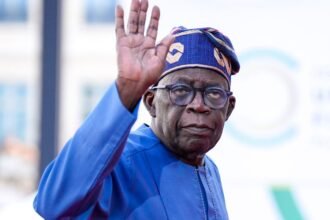
There is something fundamentally unusual about the political conversation surrounding President Bola Ahmed Tinubu and the All Progressives Congress (APC) as Nigeria approaches another electoral cycle.
A sitting president, whose party has governed Nigeria since 2015, ought ordinarily to approach the electorate with a compelling record of achievements, measurable outcomes, completed projects, fulfilled promises and a convincing account of how its policies have improved the lives of citizens.
After all, the APC has enjoyed almost twelve years in control of the Federal Government. It has had eight years under President Muhammadu Buhari and, since May 2023, the continuing opportunity to govern under President Tinubu.
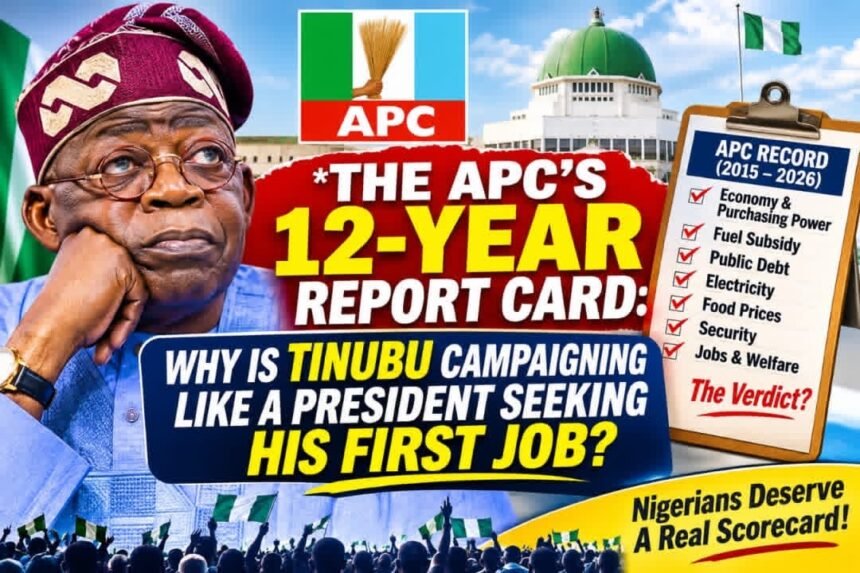
Yet, listening to the political arguments emanating from the President’s campaign platform, one is confronted with a rather curious spectacle: a sitting president who sometimes sounds more like an opposition candidate campaigning for his first opportunity to govern than an incumbent seeking renewal on the strength of an established record.
The question that naturally arises is simple: After almost twelve years in government, what exactly is the APC asking Nigerians to applaud, and what does it consider its defining legacy?
This is not a question of political hostility. It is a question of democratic accountability.
*THE CONVENIENT EXCUSE OF SIXTEEN YEARS*
For years, the APC’s most frequently deployed political argument was that the Peoples Democratic Party (PDP) had destroyed Nigeria during its sixteen years in power, between 1999 and 2015.
The narrative was consistent. Nigeria’s economic difficulties, unemployment, infrastructural deficits, corruption, insecurity and institutional weaknesses were presented as the consequences of PDP mismanagement.
The APC promised a departure from that experience. Nigerians were assured that a new political direction would restore national confidence, strengthen the economy, create employment, improve security, defeat corruption and make life more meaningful for ordinary citizens.
Muhammadu Buhari and Bola Ahmed Tinubu were both central figures in the political coalition that sold this promise to Nigerians.
They campaigned across the country, mobilising citizens with assurances of change and national renewal.
Nigerians listened. They voted. The APC assumed power in May 2015.
But here is the uncomfortable question: after almost twelve years, can the APC still attribute Nigeria’s difficulties principally to the PDP’s sixteen years in government?
At what point does inherited responsibility become present responsibility?
A political party cannot reasonably ask to be judged by its promises when seeking power and then ask to be excused from judgment when those promises remain unfulfilled.
You cannot campaign on the failures of your predecessors indefinitely when you have become the predecessor of another generation of Nigerians.
*THE ECONOMY: MACROECONOMIC RECOVERY OR IMPROVEMENT IN LIVING STANDARDS?*
One of the most important distinctions in economic management is the difference between improving economic indicators and improving the material circumstances of the population.
A country can record positive GDP growth while millions of its citizens struggle to afford food, transport, housing, healthcare and education.
This distinction is particularly important in evaluating Nigeria’s economic experience.
The World Bank’s October 2026 Nigeria Development Update reports that Nigeria’s real GDP grew by 4.2 per cent in the first half of 2026, compared with 3.9 per cent in the corresponding period of 2025.
That is a positive development and deserves acknowledgement.
However, the same institution estimates that 69.6 per cent of Nigerians lived below the lower-middle-income poverty threshold of $4.20 per day in 2025. It further estimates that 50.8 per cent, representing approximately 123 million Nigerians, lived in extreme poverty.
The implication is profound.
Economic growth is happening, but the benefits are not yet reaching enough households in a meaningful way.
The World Bank has also observed that growth remains insufficient to generate enough productive employment and materially reduce poverty.
This is where the real test of economic leadership lies.
The President cannot simply point to GDP growth and expect a market woman, a civil servant, a small business owner, a pensioner or an unemployed graduate to interpret that figure as evidence of improved living conditions.
The economy must work for the people, not merely look better in economic reports.
A nation is not economically healthy simply because its national accounts show growth. Its people must be able to feel that growth in their pockets, on their dining tables and in their quality of life.
*THE FUEL SUBSIDY QUESTION: WHERE IS THE PROMISED DIVIDEND?*
On 29 May 2023, during his inaugural address, President Tinubu declared that fuel subsidy was gone.
He defended the decision on the grounds that the subsidy regime was increasingly costly and disproportionately benefited the wealthy.
More importantly, he made a commitment that the resources saved would be redirected into public infrastructure, education, healthcare and employment opportunities that would materially improve the lives of millions of Nigerians.
That was a significant policy undertaking.
There is a legitimate argument for reforming a subsidy system characterised by leakage, opacity, diversion and opportunities for rent-seeking. No serious economic discussion should pretend that the old arrangement was beyond reform.
But removing a defective system is only half the responsibility of government.
The other half is ensuring that the people who bear the immediate cost of the reform receive tangible protection and benefits.
The critical question is therefore not simply whether subsidy was removed. It is whether the promised social and economic dividends have been delivered at a scale commensurate with the sacrifice demanded of Nigerians.
Where are the clearly identifiable, independently verifiable accounts showing how much has been saved, how much has been allocated, how much has actually been spent and what measurable benefits have accrued to ordinary households?
What proportion has gone into mass transportation, affordable healthcare, public education, rural infrastructure and targeted support for vulnerable Nigerians?
How many households can confidently say that the removal of subsidy has been offset by a corresponding improvement in their economic circumstances?
Government must understand that citizens cannot indefinitely finance economic reforms through increased hardship while waiting for benefits that remain difficult to identify.
The reform debate must move beyond announcements to transparent accounting and measurable results.
A government cannot ask citizens to celebrate the removal of a benefit while failing to demonstrate, convincingly, the replacement benefits they were promised.
*THE DEBT QUESTION: WHAT ARE NIGERIANS BORROWING FOR?*
Nigeria’s public debt has become another important measure of the country’s fiscal direction.
According to the Debt Management Office, Nigeria’s total public debt stood at approximately ₦87.38 trillion in June 2023.
By 30 June 2026, the figure had risen to approximately ₦166.79 trillion.
That is an increase of roughly ₦79.41 trillion in nominal naira terms.
This comparison requires an important qualification: exchange-rate movements, the naira valuation of foreign debt and changes in the debt portfolio affect the naira-denominated figures. Consequently, the increase should not be interpreted as entirely new borrowing.
Nevertheless, the scale of the public debt demands serious scrutiny.
The International Monetary Fund’s June 2026 assessment estimated that interest payments would consume approximately 53.7 per cent of Federal Government revenue in 2026.
Consider the implications.
More than half of government revenue is projected to go towards interest payments alone, leaving a constrained fiscal space for roads, schools, hospitals, security, social protection and other essential services.
Borrowing is not inherently irresponsible. Governments borrow to finance productive investments, stimulate economic activity and provide infrastructure.
But borrowing must produce visible returns.
Nigerians deserve to know what the country is getting in exchange for the enormous financial obligations being accumulated in their name.
What are the completed projects? What productive assets have been created? How many sustainable jobs have been generated? What measurable improvements have occurred in public services?
The ultimate test of public borrowing is not how much government can raise from creditors. It is what the country can show for the money borrowed.
*ELECTRICITY: THE PROMISE OF POWER THAT REMAINS ELUSIVE*
Electricity was another major component of the President’s inaugural promises.
In his 29 May 2023 address, Tinubu pledged to make electricity more accessible and affordable to businesses and households. He specifically stated that power generation should nearly double, alongside improvements in transmission and distribution.
This was a welcome ambition.
However, the Nigerian Electricity Regulatory Commission’s second-quarter 2026 report recorded average hourly electricity generation of approximately 4,022.40 megawatt-hours per hour.
The report also recorded an average available generation capacity of approximately 4,454 megawatts.
These figures must be understood in the context of the difference between installed capacity, available capacity and actual electricity delivered to consumers.
But they demonstrate why the electricity challenge remains central to Nigeria’s economic conversation.
Businesses continue to face the cost of alternative power generation. Manufacturers must factor diesel and petrol expenditure into production costs. Small businesses spend scarce capital keeping their operations running. Households must contend with unreliable supply and the additional burden of alternative energy.
A country aspiring to industrialise cannot indefinitely expect its productive sector to compete globally while electricity remains an expensive and unreliable operating cost.
The question for the administration is straightforward: how much closer is Nigeria to the electricity promise made at the beginning of this presidency?
*THE COST OF FOOD AND THE COLLAPSE OF PURCHASING POWER*
Perhaps nowhere is the economic experience of ordinary Nigerians more visible than in the cost of food.
Food inflation, transport costs, housing expenses and the rising cost of basic services have placed enormous pressure on household budgets.
The Federal Ministry of Finance’s macroeconomic dashboard reported headline inflation of 15.39 per cent and food inflation of 19.57 per cent in August 2026.
These are improvements from the exceptionally high inflation levels recorded earlier in the reform period. They should be acknowledged.
But a reduction in the inflation rate does not mean that prices have returned to their former levels.
Disinflation means that prices are rising more slowly. It does not automatically mean that food has become affordable again.
The distinction is important.
A household that previously spent ₦50,000 on essential groceries and now spends ₦150,000 has not recovered merely because the inflation rate has declined.
The price level matters. So does income.
If wages, pensions and business earnings do not keep pace with the cumulative increase in living costs, purchasing power remains under pressure.
This is why the administration must be judged not only by its ability to reduce the rate of inflation but also by its ability to restore real household incomes and make essential commodities affordable.
The ultimate economic question is not how impressive the inflation chart looks. It is whether a Nigerian family can feed itself adequately without sacrificing healthcare, education or other basic necessities.
*©️ Chief Akinwumi Akinfenwa*
*SW Grand Patron of Atiku Village Boys Movement*
*Political Scientist and Strategist, Social Commentator, and Advocate for Constitutional Decency writes from Ibadan*
*07062986613 for Calls/SMS*
*09091700203 for WhatsApp*
*Lookout for the follow up to this on, Tuesday, 17th of November, 2026.*