By Okoi Obono-Obla
My attention has been drawn to a comment by my cousin, Dr. Lekam Ofem, to the effect that some Cross Riverians are actually Igbo, linguistically, culturally and historically. He cited communities in Abi Local Government Area such as Agbo and Bahumono, and mentioned Igbo Imabana, Igbo Ekureku, Igbo Afafanyi, Eboronyi, Agarabe, as well as Ntankpo, Leboikom, Egbezium, Lekpankom, Yenon, Mkpanghi and Epenti, suggesting they bear Igbo names and speak Igbo language.
With respect, this is not historically or linguistically accurate.
1. On the use of the word “Igbo” in place names:

The occurrence of the word “Igbo” in a place name does not confer Igbo ethnicity. The word is not peculiar to the Igbo-speaking people of the South East. In Yoruba language, “Igbo” means forest or bush, which is why we have Yoruba towns like Igbo-Ora and Ijebu-Igbo. We cannot ascribe Igbo origin to them simply on account of the prefix. The same principle applies to names like Igbo Ekureku and Igbo Afafanyi.
On the history of the Igbo language itself, it is true that Bishop Samuel Ajayi Crowther, a pioneer student of Fourah Bay College, Freetown, Sierra Leone, produced an early primer, Isoama-Ibo: A Primer, in 1857 with the assistance of his Igbo interpreter, Simon Jonas. However, the terms Ibo and Eboe were already in use before then. His work was an early effort at reducing the language to writing, not the origin of the Igbo people.
2. On who the Abi people truly are:
Most importantly, the people of Abi Local Government Area mentioned are not Igbo. They are Agbo and Bahumono people.
Linguistically, both Legbo, also called Gbo or Agbo, and Kohumono, the language of the Bahumono people, are classified as Upper Cross River languages of the Benue-Congo branch of the larger Niger-Congo family, just like Yakurr and many other languages in Cross River State.
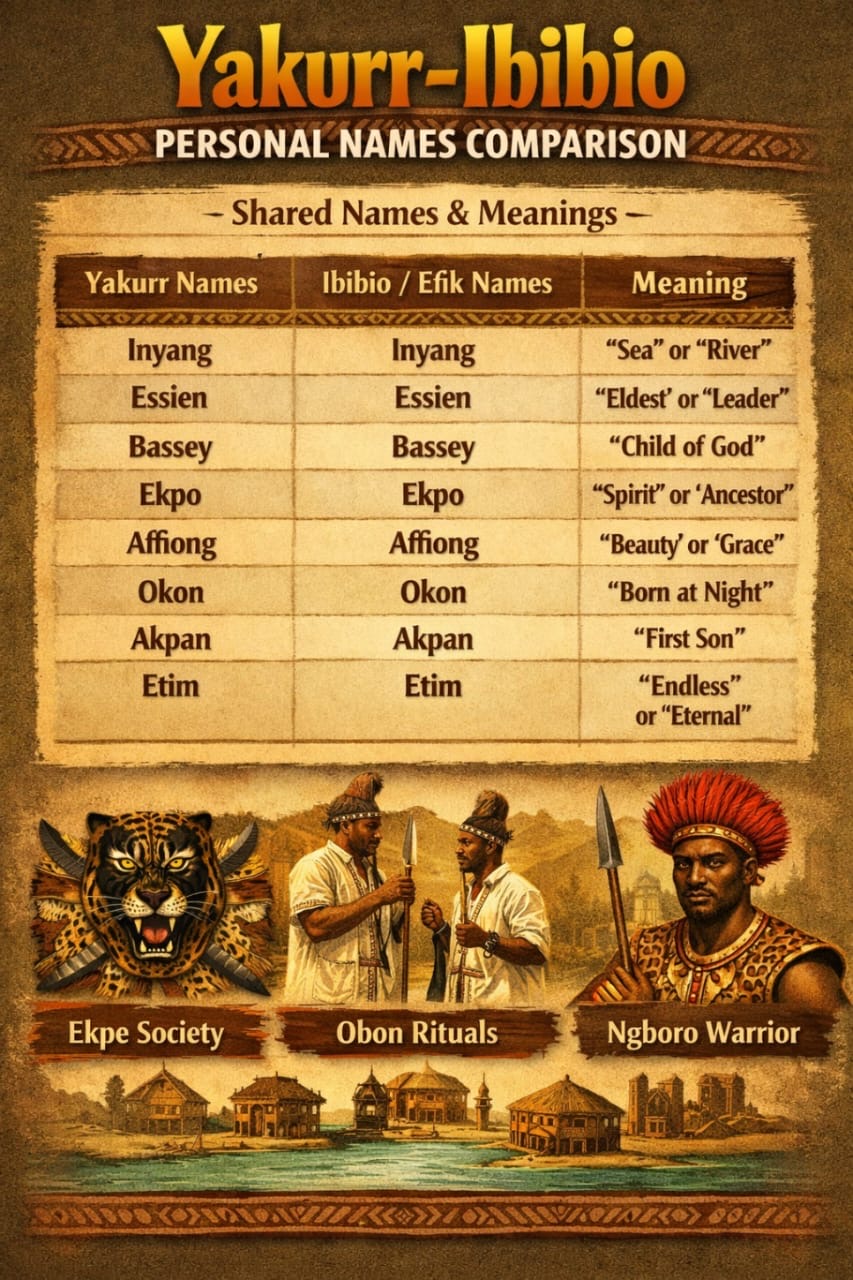
In fact, Legbo and Yakurr are very similar. That is why some communities in Yakurr Local Government Area such as Assiga, Nyima and Ekpeti speak and understand Legbo, as their dialects are mutually intelligible. The fact that some of our people may bear Igbo names or speak Igbo as a second language due to proximity to Ebonyi State and long commercial interaction does not change their ethnic identity.
3. On the administrative history that created the confusion:
The confusion about identity has an administrative origin.
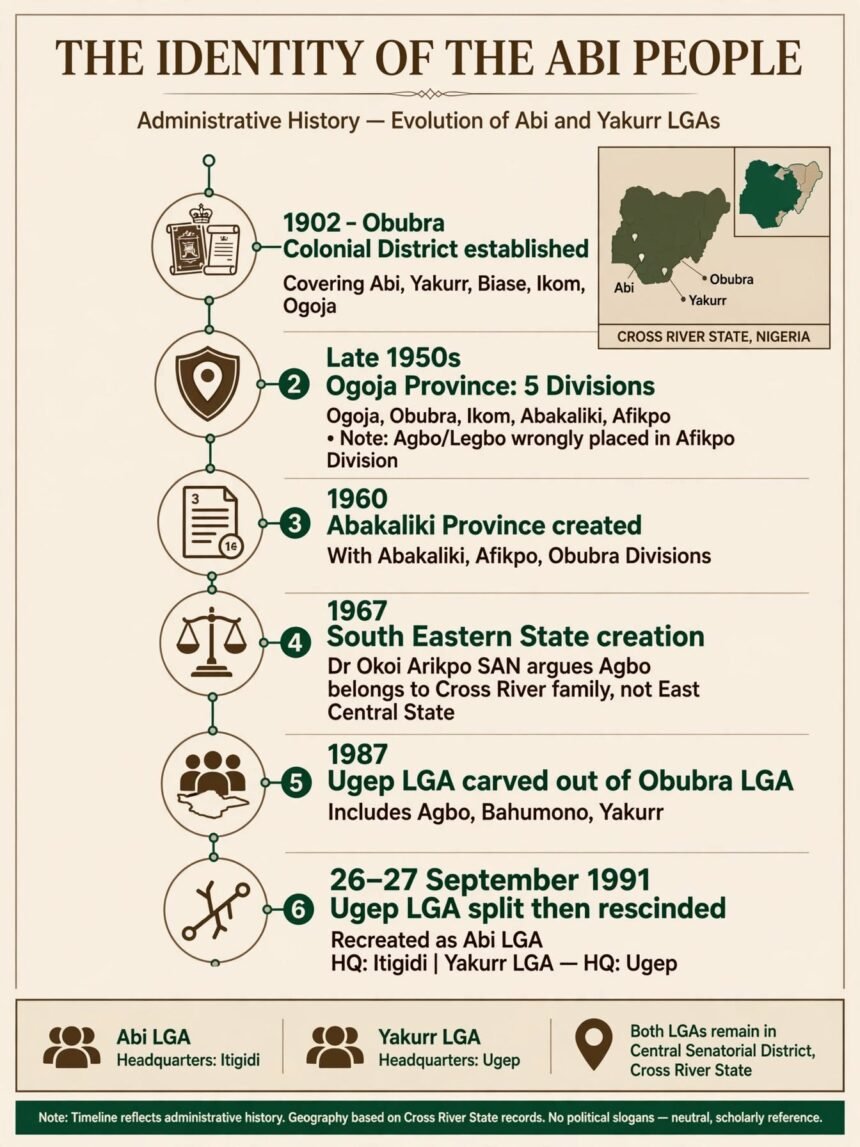
In the late 1950s, the Eastern Nigeria Government reorganised the administrative structure in a manner that many minority leaders considered political engineering. The old Ogoja Province, which originally comprised five Divisions — Ogoja, Obubra, Ikom, Abakaliki and Afikpo — was reorganised. At independence in 1960, Abakaliki was elevated to full provincial status comprising three Divisions: Abakaliki, Afikpo and Obubra.
In that exercise, the present Yakurr area, which was historically part of Obubra Division — the Obubra Colonial District having been established in 1902 covering present-day Abi, Yakurr, Biase, Akamkpa, Ikom and Ogoja — was retained in Obubra, while part of Abi, especially the Agbo or Legbo area, was placed under Afikpo Division, even though they were not ethnically Igbo but part of the broader Ekoi-Ejagham and Cross River family.
When the South Eastern State was about to be carved out of the Eastern Region in 1967, it took the efforts of our illustrious son, Dr. Okoi Arikpo, SAN. Dr. Arikpo, who was the first Nigerian to obtain a Ph.D. in Anthropology from the University of London in 1949 and who served as Secretary-General of the COR State Movement, successfully argued before the Willink Commission and before the Supreme Military Council that the Agbo people had been wrongly grouped into Afikpo Division and should belong to the South Eastern State. His argument prevailed.
4. On the creation of Abi and Yakurr Local Government Areas:
Both the Agbo, Bahumono and Yakurr areas of Obubra Division were in 1987 carved out of Obubra Division into the then Ugep Local Government Area, with headquarters at Ugep. Abi Local Government Area itself had first been created in 1983 and was later abolished.
On 26th September 1991, the Federal Military Government divided the Ugep Local Government Area into Ugep North and Ugep South Local Government Areas. Less than 48 hours later, on 27th September 1991, the Federal Government rescinded that decision and in its stead created Abi and Yakurr Local Government Areas.
The Igbo Imabana, Agbo and Bahumono areas became Abi Local Government Area with headquarters at Itigidi, while the Yakurr area became Yakurr Local Government Area with headquarters at Ugep.
That is why Abi is today in Cross River State and not in Ebonyi State.
In conclusion, our Abi communities are Agbo and Bahumono — proud Upper Cross River peoples with a distinct history, language and culture.