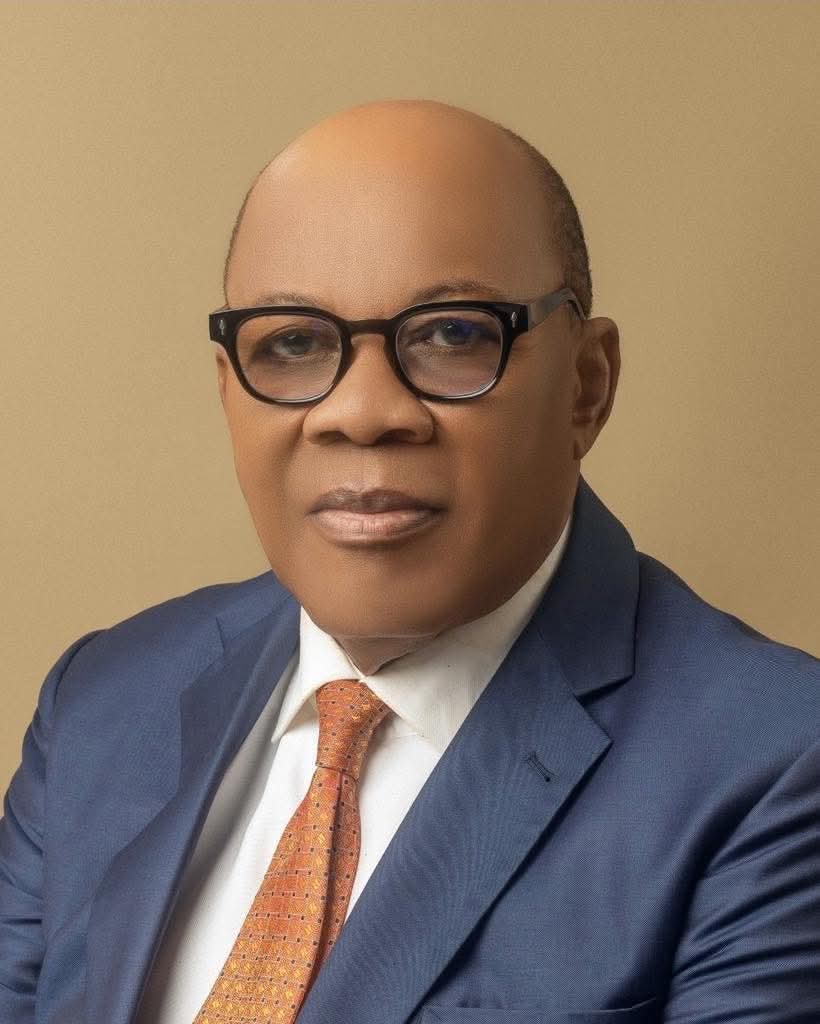
by Otunba (Dr.) Abdulfalil Abayomi Odunowo
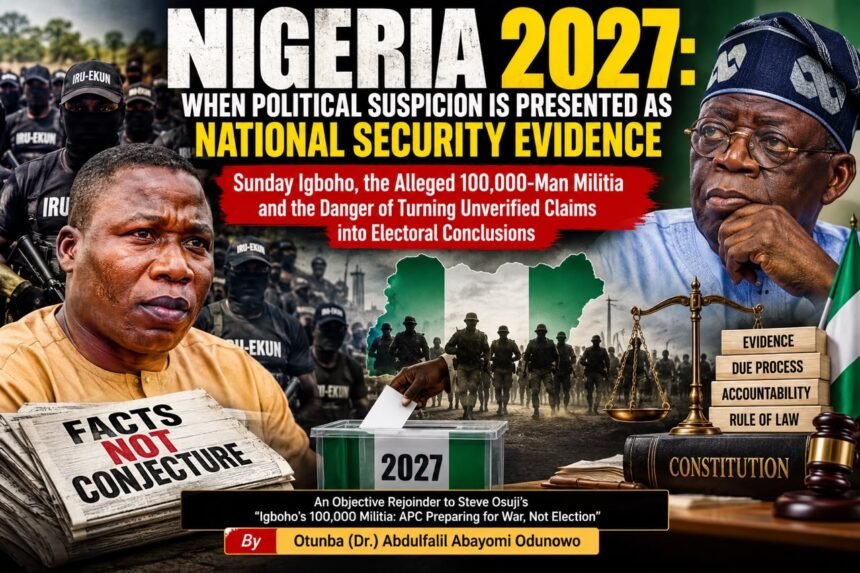
**Sunday Igboho, the Alleged 100,000-Man Militia, and the Risk of Converting Unverified Claims into Electoral Certainties**
**An Objective Response to Steve Osuji’s “Igboho’s 100,000 Militia: APC Preparing for War, Not Election”**
**By Otunba (Dr.) Abdulfalil Abayomi Odunowo**

There is an essential difference between drawing attention to credible national security concerns and presenting political suspicion as though it were already proven. That difference matters even more when a nation is heading toward a major general election.
Veteran journalist Steve Osuji has posed serious questions about reports of an organisation linked to Yoruba self-determination campaigner Sunday Adeyemo, widely known as Sunday Igboho.
Some of those questions warrant immediate attention from the Federal Government, the security agencies, and the Nigerian public.
Yet the article moves from concern over an alleged regional security structure to the much graver claim that President Bola Ahmed Tinubu and the All Progressives Congress are preparing for electoral conflict.
That is not a conclusion that can rest on conjecture, political proximity, or unverified reporting. It demands far stronger evidence.
### 1. WHERE IS THE PROOF OF A 100,000-MAN ARMY?
The article repeatedly portrays Sunday Igboho as leading between 80,000 and 100,000 militia members.
But what independently verified evidence supports that claim?
Are these people formally registered members, intending recruits, trained security volunteers, or armed fighters?
How many have actually completed training? How many have access to firearms? Who commands them? Who funds them? What is their legal standing?
These are not peripheral issues. They are the central questions that determine whether the matter concerns a proposed community security outfit, an unlawful paramilitary body, or a truly functional private army.
A public claim that an organisation plans to recruit 100,000 members is not the same as proof that it has already recruited, trained, armed, and deployed 100,000 combatants.
For that reason, comparing such an alleged force to the Nigerian Army or to the armed forces of European states is analytically unsound unless there is comparable evidence about numbers, weapons, training, command systems, and operational capacity.
A national army is not merely a large group of people in uniform.
It is a legally constituted institution with a command structure, logistics, military facilities, specialised training, and constitutionally defined accountability.
The first duty of serious journalism, therefore, is to determine whether the alleged 100,000-man force exists in the form being described.
### 2. DOES THE EXISTENCE OF IRU-EKUN PROVE APC BACKING?
The article further suggests that President Tinubu is quietly backing the organisation and that its true purpose is to intimidate political opponents ahead of the 2027 elections.
Those are extremely serious allegations.
But an allegation is still not evidence.
Has any government document authorised the recruitment of this alleged militia?
Is there any budgetary provision, official correspondence, security arrangement, or credible financial record tying the Presidency or the APC to its creation?
Has any identified government official instructed its members to harass opposition parties?
Has any independent inquiry established a link between the organisation and the ruling party’s electoral apparatus?
Without evidence of that kind, the claim that the APC is preparing for war rather than an election remains an accusation in need of proof.
This is not to say that the Presidency should be spared scrutiny. Quite the opposite: the Federal Government ought to state clearly whether the organisation has received any authorisation, funding, or operational support.
But silence alone does not amount to proof of sponsorship.
Any responsible national debate must separate what has been established from what remains speculative.
### 3. THE CONSTITUTION DOES NOT AUTHORISE PRIVATE ARMIES
Nigeria’s Constitution sets out a clear legal framework for national defence and internal security.
Section 217 of the 1999 Constitution, as amended, provides for the establishment of the Armed Forces of the Federation.
Section 218 defines the President’s authority as Commander-in-Chief.
Section 214 establishes the Nigeria Police Force and bars the creation of any other police force for the Federation or any part of it, subject to the Constitution.
In addition, Section 227 expressly forbids political parties from organising, training, or equipping persons for the purpose of using or displaying physical force or coercion in pursuit of political interests.
These provisions go directly to the allegations in question.
If any organisation is recruiting, arming, or training people to intimidate voters, suppress political opponents, or exercise unlawful coercive power, the appropriate security agencies must investigate and enforce the law.
That principle must hold whether the organisation claims to protect Yoruba communities, Igbo communities, northern communities, or any other group.
No ethnic body, political party, or private citizen is above the Constitution.
At the same time, we should not automatically label every community protection initiative an illegal army without first examining its real structure, activities, and legal basis.
### 4. TRADITIONAL BACKING DOES NOT CREATE MILITARY AUTHORITY
The article also claims that the Ooni of Ife contributed ₦100 million and a Hilux vehicle to support the organisation. If that report is accurate, clarification is needed about the purpose of the assistance, who received it, and what its legal implications may be.
Still, traditional endorsement, financial support, or public association cannot bestow constitutional military authority on any organisation. Nigeria’s traditional institutions play important cultural, historical, and peacebuilding roles. They do not hold independent constitutional authority to raise armies.
It would therefore be wrong to assume either that an alleged donation proves a military conspiracy or that royal backing automatically legalises an organisation’s security activities. Neither conclusion follows from the reported donation alone. Both would require additional facts.
### 5. THE 2015 BANDITRY CLAIM NEEDS HISTORICAL PROOF
One of the most troubling assertions in the article is the claim that the APC imported and armed bandits to secure victory in the 2015 election and later lost control of them.
A charge of that magnitude cannot responsibly be presented as settled historical fact without credible investigative evidence.
Nigeria’s banditry crisis has multiple roots, including long-running rural criminality, cattle rustling, communal conflict, the spread of arms, weak policing, competition over land, and the growth of organised kidnapping networks.
Armed violence in parts of northwestern Nigeria predates the 2015 election. It would therefore be historically inaccurate to explain the full development of banditry through a single unproven electoral conspiracy.
That does not mean allegations of political sponsorship of violence should be dismissed. Any credible claim that politicians armed criminal groups deserves full investigation and prosecution.
But sound analysis must distinguish between a possible contributing factor and a conclusively established explanation for an entire national security crisis.
### 6. SUNDAY IGBOHO AND NNAMDI KANU: APPLY THE SAME LAW, BUT EXAMINE THE FACTS
The article asks why Sunday Igboho should remain free while Nnamdi Kanu has been prosecuted. The broader concern about equal treatment under the law is a legitimate one. Nigeria cannot sustain a justice system in which ethnicity, political influence, or closeness to power determines who is investigated, prosecuted, or shielded.
Even so, the two cases must be judged on their separate facts, evidence, charges, judicial processes, and applicable laws. They cannot be declared legally identical simply because both men have been associated with self-determination movements.
Likewise, disagreement with the legal or political handling of one case does not prove another person’s guilt. If there is evidence that Sunday Igboho or any organisation linked to him has committed offences, the authorities should investigate and proceed lawfully. If there are valid constitutional, appellate, or human-rights grounds for relief in Nnamdi Kanu’s case, those grounds should be assessed on their own merits.
Justice requires consistency, due process, and respect for judicial independence—not selective prosecution or selective immunity.
### 7. POLITICAL INTIMIDATION MUST NEVER BE ACCEPTED
One allegation in Osuji’s article deserves especially close attention: the claim that Sunday Igboho warned opposition political figures not to campaign in the Southwest.
If an authenticated recording confirms that such a threat was made, it deserves clear and unequivocal condemnation. The Southwest belongs to every Nigerian citizen, not to any political party, ethnic movement, or individual.
Peter Obi, Bola Tinubu, Atiku Abubakar, and every other legally qualified political actor must enjoy the constitutional right to campaign peacefully across the Federation.
Sections 40 and 41 of the Constitution protect freedom of association and movement, subject to lawful restrictions. No individual has the right to assume the power to decide which political candidate may enter or campaign in any part of Nigeria.
In the same way, any reported instruction to kill civilians simply because they possess firearms must be examined with great care. Possession of a firearm may be lawful or unlawful depending on the circumstances, but no private organisation has unlimited authority to execute suspected offenders.
Where credible evidence of threats or incitement exists, law enforcement must act. Political intimidation is unacceptable whether those responsible support the government or the opposition.
### 8. THE ALLEGED MILITIA MUST NOT DIVERT ATTENTION FROM THE REAL ELECTORAL TEST
Nigeria’s 2027 elections should be decided by leadership quality, public trust, economic performance, security, institutional credibility, and the ability of political parties to persuade voters.
The ruling party must defend its record.
Opposition parties must offer credible alternatives.
INEC must conduct the elections impartially.
Security agencies must protect citizens without political bias. And political commentators must avoid turning speculation into conclusions that could deepen regional suspicion.
The strongest safeguard against electoral violence is not the spread of competing ethnic formations. It is an impartial state that enforces the law, protects political freedoms, and ensures that every lawful vote can be cast and counted without intimidation.
### 9. ON THE REPORTED AIR FORCE CRASH: INSIST ON VERIFICATION AND ACCOUNTABILITY
The final part of Osuji’s article raises important concerns about military aviation safety and emergency response.
Those are proper subjects of public interest.
But the specific claim that an aircraft carrying 25 people crashed near Igbokoda in Ondo State must be backed by verifiable incident records, an official statement, or credible independent reporting before it is accepted as established fact.
Nigeria has suffered serious military aviation accidents over the years. Those tragedies justify demands for stronger maintenance oversight, transparent investigations, improved emergency response, and publication of safety recommendations where national security allows.
Even so, the mere absence of immediately available public information does not, by itself, prove that no investigation took place.
NEMA, the Nigerian Air Force, relevant emergency agencies, and state authorities should be evaluated according to their actual statutory duties and operational performance.
Accountability is strengthened by accurate incident reporting, not by circulating casualty figures that have not been independently confirmed.
### 10. WHAT THE FEDERAL GOVERNMENT SHOULD DO NOW
Instead of allowing the controversy to collapse into another exchange of ethnic accusations and political hostility, the Federal Government should address the substantive issues directly.
The Presidency and the relevant security authorities should clarify the legal status of Iru-Ekun, investigate credible allegations of unlawful recruitment or weapons possession, determine whether any public resources have been committed to the organisation, and publicly restate that no private formation may interfere with electoral activity.
INEC, the Nigeria Police Force, and other lawful security institutions should also make it clear that every political party and candidate will receive equal protection during the 2027 electoral process. Any credible threat against a candidate, voter, journalist, or political gathering should be investigated, no matter its source.
These are practical and constitutional steps that would do more to reassure Nigerians than either official silence or inflammatory political rhetoric.
### CONCLUSION: LET EVIDENCE LEAD, NOT FEAR
Steve Osuji is right to insist that Nigeria must never permit an unlawful private army or allow political actors to militarise the electoral process. But he is not justified in treating the alleged existence of a 100,000-man force, presidential sponsorship, and a planned APC electoral operation as a single proven chain of facts without showing the evidence that connects them.
There is a profound difference between asking whether a dangerous political conspiracy exists and declaring that it has already been established. Nigeria has suffered enough from political violence, ethnic mistrust, and the manipulation of public fear.
As 2027 approaches, Nigerians deserve rigorous journalism, accountable government, credible opposition, and impartial law enforcement.
Let every allegation be investigated.
Let every real threat be confronted.
Let every political candidate campaign freely.
And let no government, opposition party, ethnic organisation, or private individual claim exclusive ownership of the security of the Nigerian people.
The future of Nigerian democracy must be settled by the ballot, safeguarded by the Constitution, and directed by evidence not by militias, intimidation, or politically convenient assumptions.
**Otunba (Dr.) Abdulfalil Abayomi Odunowo**
**National Chairman AATSG**
**Public Affairs Commentator**