By Otunba (Dr.) Abdulfalil Abayomi Odunowo
I support dialogue, compromise and cooperation between the peoples of Ijebu and Remo. Compromise, however, must be transparent, historically grounded and demonstrably equitable. Anything less risks converting a legitimate quest for administrative recognition into a new source of structural imbalance.
Having examined the 19-page harmonised memorandum that proposes the creation of Ijebu-Remo State with Ijebu-Ode as capital, I conclude that several fundamental questions remain unanswered. My concern is not with Remo identity. Remo’s history, institutions and distinctiveness deserve full recognition and protection. My concern is whether, in the effort to resolve differences, the substance of an agitation long understood as the demand for Ijebu State is being quietly altered.
What Happened to the Agitation for Ijebu State?
This is not a sentimental question. It is a documentary one. A Senate constitutional-review report published in 2013 recorded a formal submission from the Ijebu State Creation Movement requesting the “Creation of Ijebu State with Ijebu Ode as the Capital.” As recently as April 2025, the Ijebu State Implementation Committee publicly stated that it had submitted a memorandum to the National Assembly advocating precisely the same formulation: Ijebu State with Ijebu-Ode as capital.
Any reader of the current harmonised memorandum is therefore entitled to ask:
* When was the longstanding proposal for Ijebu State changed to Ijebu-Remo State?
* Who authorised that change?
* What formal consultation produced it?
* What resolution was passed?
* Which Ijebu institutions or elected representatives of the six Ijebu local government areas approved it?
These are questions of process and legitimacy, not expressions of hostility toward Remo.
There Was No Historical Unanimity on the Name
The public record shows competing positions, not a seamless consensus. In February 2025 the Remo Committee proposed Remo-Ijebu State with Sagamu as capital. In May 2025 the same committee publicly restated its opposition to Ijebu State with Ijebu-Ode as capital, arguing that such an arrangement failed to recognise Remo’s separate identity sufficiently.
The disagreement was real and publicly articulated. There is nothing improper about subsequently reaching a compromise. But if a historic disagreement has now been “put to rest,” as the memorandum asserts, the public is entitled to see the resolution that settled it the participants, the date, the terms, and the mandate under which it was taken.
Representation and the Meaning of Balance
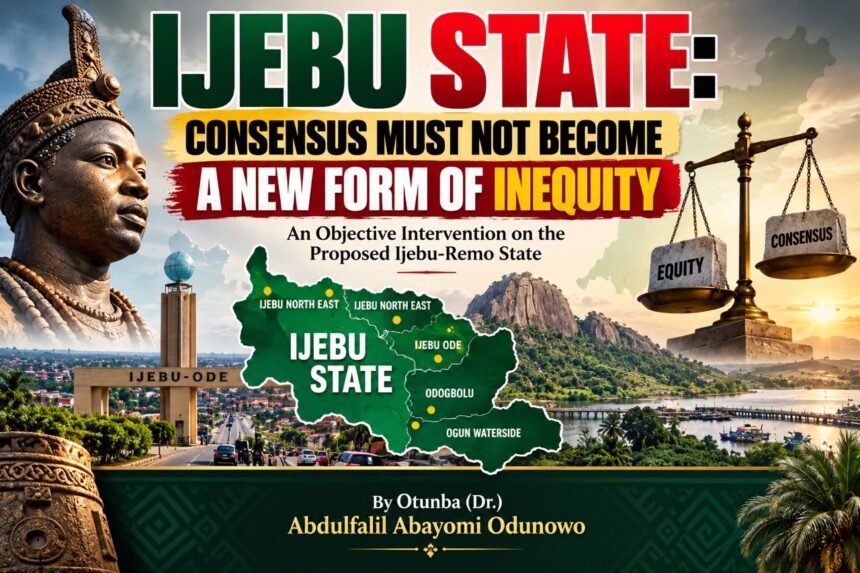
The proposed state comprises nine existing local government areas. Six fall within the contemporary Ijebu division (Ijebu-Ode, Ijebu North, Ijebu North East, Ijebu East, Odogbolu and Ogun Waterside). Three constitute Remo (Sagamu, Ikenne and Remo North). The existing LGA ratio is therefore 6:3, or 2:1.
Population, land area, number of communities, economic contribution and historical administrative patterns do not automatically follow the same ratio. This is where the memorandum requires greater precision.
The document repeatedly invokes “balanced development” between Ijebu and Remo. The principle is sound; its content is not. Balance can mean:
* mechanical 50:50 allocation of institutions and offices,
* equal development expenditure regardless of scale,
* equal numbers of future local government areas, or
* equitable treatment calibrated to population, territory, communities, economic activity and existing representation.
These are fundamentally different models. Where two component areas differ in population, territory or number of communities, an automatic 50:50 division can itself produce inequality. Conversely, reliance on the present LGA count alone may overlook other relevant metrics. The memorandum should therefore state, in concrete terms, what “balance” means for future local government creation, legislative constituencies, appointments and the location of state institutions.
The Historical Trajectory of Local Government Representation Must Be Documented
Claims about progressive under-representation cannot rest on assertion. If successive reorganisations since 1976 have altered the relative weight of Ijebu and Remo, the chronology should be placed on the public record. I therefore propose that the harmonised committee publish a clear table covering:
1976 → each subsequent local-government creation exercise → the present nine LGAs,
showing for every period: number of Ijebu LGAs, number of Remo LGAs, population, land area, wards and recognised communities.
Only then can citizens judge whether relative representation has narrowed, remained stable, or shifted and on what basis any new formula is justified.
Preferred Formulation and the Case for Continuity
Against this background, my preferred formulation remains:
IJEBU STATE with IJEBU-ODE AS CAPITAL.
This preference does not seek to erase Remo. It rests on a different proposition: the name of a state need not incorporate every constituent identity. A state may contain several historically distinctive peoples while retaining a geographical or historical designation. The old administrative territory around which the present proposal is constructed was itself known as Ijebu Province. British parliamentary records from 1938 refer explicitly to “Ijebu Province” in discussions of the administrative separation of Ijebu Remo from Ijebu-Ode. That history establishes two simultaneous truths: Ijebu Province existed as an administrative identity, and Remo’s demand for distinct recognition within that territory has deep roots. Both facts deserve acknowledgement.
The case for Ijebu-Ode as capital should likewise rest on evidence rather than entitlement. The harmonised memorandum already proposes Ijebu-Ode. The historical argument is that it served as the administrative centre associated with the old Ijebu Province. Contemporary suitability should be assessed by infrastructure, accessibility, available land, institutional capacity and the comparative cost of establishing a capital. If those criteria favour Ijebu-Ode, the data should be published. The choice then rests on evidence, not assertion.
Language Matters: From “Compensation” to Continuity and Equity
I would avoid framing the preference for Ijebu State and Ijebu-Ode as “compensation” for past unfairness. That language turns a constitutional arrangement into a settlement between competing ethnic interests. A stronger and more durable formulation is:
“The proposed constitutional arrangement should recognise historical continuity while guaranteeing equitable political representation and development for every constituent community.”
This protects the historical and administrative case for Ijebu State without suggesting that Remo must surrender anything by way of restitution.
Questions That Require Clear Answers
The signatories to the harmonised memorandum should therefore be invited to answer a straightforward set of questions:
1. What formal resolution changed the longstanding proposal for Ijebu State into Ijebu-Remo State?
2. Who participated in that decision, and when was it taken?
3. Were the six Ijebu local government areas independently consulted, and did their elected representatives endorse the change?
4. What does “balanced development” mean numerically and institutionally—50:50, 2:1, by population, by territory, or by another explicit formula?
5. What safeguards ensure that neither Ijebu nor Remo becomes structurally disadvantaged in the proposed state with respect to future local governments, constituencies, appointments and the location of institutions?
Until these questions are answered with documentary clarity, it remains reasonable to distinguish between agreement among particular leaders and an established consensus of the affected population.
The Governing Principle
This matter should not become Ijebu versus Remo. Protecting Remo identity does not require diminishing Ijebu identity. The constitutional objective should be an arrangement in which neither side needs the relative weakness of the other to secure its own future. For those who support the historical formulation, the proposition can be stated plainly:
IJEBU STATE CAPITAL: IJEBU-ODE
One historical state identity. Full protection of Remo identity. Equitable development across all nine local government areas. Representation determined transparently by population, geography, communities and constitutional principle not by an unexplained political formula.
Before the words “harmonised” and “unanimous” enter the historical record, the resolutions and evidence that establish that consensus should be made public. In a matter as consequential as the creation of a state, consultation must not be mistaken for consent, compromise must not obscure history, and “balance” must never become another name for structural inequality.
Signed by
Otunba (Dr) Abdulfalil Abayomi Odunowo
Convener
Ijebu Lokan fun itesiwaju Ijebu Movement