by Agbonmagbe Kazeem
Just after midnight, at the Lagos Race Course, the Union Jack came down and the green-white-green flag of Nigeria went up in its place. It sounds like the whole story. It is really only the headline of it.
By the time the flag changed, Nigeria had already spent the best part of a year governed by its own coalition government, and it would spend the next three years still sharing a monarch with Britain, still sending its hardest legal appeals to a court in London, and still calling its head of state “Her Majesty”. Independence on 1 October 1960 was real, and it mattered enormously to the people who had campaigned for it since the 1940s. But it was also narrower, more procedural, and more carefully negotiated than the flag-raising image suggests.
What actually took place in Lagos that day and what “independent” did and did not mean for the roughly 35 million people who woke up in a new country on the morning of 1 October 1960?
Nigeria’s independence was decided in Lagos and London, but the shape of its first government was decided at the ballot box a year earlier. The federal election of December 1959 was the last one held under British rule, and it produced no outright winner. The Northern People’s Congress (NPC), led in the House by Abubakar Tafawa Balewa, took 134 of the 312 seats in the federal House of Representatives, the largest single bloc, but well short of a majority. The National Council of Nigeria and the Cameroons (NCNC), in alliance with the Northern Elements Progressive Union and led by Nnamdi Azikiwe, won 89 seats. The Action Group, under Obafemi Awolowo, came third with 75.
Awolowo and Azikiwe had each explored the idea of a northern alliance of their own before the election. Neither materialized, partly because the Northern regional premier, Ahmadu Bello, made it clear he would rather see the North secede than govern under an NCNC-Action Group arrangement he did not control. What emerged instead, in the weeks after the results came in, was a coalition of convenience between the NPC and the NCNC/NEPU alliance. Balewa became prime minister; Azikiwe, denied the executive role his party might once have expected, accepted the presidency of the Senate, a position with dignity but comparatively little power.
This was the government that would carry Nigeria across the independence line, and it deserves more than a footnote in the story of the ceremony that followed. It was the political engine behind that ceremony. Northern dominance, an uneasy NPC-NCNC alliance, an Action Group shut out of government, those fault lines would go on shaping Nigerian politics for the rest of the First Republic.
The legal instrument that made 1 October 1960 possible was drafted not in Lagos but in London. On 15 July 1960, the Colonial Secretary Iain Macleod introduced the Nigeria Independence Bill for its second reading in the House of Commons. Macleod described Nigeria, then home to some 35 million people, as Africa’s most populous country, and framed its coming independence within a federal structure of three self-governing regions, Northern, Western and Eastern, as something close to a model for the continent’s decolonisation.
The debate is worth reading in full for what it reveals about the terms being set. MPs discussed the entrenched clauses that would protect the new federal constitution: any fundamental change would require a two-thirds majority in the federal parliament plus the agreement of at least two of the three regions, a safeguard meant to stop any single region, particularly the more populous North, from rewriting the rules alone. The bill also carried a code of fundamental human rights written into both the federal and regional constitutions, something Nigerian leaders themselves had pushed for during the constitutional conferences of the late 1950s. And every speaker recorded approval of Nigeria’s wish to remain in the Commonwealth, a request the Commonwealth prime ministers had already welcomed unanimously.
One detail from that debate is easy to miss but shouldn’t be: Nigeria would keep the right of appeal to the Judicial Committee of the Privy Council in London. Independence did not mean a clean break from British legal authority. It meant a carefully bounded transfer of it, with several threads left deliberately uncut. The Nigeria Independence Act received royal assent shortly afterwards, and it, not the ceremony in Lagos, is the actual legal foundation of Nigerian statehood.
MIDNIGHT AT THE RACE COURSE
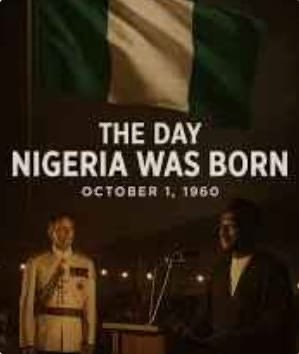
The formal transfer of power happened just before midnight on 30 September, spilling into the first minutes of 1 October, at the Lagos Race Course, the open ground in the heart of the city that is now Tafawa Balewa Square. The choreography was simple and deliberately solemn: the Union Jack was lowered, the green-white-green flag was raised, and the crowd gathered around the course applauded.
Representing Queen Elizabeth II at the ceremony was her cousin, Princess Alexandra of Kent, who had arrived in Lagos on 26 September to a reception led by the outgoing Governor-General, Sir James Robertson, and by Balewa himself. It was Princess Alexandra who handed over Nigeria’s Instrument of Independence, often referred to as the Freedom Charter, at the ceremony. It was received not by Balewa but by Jaja Wachuku, the Speaker of the House of Representatives and the first Nigerian to hold that office. Two days later, on 3 October, Princess Alexandra returned to formally open Nigeria’s first independent federal parliament on the Queen’s behalf.
Also present, representing the wider world’s interest in the moment, was Nelson Rockefeller, then Governor of New York, sent by President Dwight D. Eisenhower, alongside delegations from other Commonwealth states, the United Nations, and newly independent nations across Africa and Asia. Nigeria was not becoming independent in isolation. It was joining a wave of decolonisation, Ghana had gone first in 1957, and the ceremony was staged, in part, for an international audience watching to see how the largest of Britain’s African colonies would make the transition.
Here is where the popular telling of independence day tends to slip. It is tempting to picture Azikiwe, Nigeria’s most prominent nationalist, stepping into the Governor-General’s shoes the moment the flag went up. He didn’t, not yet. Sir James Robertson, the last colonial Governor-General, remained in post as the Queen’s representative through independence itself and for a further six weeks, until 16 November 1960, when Azikiwe formally succeeded him. On the day Nigeria became independent, Azikiwe’s actual role was president of the Senate, a chamber, not a Crown office.
It is a small correction, but it says something true about how independence worked in practice. Sovereignty passed to Nigeria as a state on 1 October 1960. The personnel changed more gradually. A British colonial administrator represented the British monarch as Nigeria’s own head of state for six more weeks after the country had, on paper, stopped being a colony. Continuity, not rupture, was the order of the day, a pattern that held for the constitutional structure more broadly, and one that the men who negotiated independence, on both sides, seem to have wanted.
Legally, 1 October 1960 made Nigeria a sovereign state and a member of the Commonwealth in its own right, with its own seat at the United Nations soon to follow. It ended the Colonial Office’s authority over Lagos. Nigerian ministers, not British ones, would now advise the Crown on Nigerian affairs.
What it did not do was make Nigeria a republic, or remove the British monarch as its head of state. Elizabeth II remained Queen of Nigeria, a distinct constitutional role from her position
as Queen of the United Kingdom, represented day to day by the Governor-General and, at regional level, by three Crown-appointed governors in the North, West and East. The Governor-General granted royal assent to legislation, summoned and dissolved parliament, appointed and dismissed ministers on the advice of the prime minister, and exercised the prerogative of mercy: all the ordinary business of a constitutional monarchy, just with Nigerian rather than British hands increasingly on the levers. Nigeria’s highest court of appeal, as the July 1960 Commons debate had confirmed, still sat in London.
That arrangement lasted almost exactly three years. On 1 October 1963, Nigeria became a republic, the monarchy was formally abolished, and Azikiwe, by then Governor-General, became the country’s first president. Queen Elizabeth II sent her congratulations, noting that “common memories of our long association will strengthen and increase the friendship” between the two countries, a graceful line marking the end of an arrangement that had always been closer to a legal formality than a felt reality for most Nigerians.
Accounts of the mood at the Race Course itself pull in different directions, and I’d rather sit with that than smooth it over. Some retrospective accounts describe the midnight ceremony as notably restrained, a crowd offering polite applause rather than open jubilation, watching a formal, almost solemn changeover of flags in the dark. Away from the ceremonial precinct, though, and in the days that followed, the mood was warmer: dancing in the streets of Lagos, public marches with people dressed in white and carrying the new flag, and celebrations that spread across the regions as news of independence reached radio sets and newspapers.
A carefully staged, internationally watched constitutional handover at midnight is not naturally a moment of loud celebration, whatever it means to the people watching it. The wider, freer celebration, the one most Nigerians who lived through it now remember, happened in daylight, away from the dignitaries, in the days around the ceremony rather than in the minute the flag actually changed. For a country of Nigeria’s size and diversity, spanning three regions with different languages, religions and recent political histories, there was never going to be one single experience of the day. There was a formal one, staged for cameras and colonial officials, and there were hundreds of informal, local ones, staged by Nigerians themselves.
NIGERIA OUR FATHER’S LAND
“THE HISTORIAN”
AGBONMAGBE REMILEKUN KAZEEM
+2348036472826