
By Okoi Obono-Obla
In the wake of the frenetic election season, a permanent feature of Nigeria’s political culture has again emerged: the waywardness and desperation of politicians seeking tickets to contest general elections. This culture has permeated the fabric of the political system since the return to democratic civil rule in 1999 — itself a hangover from the period of democratic civil rule under the paternalistic supervision of our colonial masters in the 1950s.
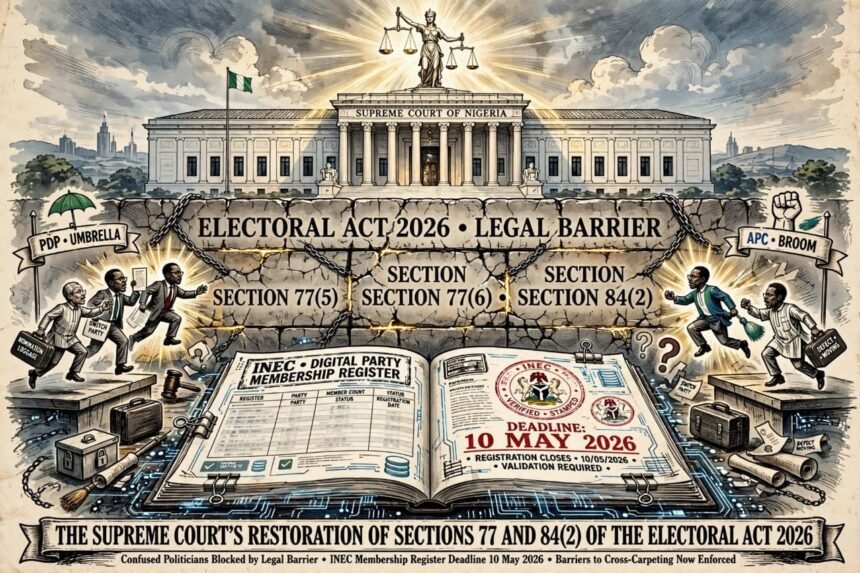
In this season, politicians have left their political parties to seek tickets and refuge in other parties without the slightest regard for the new regime introduced by Sections 77(5), 77(6), 77(7) and 84(2) of the Electoral Act 2026, which was designed to cure this wayward behaviour enabled by corrupt party leadership.
A temporary reprieve for this indiscipline came by way of judicial intervention when the Court of Appeal, Abuja Division, set aside the judgment of the Federal High Court, Abuja, presided over by Justice Mohammed Umar. The suit had been filed by the Zenith Labour Party — one of those ramshackle portfolio parties existing in the country — against the regulatory body, the Independent National Electoral Commission (INEC), challenging the constitutionality of the digitalisation of party membership registers, the submission of these registers to INEC not later than 21 days before primaries, congresses or conventions, and the prescription of consequences for non-compliance.
The Court of Appeal accepted the argument of the Zenith Labour Party that Sections 77(5), 77(6), 77(7) and 84(2) of the Electoral Act 2026 were inconsistent with the Constitution, particularly the right to freedom of association under Section 40 of the 1999 Constitution — a right which politicians have always treated as a licence to justify political prostitution and nomadic behaviour.
The decision was cashed in on by hordes of politicians. There was a frenetic and hurried movement from their former platforms to new ones when it became obvious that they would not secure tickets in their previous parties, believing that an escape route had been provided by the Court of Appeal judgment of 16 July 2026.
Alas, the Supreme Court decision of 24 September 2026 has again thrown a spanner in the works and re-established the legal regime that the framers of Sections 77(5), 77(6), 77(7) and 84(2) sought to introduce. A seven-member panel led by Justice Adamu Jauro allowed INEC’s appeal, set aside the Court of Appeal judgment, restored the Federal High Court judgment, and reinstated the provisions, holding that they are not inconsistent with Section 40 of the Constitution. The Court awarded N2 million costs against the Zenith Labour Party.
What Then Is The Fate Of Politicians Who Decamped By 10th May 2026?
This is the crux of the matter. INEC, in compliance with Section 77(4) of the Electoral Act 2026 which requires parties to submit their membership registers at least 21 days before their primaries, had fixed an initial deadline of 21 April 2026, and later extended it to 10 May 2026 after consultations with parties on 24 March 2026. All 22 registered parties complied by 8 May 2026. Party primaries are scheduled by INEC’s timetable between 23 April and 30 May 2026.
The legal effect of the Supreme Court restoration is in rem — it binds all parties and takes effect from the commencement of the Act, not from 24 September 2026.
By virtue of:
Section 77(5): Only persons whose names are in the register submitted to INEC not later than 21 days before the primaries are eligible to vote or be voted for.
Section 77(6): A party shall not use any other register for primaries, congresses and conventions except the register submitted to INEC.
Section 77(7): A party that fails to submit its register within the stipulated time shall not be eligible to field a candidate.
Section 84(2): The procedure for nomination of candidates shall be by direct primaries or consensus based on that register.
Therefore, any politician who left his party and joined a new party on or after 10 May 2026, or whose name was not contained in the digitalised register of the new party as submitted to INEC by that deadline, cannot lawfully participate in the primaries of the new party as an aspirant or delegate. His candidacy, if procured, is invalid ab initio. He is a stranger to the register. A primary conducted with such a person is liable to be nullified for non-compliance with Sections 77(5) and (6).
Are Their Candidacies Still Valid and Can They Be Challenged When Pre-Election Windows Appear Closed?
No. The candidacy is not valid. It is void for breach of a mandatory statutory provision.
The question of challenge raises two issues:
1. It is a pre-election dispute: By virtue of Section 285(14) of the 1999 Constitution (as amended) and Section 84(14) of the Electoral Act 2026, any complaint about membership register, conduct of primaries, and nomination of candidates is a pre-election matter. The limitation is 14 days from the occurrence of the event.
2. Can it be carried over into a post-election dispute? Ordinarily, no. A pre-election matter cannot be converted into a post-election petition under Section 134 of the Electoral Act. However, the Supreme Court judgment of 24 September 2026 creates a new legal fact. The Court of Appeal had created a state of lawlessness in which parties acted on a voided law. With the restoration, those who acted on the Court of Appeal’s interim position acted at their own peril.
Where the 14-day window for pre-election litigation under Section 84(14) has expired, an aggrieved aspirant within the party who was a participant in the primary still has a window to argue that the cause of action only crystallised on 24 September 2026 when the Supreme Court restored the law. Furthermore, non-compliance with Section 77 can be raised as a qualification issue. INEC, under Section 84(13), can refuse to include a candidate whose nomination was procured in breach of the Act, and such disqualification can ground a post-election challenge under Section 134(1)(a) that the candidate was not qualified ab initio because he was not a valid member of the party that sponsored him at the time of nomination.
In essence, the fallout remains a pre-election dispute, but its consequences infect the general election. The election tribunal may be invited to determine whether a candidate who was not in the INEC-certified register can be deemed a duly sponsored candidate of the party.
Conclusion
The Supreme Court’s judgment is a watershed. It has ended political nomadism and restored internal democracy. Politicians who decamped after 10 May 2026 to pick tickets in parties where their names were not in the register submitted to INEC have built on quicksand. Their tickets are liable to be set aside. The only safe harbour is for those whose names were already in the registers of their new parties as of 10 May 2026, or for parties to conduct fresh, compliant primaries where the timetable still permits. Otherwise, both INEC and the courts will have no choice but to void such candidacies.