By Okoi Obono-Obla
My Rebuttal to @Chidozie Uwaezuoke
@Chidozie Uwaezuoke,
What percentage of the Nigerian population is actually employed or earning wages?
If you put together the entire Nigerian public service — federal, state, and local governments — do you think those employed are up to 10% of the Nigerian population?
In the same vein, do you think those employed in the formal private sector are up to 10%?
Let me tell you that the bulk of the Nigerian population is engaged in the informal sector.
Therefore, to ask me how many litres of petrol the minimum wage in each of the countries enumerated in my write-up can buy is nonsensical.
How does minimum wage come into this when we are making a comparison of the cost of petrol in these African countries as compared to Nigeria? Do you think the minimum wage in some of these African countries is higher than that of Nigeria?
Therefore, the question posed by you to the effect that the minimum wage in some of these African countries is higher than that of Nigeria, and that Nigeria’s lower petrol price is cancelled out when you compare her minimum wage with that of these countries, is fundamentally flawed.
And this brings me to my last question which you ignored:
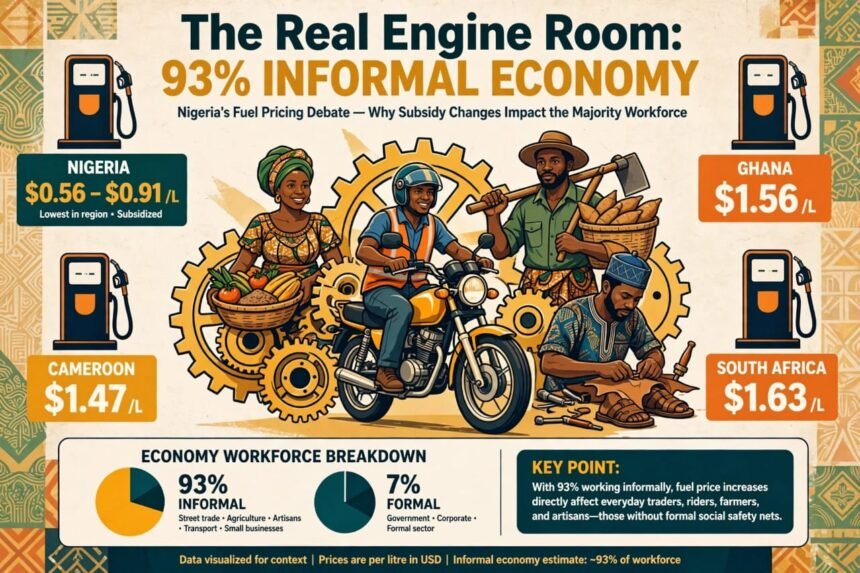
Is he suggesting that only Nigerians earning wages should be entitled to lower petrol prices? Then what about the 93% that are involved in the informal economic sector which constitutes the engine room of the Nigerian economy?
The Verifiable Facts:
1. The informal sector is the real economy.
The Jobberman/Mastercard Foundation Report (2024) found the informal sector accounts for 76.7% of employed Nigerians. The National Bureau of Statistics Q2 2024 report puts it at 93%. If petrol price is judged only by minimum wage, you are excluding 93% of Nigerians — the farmers, traders, okada riders, artisans and market women who actually drive the economy and who also buy petrol.
2. Public and formal private sector are not up to 10% each.
The public sector employs just 25.6% of the workforce itself, while the private sector drives 74.4%. Against a population of over 230 million, federal, state and local government employees combined are far less than 10% of the population. Formal wage employment is also far less than 10%. So minimum wage is not a true measure of purchasing power for Nigeria.
3. Minimum wage in those countries vs. Nigeria.
Nigeria: ₦70,000 (∼$49.18).
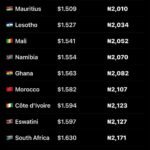
Mozambique: ∼$104.92 (Petrol $1.466),
Cameroon: ∼$72 [FCFA 43,969] (Petrol $1.479),
Ghana: ∼$30-$40 (Petrol $1.563),
Kenya: ∼$118.20 (Petrol $1.642),
South Africa: ∼$273 (Petrol $1.630),
Senegal: ∼$94 (Petrol $1.743),
Uganda: ∼$36.33 (Petrol $1.664).
Ghana and Uganda have LOWER minimum wages than Nigeria but pay almost double for fuel.
There is no correlation between minimum wage and petrol price. Petrol price is determined by global crude price, refining capacity, subsidy and exchange rate.
Conclusion:
You cannot use a wage that applies to less than 10% of the population to nullify the fact that Nigeria still has one of the cheapest petrol prices in Africa. And if cheap fuel should only be for wage earners, what happens to the 93% in the informal sector who constitute the engine room of the economy? Until we refine enough locally in Naira, for Naira, through Dangote and functional NNPC refineries, we will continue to import global volatility.