By Okoi Obono-Obla
One of the most debated features of Nigeria’s political structure today is the six geopolitical zones. The same structure that some Nigerians denounce today as a tool of marginalization was in fact conceived as an instrument for equity, fairness and national stability.
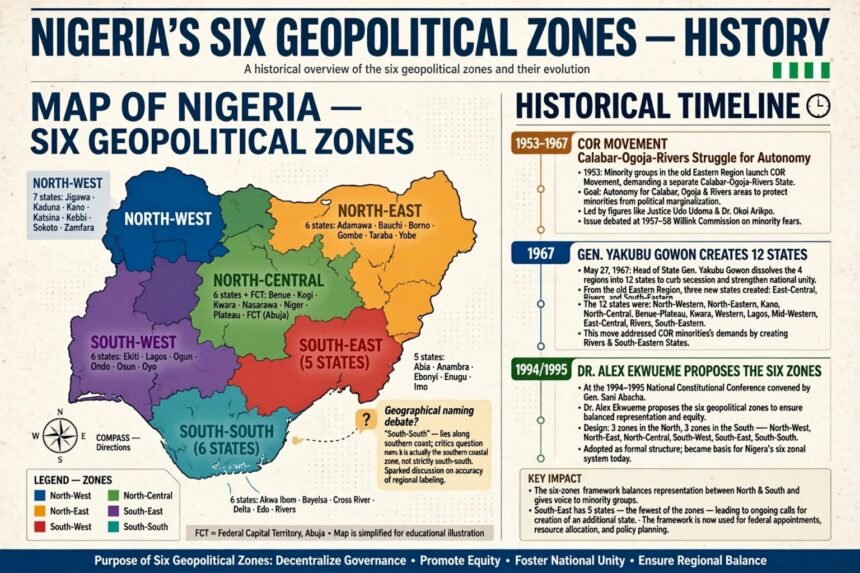
It was former Vice President Dr. Alex Ifeanyichukwu Ekwueme who proposed it at the 1994/1995 National Constitutional Conference convened by General Sani Abacha.
The Origin
Dr. Ekwueme served on the Committee on the Structure and Framework of the Constitution. In that committee, he presented what has become his most enduring political legacy: a proposal for just and equitable power-sharing based on six geopolitical zones — North-West, North-East, North-Central, South-West, South-East and South-South.
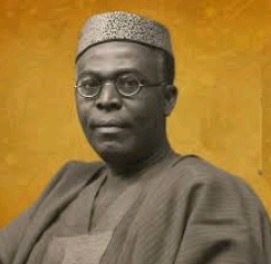
The idea was not born in the conference hall. Ekwueme himself explained that he and Chief Bisi Onabanjo had first discussed it while both were political prisoners after the 1983 coup.
The Conference approved the zones as a basis for distribution of offices, and though it did not enshrine them in the draft constitution, General Abacha adopted them as a working framework. Since then, they have become the unwritten basis for power-sharing in Nigeria.
The South-East Critique
One of the strongest criticisms of the concept, particularly from protagonists in the South-East, centers on nomenclature and political intent.
Critics argue that the name “South-South” is geographically wrong. In conventional geography, using the standard compass, we have North, South, East and West and their inter-cardinal points like North-West and South-East; there is nothing like “South-South.”
They argue that the whole exercise was a deliberate and subtle attempt to marginalize the South-East and that the South-South should have been part of the South-East geopolitical zone. To them, separating the South-East, now with five states, from the South-South with six states, weakened the political weight of the old Eastern Region.
The Minority Question: Why Return Was Impossible
However compelling that argument may seem from a South-East perspective, it ignores the historical reality of the minorities of the old Eastern Region.
The minorities would not have agreed to return to the concept of the old Eastern Region in view of their harrowing experience of marginalization they suffered within that region.
That experience led to a protracted and organized struggle for autonomy — the Calabar-Ogoja-Rivers, or COR State Movement — which began as early as 1953. The minorities of Calabar, Ogoja and Rivers consistently demanded a separate state to protect themselves from what they perceived as Igbo domination of the Eastern Region’s politics, civil service and economy.
That struggle lasted for 14 years until May 27, 1967, when the military regime headed by General Yakubu Gowon decisively resolved it by dissolving the four regions and creating twelve states. Out of the old Eastern Region, Gowon carved three states: East-Central State for the Igbo heartland, Rivers State for the Ijaw, Ogoni and other riverine peoples, and South-Eastern State [later renamed Cross River State] for the Efik, Ibibio, Annang and Ogoja peoples.
To ask the people of what is today Rivers, Cross River, Akwa Ibom and Bayelsa States to be subsumed again into a larger South-East zone would be to ask them to reverse the emancipation they fought for from 1953 to 1967 and won in 1967.
Conclusion: Geography vs. History
Geographically, critics are correct that “South-South” is not a conventional compass term. It is a political label, not a geographical one.
Historically, however, it represents a hard-won identity. Dr. Ekwueme, himself an Igbo from the South-East, understood this history. His proposal of six zones was not an attempt to marginalize the South-East, but an attempt to balance two competing historical imperatives: the need to give the South-East a recognized bloc in national power-sharing, and the need to respect the distinct identity and autonomy of the former Eastern minorities who had fought for decades to stand apart.
If today there is dissatisfaction with the structure — whether over the name South-South, or the unequal number of states and local governments per zone — the honest debate should not be about re-creating the old Eastern Region, which history has rendered impossible, but about how to make the six zones more equitable, justiciable and constitutionally grounded for all Nigerians.