

by Moses Oludele Idowu
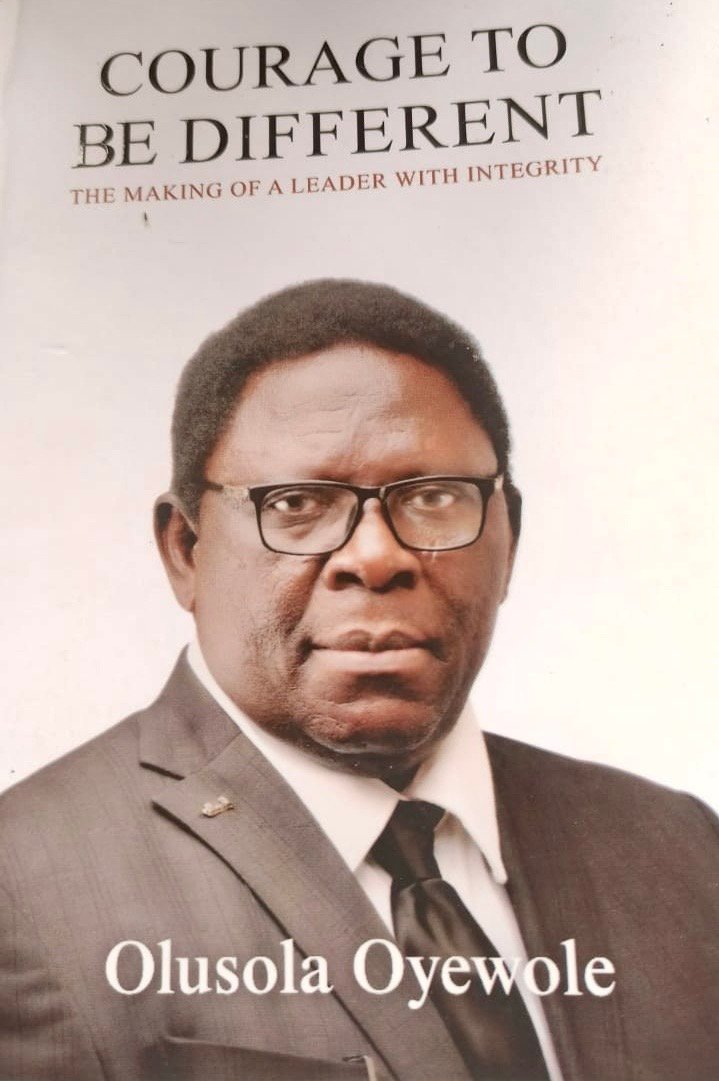
Title: *Courage to Be Different*
Author: Prof. Olusola Oyewole
Pagination: 312
Price: Unknown
Publisher: Olutus Heights Ltd, Abeokuta
Reviewer: Moses Oludele Idowu
*Introduction*
I have read three outstanding Christian biographies this year but two of them are particularly splendid and breathtaking. Coincidentally, the two central characters of the biography are of Egba origin, born by an Abeokuta native and both are outstanding Christians and pastors.
The first is that of Paul Jinadu, the very cerebral founding pastor of London – based New Covenant Church (Although it is doubtful if Paul Jinadu would ever call himself or see himself as an Egba man being a cosmopolitan Lagos man from the beginning) and the second is that of Olusola Oyewole, a former Vice Chancellor of University of Agriculture in Abeokuta. The two books offer great lessons for all but particularly Christians aspiring to go into ministry or public service. For that reason I will review both books here and I am starting with the Oyewole’s.
*In Praise of the Egba*
Let me confess what most people do not know: I have a very high regard for Egba people. Contrary to what most of my readers believe and despite my occasional harsh criticism of Egba, the Egba man stands tall and – in my opinion – is on top of the pyramid of cultural distinction among all Yoruba subgroups. Yes, I have blasted them in one or two essays in the past. Because I can trust them.
One characteristic feature that I admire so much in Egba and which is visibly on display in these two books and which is lacking in most other Yoruba is the Egba man’s penchant for “brutal frankness, downright honesty and outspokenness.” Even sometimes to the point of occultic arrogance.
You see it in Fela Anikulapo Kuti ( who called his own mother “a strong witch”) Olusegun Obasanjo, Tunde Bakare ( when he stands in his office as a pastor not as a politician)…
And you will see in the two authors mentioned above.
How many of us would have the boldness and courage to put inside a book that the whole world would read :
– that your mother had four children from four different men and you are one of them?
– that you never remember any weekend during your childhood when your mother wasn’t brought home drunk?
How about that? Incredible!
Paul Jinadu did and you will read it in his book. Only an Egba man and especially a Christian can say that without being ashamed or moved.
Here is even worse.
How many of us will have the courage to tell the whole world in a book of biography:-
– that your mother had five children from five different men.
– that you once caught your own mother in the process of unleashing diabolical forces through incantatory poetry to destroy another human being…
– that your own father did not attend your own wedding because your mother would be present and the two of them must not meet as the lagoon and the ocean do not meet…
Only an Egba man can tell that and especially a Christian. Most of us Yoruba would prefer to doctor and polish and package that story rebranding it to make it palatable so that people can think well of us. There is even a person now on the stage whose widely acknowledged “mother” is better than the original and the one provided by biology. Not an Egba man though. That is why the Egba man is top in my hierarchy of the Yoruba.
If you do not have a heart, a strong heart the Oyewole’s Autobiography will make your heart strong if you read it. It is strong meat for those with strong heart.
*The 7 Pillars of Personal Philosophy and Values*
This book begins with a concept of leadership and a philosophy of personal values. Leadership means so much to the author that he decided to preface the book with its philosophy and values. He begins with a redefinition of leadership as “the sacred responsibility of guiding people, institutions and communities toward a shared vision of transformation.”‘ (p.5) For a man who have been to the mountain top of leadership at University level and at Continental level he definitely have something to offer especially to the upcoming ones and several warnings about the slippery terrain and the banana peel that have derailed many especially, people of Faith. He said that leadership to him is not about the pursuit “of position, power or prestige” but a divine calling and sacred responsibility. Although he adopts the servant- leadership model he does not lead from above or from below but “from among with compassion, clarity and courage.”
Because of the pivotal place of leadership in his vision and purpose he has developed a 7- personal values and philosophy on which his leadership vision and principles are anchored
1. Godliness: “At the heart of my life and leadership is an unshakable commitment to God.”
2. Excellence: “Excellence is a defining hallmark of my professional and personal pursuits. Whether in research, leadership, teaching or administration, I have consistently modeled an unwavering standard of quality and distinction.”
3. Integrity: “Integrity is the invisible thread that runs through my actions, relationships and decisions….My word is my bond; my life is my testimony.”
4. Team Work: ” My success is not the product of individualism but of collaborative leadership. I believe that true progress is achieved through synergy…”
5. Humility: Oyewole is a humble man, a very modest and humble man. If you don’t know this about him, you do not know him yet. Hear him again: ” Despite my various achievements, I intentionally wear humility like a crown. I remain approachable, teachable and thankful.”
6. Faith: Oyewole is a man of Faith and unlike many with high achievements he does not hide it. “My faith in Jesus Christ, as my Lord and Savior, has shaped my worldview, sharpened my purpose and sustained my calling.”
7. Courage: ”My courage is born out of conviction, not convenience.” ( pp.9 &10)
These are the philosophical pillars that undergirded his leadership styles and Christian commitments and even values. These are the pillars of what would become his destiny in life and ministry.
In the following pages we shall see how these values shaped him and how he put them to work in the slippery labyrinths of power and corrupting influences in the corridors of executive power as a university Vice Chancellor with all its concomitant temptations, seductions and betrayals.
But before we go further let us dig into his background.
Who is Olusola Oyewole?
*A Difficult Beginning, A Suffocating Background*
Here is a statement that I want to make with all sense of seriousness: If there is anyone who should have no business with success or distinction, if there was any child who should never have had any aim high in life or expect to become somebody or anything barring divine interventions, that man should have been Olusola Oyewole. Too many odds against him from the very beginning, too many obstructions that should snuff out any flame of glory in a child’s heart; and he surmounted all to become somebody – a man of purpose and significance.
Born on September 30, 1955 to a couple who were not as yet legally married and who refused to marry after his birth, it was a difficult beginning – “an unplanned, and perhaps unwanted child within a complicated and fragmented family structure.” (p.15) To a father who already had a wife and children. His father would sow his seeds in two other women, making four altogether but Oyewole was the only son of his own mother and to make matters worse, his own mother wasn’t there for him. In a polygamous family that is a signal disadvantage: it is like being a minority tribe from an insignificant federating unit in a Union of powerful states.
A word about his mother, this remarkable woman. Yes, she was a remarkable woman although she did not share the Faith of her famous son. A native of Ogbomosho and the younger sister by the same father and mother of the famed Civil War hero, the dreaded “Black Scorpion,” Brigadier (rtd) Benjamin Adekunle, but her own mother was of Kanuri ancestry. I think it is from this woman’s family ancestry and gene or chromosome that I believe Oyewole drew his bravery, inner resolution and fighting and crusading spirit against injustice without wavering as you will see in the second part of this review – traits that would later be magnified with Faith in the Living Christ, the Lion of Judah.
The years of growing up were difficult as their father, a locomotive train driver was always being posted to different parts of Nigeria at short notices causing the family to move. As a result of this he had to be staying with different people, relations of his father growing up.
He grew up mostly in Lagos and attended primary school there.
There is a part in this book that is so touching and will bring tears to one’s eyes. The mother left him when he was around 1 year so he did not really know her initially. He said one day he was walking the street and he longed to see his own mother as he saw other women carrying their children. That a woman too would show up and say to him, “I am your mother.”
Another moment was when his step mother, that he stayed with said to him very unthoughtfully of her in Yoruba – “You have a mother to give birth to you but no one to train you.” To a child’s tender heart and impressionable mind that statement was enough to damage and destroy it for life. Again he survived this “household wickedness.” [Today none of the children of this same woman even came close in achievement to him.]
Yet in the Providence of God it was that same child through which the name of the Oyewole family would be known throughout the world today.
Those were just two bitter experiences in his childhood.
Soon his mother came and he knew her mother but knowing her did not bring much relief because he discovered that he could not follow her way of life.
Because there were so many children and limited resources the father decided to train one child from each mother in school. Since he was the only child from his own mother line his minority status became an advantage.
That gave him the benefit of a secondary grammar school education at Odo- Otin Grammar School, with his elder brother from his father’s first wife.
It was in this school at Form 4 at the age of 17 that he met Jesus Christ through the Scripture Union fellowship. Thus began a journey of purpose and sustained and active spiritual development.
*Higher Education : Journey to Scholarship*
Oyewole’s journey to scholarship is a story on its own and a testimony to the fact that “nothing can stop a man who has in him the yeast to rise” as E.W. Kenyon discovered more than a hundred years ago. There is always a path to the soul who seeks, a way to the strong man.
After his secondary education he waited at home but the hunger to further his studies refused to die. Providentialy he secured a job through his maternal uncle with oil giant Haliburton in Port Harcourt and thus began a career at 19 in a strange land. This was where he would get the means and savings to send himself to school after losing two years.
He would later found himself at Great Ife where he pursued a degree first in Biochemistry before changing to Microbiology. It was here in Ife two major things that would shape his life radically occurred as two important persons entered into his life. It was here he met a mentor, the Aba lion and S.G.Elton’s disciple and life-long associate and lawyer, Intercessor for Africa, Barrister Emeka Nwankpa. You couldn’t pass through the Evangelical Christian Union of Ife in the 1970’s and even early 80’s and not know or feel the impact of Emeka Nwankpa. And it was here too he would meet his own wife and “jewel of inestimable value,” although of also Abeokuta extraction and from the same Baptist Church but both passed through Ife. It is obvious Oyewole loved his wife and they had been through a lot together and survived together.
Hear him –
“Next to my salvation in Christ marrying the right woman remains one of the greatest blessings I have ever received.” He thus agrees with William Branham who also had a good wife and declared – “The greatest gift that God can give a man after his salvation is a good wife.”
The stage was set for him to pursue his scholarly ambition with the support of a good wife manning the home front. He would ultimately reach the apogee of academic distinction when he was made a professor in 2002 at the very same university where he began his teaching.
*Mountain of Fire and Miracle Ministries* (MFM)
The only major weakness, in my opinion, of this biography is the author’s refusal to state in specific details the reasons why he decided to leave this church, the church which ordained him a pastor and inside which he had reason to the regional pastor of even West Africa region. He even planted the church in Abeokuta and Ogun State. For reasons best known to him he would not dwell much on the church except to mention “internal complexities” – whatever that means. How will a reader understand that? The purpose of a biography is to tell so as to serve as a lesson and a warning for incoming generations.
Is it fear of litigation or something? Someone with a Benjamin Adekunle’s maternal gene cannot be afraid of any man. So what?
May be when we meet I will ask him
*The Man and His God*
Contemporary Western European academic scholarship is largely agnostic at best and essentially atheistic at worst. Since Friedrich Nietzsche academic scholarship tends to favour an epistemology deliberately designed to bifurcated polarities and dichotomy between the upper and lower- case compartments, separating Faith from Reason. In this epistemic categorization, reason is supposed to stand higher and apart in the higher compartment from faith and credulity; what is objectively verifiable from what is not. Thus, God, because He is not verifiable is not supposed to exist. He belongs to the realm of Faith, the subjective, “the leap of faith,” (Soren Kierkegaard) – the lower case compartments of Francis Schaefer. Along with him in that compartment are consigned all superstition, ritual, religious beliefs, miracles, scriptures etc. Since they cannot be objectively verified they are not regarded as facts and contrary to Reason and private sphere. On the basis of this there are no absolute truths, in fact there are no truths, no thesis and antithesis only synthesis and relativities. Your truth is only private to you and not me. No absolutes.
This is contemporary scholarship in its real form. Thus when Nietzsche declared that “God is dead and we have killed him” he was making a statement that has proved true in contemporary Western European scholarship and its surrogate mouthpieces and vectors around the world.
This is why Oyewole’s biography is of singular achievement for Christian testimony. Here we have a man of outstanding scholarship and trained in the scientific frame of mind and worldview affirming faith in God that he cannot see. Nietzsche’s God may be dead but Oyewole’s God is a Living God. He speaks and leads like a Real Person is expected to do because He is a Real Person. At least in five different times in this book we see that God speaking and giving him clear and specific instructions and directions without any room for ambiguity as to what step to take and not a single instance was He not vindicated.
First, he was studying Biochemistry at Ife in the late 1970’s when the Voice directed him to change to Microbiology in his second year. Today he is one of the notable names in the world of Microbiology with more than 50 scientific papers and journal articles.
Two, he relocated to Abeokuta after his national service year and here again the Voice spoke to him – ” This is the town where I will bless you.” And so it was.
Even in the choice of marriage it was the Voice that directed him on first sighting the lady at a Baptist Church in Abeokuta – “That is your wife.”
There were at least two or three other instances when he could remember hearing God spoke to him and in each case outstanding testimony and outcome resulted. You will read them in the book
Now, how do you tell me or convince me that such a God does not exist? God is not dead, He is alive and well too. Nietzsche, shame on you!
I asked him whether there is even any son of his father who has a PhD and there was none. Not even a Master’s degree. God just removed him from the mass to make a testimony out of his life. He was just different like a clap of thunder out of the blue sky because he made a decision at the age of 17 to follow the Man of Galilee and that decision fundamentally altered his life and changed the course of his destiny moving him from minimum to maximum thus confirming the Scripture: “If any man is in Christ he is a new creature, old things are passed away.all things become new.”
They say religion is for the losers, those who don’t think and read – that is what the army of mediocre scholars in our academy, universities and colleges say. Here is a man of Faith, an outstanding scholar of global distinction and achievement…and a believer in God to boot.
I asked him what he would attribute his singular success as an oasis in a desert of familial ignorance and he did not attribute it to brilliance or courage or whatever but to the fact of the decision he made at 17 and the Grace of God which changed him forever and shielded his life. Even his own mother testified to the authenticity of his faith in Christ: “I know that someone who is truly with Jesus Christ cannot be killed by the agents of darkness.”
Yet there were occasions of strains between mother and child. Once, out of religious zeal as a student he sent a tract of The Apostolic Church to the father, a staunch member of the African Church and the father in turn sent the tract to the mother in Kaduna to see what nonsense the son was doing. The mother then made the fatal pronouncement:
“For sending this to your father I renounce you as a child both here and hereafter.”
But which mother would renounce her own child? She would attend his wedding years later swallowing her own words..
And the father would also remember the occasion of his son’s inaugural lecture as a professor as one of the most fulfilling and most memorable thing he witnessed as an achievement even though he made no financial contributions beyond the secondary education of his son.
It was beautiful and a good ending that father and son reconciled before death. And it was fitting tribute that the father named him as one of the administrators of his Will and also willed one of the flats in the Block of 5 flats he left behind in Lagos to the only son that is, like Joseph of the Bible “separate from his brethren.”
It was a beautiful ending.
I strongly recommend every university library, academy and particularly every Christian to read this book and especially anyone aspiring to lead or go into politics. This book should be in every Christian library. It is an outstanding work of the highest grade both in print, quality and content.
[ End of the First Part ]
[ This is the first part of the story. In the second part we shall examine his life and experience as a scholar and how he rose through the ranks to become the Vice Chancellor and the battles he fought to keep those values enumerated as his life purpose as forces from everywhere battled to destroy his Faith and his character and integrity.]
*A PURITAN IN BABYLON*
*A Review of Professor Olusola Oyewole’s Years in Leadership and Public Service (2)*
Watch out for it and book your copy ahead.
Follow me:
Facebook: Moses Oludele Idowu
Whatsapp: 08034697670
X: @Prof Moses Oludele Idowu
©️ Moses Oludele Idowu
September 12, 2025
All Rights Reserved