
by Khaleed Yazeed
How a Leadership Rift in the Western Region Reshaped Nigeria’s Destiny
Introduction: The Fracture That Changed Everything
In the early 1960s, Nigeria stood at a crossroads. Independence had been won just months earlier, and the promise of a united, prosperous nation seemed within reach. But beneath the surface, a simmering rivalry was about to explode one that would not only destroy a political party but would set in motion a chain of events that led to military coups, a devastating civil war, and the entrenchment of a system of ethnic domination that plagues Nigeria to this day.
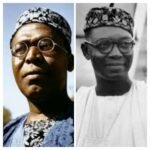
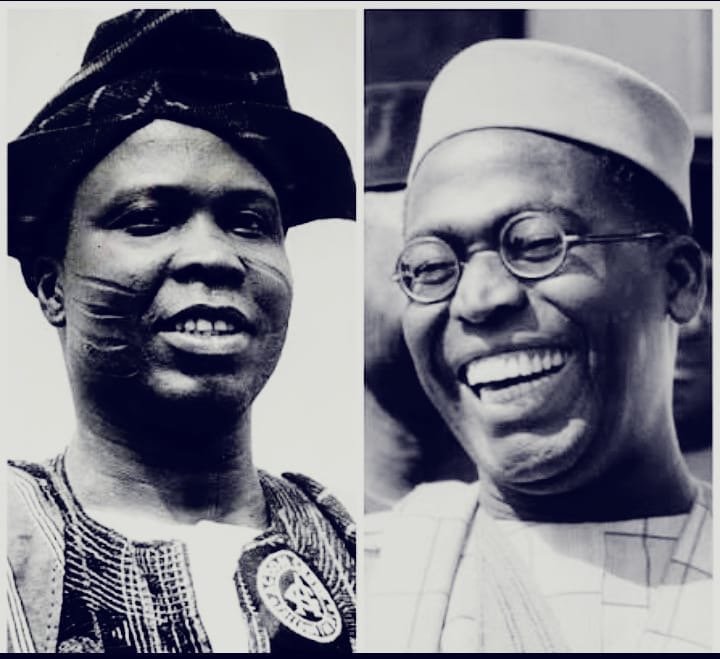
At the heart of this crisis was a bitter personal and political struggle between two men: Chief Obafemi Awolowo, the charismatic leader of the Action Group (AG) and Premier of the Western Region until 1959, and his deputy and successor, Chief Samuel Ladoke Akintola. Their conflict, which came to a head at the AG’s annual congress in Jos in February 1962, was not merely a disagreement over policy. It was a battle for the soul of the Yoruba political establishment, and, ultimately, for the future of Nigeria itself.
The conventional narrative, carefully constructed over decades by Awolowo’s admirers and apologists, paints Akintola as a traitor who sold out his people by seeking an alliance with the Northern People’s Congress (NPC). But a deeper examination of the historical record reveals a far more uncomfortable truth: Awolowo had forced Akintola into the arms of the NPC. He then blamed Akintola for the very alliance he had provoked.
“THIS IS NOT REVISIONISM. THIS IS HISTORY.”
THE JOS CONGRESS: THE BREAKING POINT
The Action Group’s annual congress in Jos, held from February 1 to 8, 1962, was meant to be a moment of unity for the party that formed the official opposition in the federal parliament. Instead, it became the scene of a dramatic rupture. Awolowo publicly denounced his deputy, and Akintola, along with the party’s General Secretary, Ayo Rosiji, walked out of the convention when it became clear they would be expelled.
What triggered this public humiliation? The immediate cause was a fundamental disagreement over political strategy. Akintola, who had become Premier of the Western Region in 1959 after Awolowo stepped down to lead the party at the federal level, believed that the Action Group should seek an alliance with the Northern People’s Congress, the dominant party in the North. He saw the NPC’s electoral strength and reasoned that the Yoruba people could not afford to be excluded from the centre of power.
Awolowo, however, refused. He insisted that the AG should instead ally with the NCNC, the party led by Nnamdi Azikiwe. But this was not merely a strategic disagreement. It was a power struggle. Awolowo wanted to maintain control over the party and the Western Region. Akintola, as Premier, had his own base of support and his own ambitions. Awolowo viewed Akintola’s overtures to the North as a direct challenge to his authority.
And so, in Jos, Awolowo moved to crush his rival. He mobilized the party machinery against Akintola, forcing him out. But in doing so, he made a fatal miscalculation: he pushed Akintola directly into the arms of the very people he feared.
AKINTOLA EMBRACE OF THE NPC: A CALCULATED MOVE OR A DESPERATE ACT?
Following his humiliation at Jos, Akintola did what any politician in his position would do. He sought allies where he could find them. And the NPC, led by the Sardauna of Sokoto, Sir Ahmadu Bello, was more than willing to welcome him.
The Sardauna saw an opportunity. The NPC had long viewed the Action Group as a troublesome, unpredictable party that threatened Northern hegemony. By supporting Akintola’s breakaway faction, the Fulani elite could destroy the AG from within, divide the Yoruba political front, and ensure that the South-West would never pose a united challenge to Northern domination.
The alliance was quickly cemented. Akintola “sought refuge in the Northern political tent and was enthusiastically welcomed by Sir Ahmadu Bello”. The Sardauna visited Ibadan on a state visit to formalize the accord, much to Awolowo’s annoyance.
The NPC’s support for Akintola was not subtle. As one contemporary account noted, “It was clear that Chief Akintola had the sympathy, if not the support, of the NPC, which saw in the Action Group crisis an opportunity of destroying that turbulent party completely”. The federal government, dominated by the NPC, was “interested in the fate of both the Action Group as a party and Chief Awolowo as the leader of that party”.
But who had made this alliance inevitable? It was Awolowo himself. By publicly denouncing his deputy, by attempting to expel him from the party, by refusing to compromise, Awolowo had closed off every other avenue for Akintola. He had backed his rival into a corner, and the only way out was through the NPC. Awolowo had forced Akintola into the arms of the NPC. He then blamed Akintola for the very alliance he had provoked.
THE COKER COMMISSION AND THE TREASON TRIAL: THE DESTRUCTION OF THE ACTION GROUP
With the AG split, the federal government moved to consolidate its advantage. In 1962, Dr. Moses Majekodunmi, the Sole Administrator of the Western Region, set up the Coker Commission of Inquiry into the affairs of certain statutory corporations. The commission was tasked with investigating allegations of financial mismanagement within the Western Region.
The findings were devastating for Awolowo. The Coker Commission found him guilty of diverting regional funds to finance the Action Group, while exonerating Akintola. The commission’s report was a political weapon, used to discredit Awolowo and legitimize Akintola’s faction.
But the federal government did not stop there. In November 1962, Awolowo and several of his associates were arrested and charged with treasonable felony. The trial that followed was a spectacle. In September 1963, Awolowo was found guilty on three charges: treasonable felony, conspiracy to commit felony, and conspiracy to contravene the Firearms Act. He was sentenced to ten years in prison.
The New York Times reported the verdict: “Chief Obafemi Awolowo … was found guilty and sentenced to 10 years in prison today for having plotted to overthrow the Government of Prime Minister Sir Abubakar Tafawa Balewa”. The paper noted that “Chief Awolowo was found guilty on three charges: treasonable felony, conspiracy and illegal importation of firearms”. His supporters were given even longer sentences.
Awolowo’s conviction was the final blow to the Action Group. The party that had once been the voice of the Yoruba people was now shattered, its leader in prison, its structures dismantled. The Yoruba political front was divided, and the Fulani elite had achieved their goal: the South-West was no longer a threat to their hegemony.
THE 1965 ELECTION AND OPERATION WETIE: THE VIOLENCE THAT PRECEDED THE COUP
The 1965 Western Region elections were a bloodbath. The election was rigged beyond recognition against the Awolowo-led Action Group by the combined might of the Nigerian National Democratic Party (NNDP), led by Akintola, and the ruling NPC. The violence that followed became known as “Operation Wetie”, a Yoruba term meaning to pour petrol on perceived opponents and set them on fire. Thousands were killed in an undignified manner.
This apocalyptic interlude, which consumed the Western Region from 1962 to early 1966, was the direct result of the Awolowo-Akintola feud. It was the first major test for Nigeria’s government in the post-colonial era. And it essentially set in motion a chain of events that eventually led to the first military coup in Nigeria on 15 January 1966.
THE JANUARY 1966 COUP: A FULANI SMOKESCREEN
On January 15, 1966, a group of young military officers, led by Major Chukwuma Kaduna Nzeogwu, staged a coup. The plotters included officers of Igbo, Yoruba, and other ethnic backgrounds. Their targets were the political elite who they believed had corrupted the nation. The coup was a response to the perceived corruption and authoritarianism of the NPC-dominated government.
The casualties included Sir Ahmadu Bello, the Sardauna of Sokoto and Premier of the Northern Region; Sir Abubakar Tafawa Balewa, the Prime Minister; Chief Samuel Ladoke Akintola, Premier of the Western Region; and other senior political and military figures. Notably, the coup plotters also killed key Fulani figures, including Brigadier General Zakariya Maimalari and Colonel Kur Mohammed.
But the Fulani elite quickly twisted the narrative, labeling it an “Igbo coup” because the majority of the plotters were Igbo. This framing served a strategic purpose: it turned the anger of the Hausa-Fulani masses against the Igbo, diverting attention from the Fulani oligarchy’s own failures and justifying a brutal crackdown on the Igbo population. The counter-coup of July 1966, spearheaded by Hausa-Fulani elements in the army, restored Fulani dominance—and the massacres of Igbo civilians in the North that followed were a calculated campaign of ethnic cleansing, not a spontaneous outbreak of violence.
BRITAIN AND THE FULANI: THE ALLIANCE THAT SHAPED NIGERIA
The British role in these events cannot be overstated. Declassified documents show that British policy in Nigeria was shaped by oil interests. The British secretly provided large quantities of arms to the federal government during the civil war, with the Foreign Office noting that “anything that we now do to assist the FMG should help our oil companies to re-establish and expand their activities in Nigeria after the war”. The Fulani elite were the primary agents of this British-controlled political power, and they were more than willing to serve as collaborators in the extraction of Nigeria’s resources.
QUESTIONING THE NARRATIVES WE HAVE BEEN SOLD
What I have written here is based on what I have learned from history, from the documented evidence, from the papers, articles, and documentaries that have painstakingly uncovered the truth. This is not a polemic against any tribe. This is not an attack on the Yoruba people, the Igbo people, or the Hausa people. This is a questioning of the narratives that the elites have been selling us for decades.
The Awolowo-Akintola crisis was not a simple story of a hero and a villain. It was a complex struggle for power, one in which both men made mistakes, and in which the Fulani elite played a cynical role. Awolowo forced Akintola into the arms of the NPC. He then blamed Akintola for the very alliance he had provoked. This is not an opinion. This is the historical record.
We owe it to ourselves, to our children, and to the generations yet unborn to question the narratives we have been fed. We owe it to ourselves to dig deeper, to read widely, and to think critically. Only then can we begin to build a new Nigeria, one based on justice, equity, and the dignity of all our people.
Further Reading and References:
· The New York Times, “Nigeria Imprisons Opposition Head for 10 Years,” September 11, 1963
· The Guardian, “This Awo, when is he coming?” May 17, 2017
· Daily Post, “Obafemi Awolowo: Hero of Yoruba, Killer of Biafra, Betrayed by the North,” March 6, 2013
· The Will News, “Obafemi Awolowo: Hero of Yoruba, Killer of Biafra, Betrayed by the North,” August 15, 2013
· The Cable, “FLASHBACK: How Nzeogwu killed Ahmadu Bello and wife,” December 17, 2017
· The Cable, “Operation Wetie: When power chose restraint,” August 17, 2026
· Max Siollun, Oil, Politics and Violence: Nigeria’s Military Coup Culture (1966-1976)
· Taylor & Francis, “The Hausa-Fulani and their Authority Patterns”
khaleed yazeed
founder wakilin yamma youth development network Katsina state Nigeria.