By Okoi Obono-obla
As campaigns for the 2027 general election commence today, 19 August 2026, the opposition has again raised to the front burner the 1993 United States civil forfeiture case involving President Bola Ahmed Tinubu. The current claim circulating is that a United States District Court has granted a Freedom of Information request for the case file to be “opened and released to the Department of Justice,” implying that a criminal case is being resurrected.
This is legally incorrect. It conflates three different things under U.S. law: civil forfeiture, criminal prosecution, and a FOIA request for records.
1. What was the 1993 case?

The case was United States v. Funds in Accounts Nos. 263226700, etc., No. 93 C 4483, U.S. District Court for the Northern District of Illinois, Eastern Division, before Judge John A. Nordberg.
The government filed a civil forfeiture complaint under 21 U.S.C. § 881 — the federal statute that authorizes civil forfeiture of property linked to drug trafficking. The government alleged that funds in accounts held in the name of Bola Tinubu at First Heritage Bank and Citibank were proceeds of narcotics trafficking.
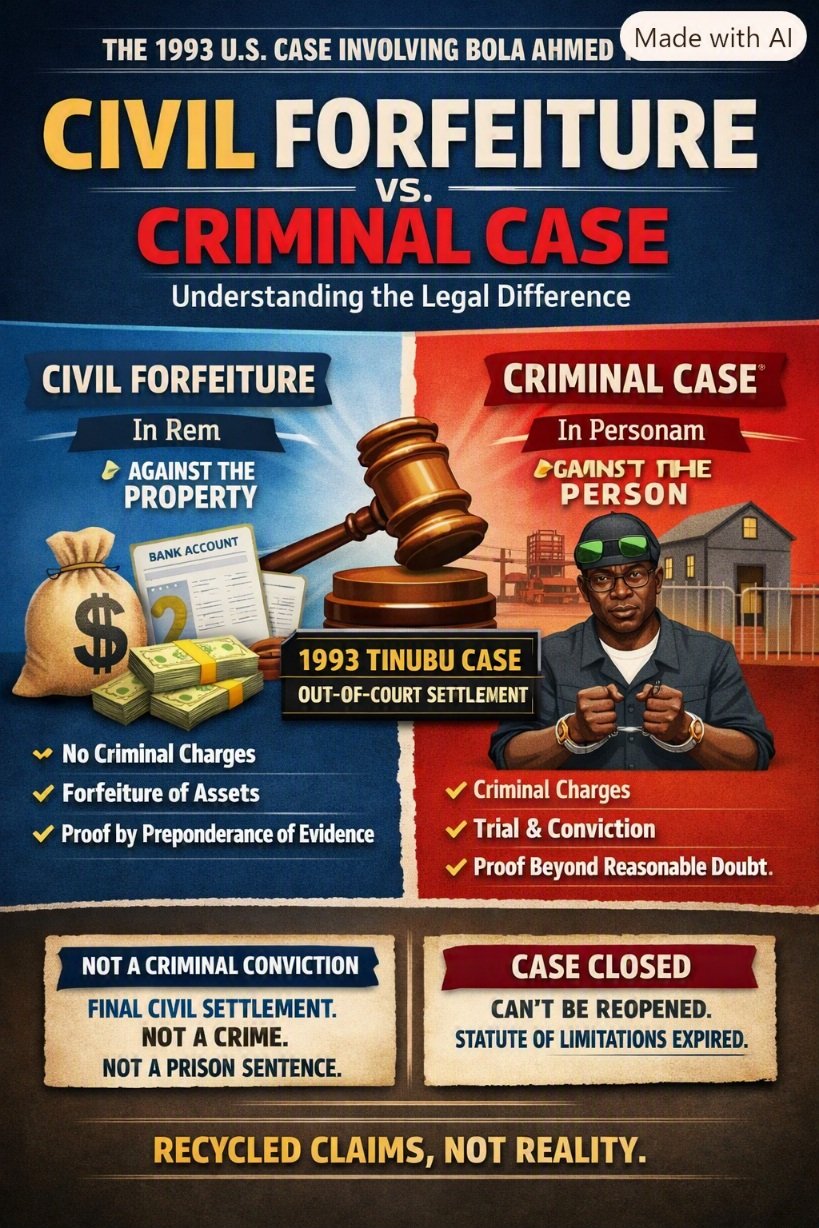
The matter did not go to trial. On September 15, 1993, the parties reached an out-of-court settlement that was read into the record. Under that settlement, $460,000 was forfeited to the United States. The APC’s own filing before the Presidential Election Petition Court described it accurately: the decision was “not a fine but a decree of forfeiture… pursuant to the settlement of claim by the parties to the case” and was “not against the 2nd Respondent but against the funds.”
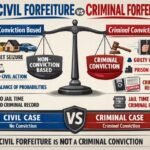
2. Is a civil forfeiture a criminal case?
No. Under U.S. law, there are two separate tracks:
a) Civil Forfeiture – 18 U.S.C. § 981 and 21 U.S.C. § 881
It is in rem — the case is against the property itself, not the person. The government must prove by a preponderance of evidence that the property is connected to a crime. No criminal conviction is required.
b) Criminal Forfeiture – 18 U.S.C. § 982 and 21 U.S.C. § 853
It is in personam — against the person. It is part of the sentence after a criminal conviction, and requires proof beyond reasonable doubt.
The 1993 Tinubu matter was on the civil track. It was never a criminal indictment, never resulted in a criminal conviction, prison sentence, or criminal fine. The Supreme Court in United States v. Ursery, 518 U.S. 267 (1996) held that civil forfeiture is not “punishment” for double jeopardy purposes.
3. Can the 1993 case be “resurrected” today?
No. A settlement judgment entered in 1993 is a final judgment subject to res judicata. Most federal drug felonies have a 5-year limitation under 18 U.S.C. § 3282, so a new criminal case based on conduct from 1990-1993 would be time-barred. The Department of Justice was already the plaintiff in 1993 and has always had the file; the Illinois docket has always been public on PACER.
4. What then is the current FOIA case?
This is a completely different lawsuit: Aaron Greenspan v. Department of Justice, et al., U.S. District Court for the District of Columbia.
Between 2022 and 2023, Greenspan filed FOIA requests seeking records on a Chicago drug ring and on Tinubu and others. On April 8, 2025, Judge Beryl Howell ordered the FBI and DEA to search for and process non-exempt records, rejecting their Glomar refusal. The order did not reopen the 1993 forfeiture case and did not create a prosecution. FOIA is a records-access statute only.
5. The Matter Has Already Been Litigated in Nigeria and Decided
The Presidential Election Petitions filed by Atiku Abubakar and Peter Obi against Bola Ahmed Tinubu, which sought his disqualification on the ground of this very civil forfeiture case couched as a criminal trial, were dismissed by both the Presidential Election Petitions Tribunal and the Supreme Court of Nigeria, respectively.
Both courts held that the U.S. proceeding was a civil forfeiture of funds, not a criminal conviction or a fine for dishonesty or fraud within the meaning of Section 137(1)(d) of the 1999 Constitution. That issue is therefore res judicata in Nigeria as well.
6. Conclusion: Red Herrings Instead of an Alternative Agenda
The opposition in Nigeria clearly lacks the vision and the stamina to take on President Bola Ahmed Tinubu on his policy agenda and performance, and is resorting to red herrings and diversions such as a dead civil forfeiture case decided 33 years ago, an NYSC discharge certificate with discrepancies in names, and all such frivolous issues, rather than convincing Nigerians that it offers a dependable and credible alternative.
Voters deserve a campaign based on ideas, economic policy, security, and governance — not on the deliberate recycling of a settled civil case that, under American law, was never a criminal conviction and can never be resurrected as one.