By Okoi Obono-Obla
ABSTRACT
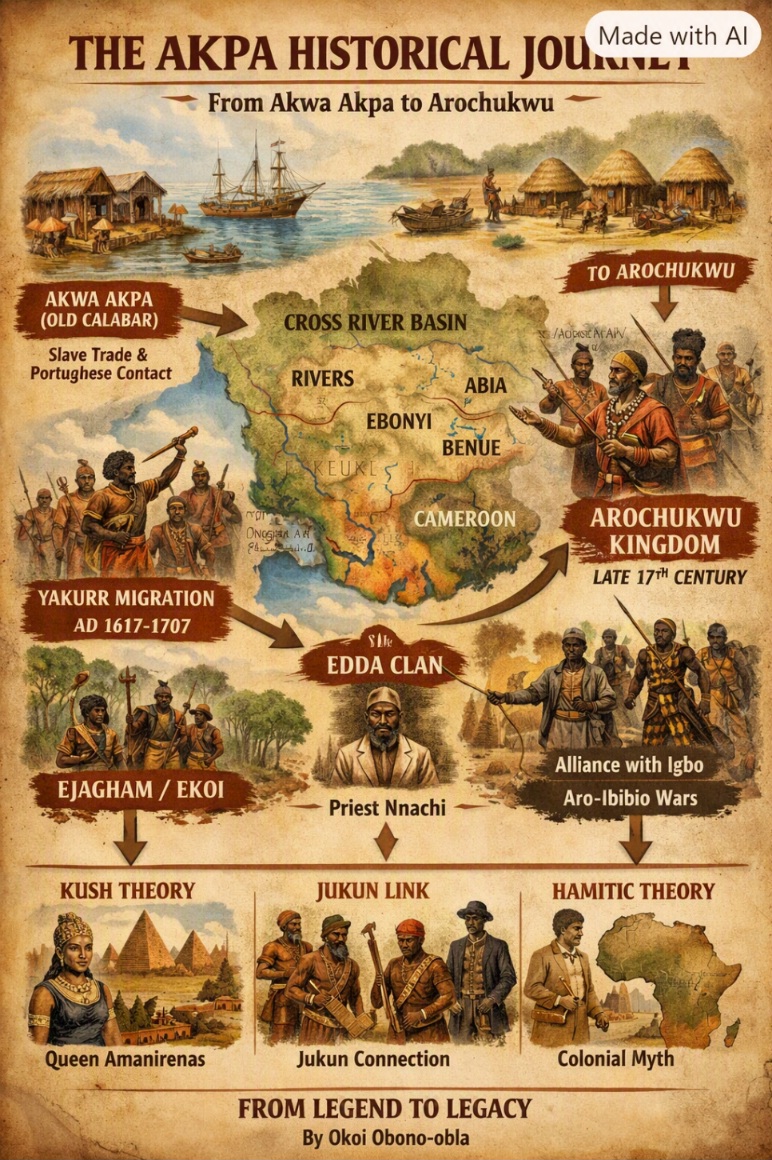
This paper examines the historical phenomenon of the Akpa people, a group whose memory recurs persistently in the oral traditions of the Cross River Basin, covering Cross River, Akwa Ibom, Abia, Rivers, Bayelsa, Ebonyi and Benue States, as well as the Jukun area of Taraba and South-western Cameroon. Although the Akpa appear to be extinct in Nigeria’s contemporary ethnic taxonomy, toponymic, oral and documentary evidence demonstrates their continuity as the Ejagham/Ekoi (Abakpa/Qua) people of Akamkpa. The paper interrogates traditions from Yakurrland, Arochukwu and Old Calabar (Akwa Akpa), corrects colonial-era chronological errors regarding Portuguese contact, the Kushite hypothesis and the Hamitic theory, and argues that the Akpa represent a case of political transformation rather than extinction.
Keywords: Akpa, Akwa Akpa, Ejagham, Ekoi, Arochukwu, Yakurr, Calabar, Cross River
1.0 INTRODUCTION
The Akpa people are a common historical phenomenon that runs throughout the entire gamut of the historical traditions of the people of the Cross River Basin right to Abia, Rivers, Bayelsa, Ebonyi, Akwa Ibom and Benue States. From the Jukun people of Taraba State to the people of Southern Cameroon, references to Akpa are so persistent that they have become stuck in a profound conundrum and mystery, appearing extinct in the present firmament of Nigeria’s ethnic make-up. Yet in these states there are several places and even names of places in which the word Akpa resonates everywhere.
This paper seeks to grammatically refine, historically correct and analytically expand this puzzle.
2.0 AKPA IN YAKURR TRADITION: EDIM OMIN AKPA AND UWOU AKPA
In the tradition of the Yakurr people of Cross River State, the word Akpa is powerfully nostalgic. According to these traditions, the Yakurr began leaving Akpa around AD 1617 after a dispute with neighbouring groups over a burial custom led to war and forced them from their homeland¹.
Ubi describes the Yakurr migration as occurring between 1617 and 1677 following a military defeat by the Akpa². Around AD 1660, Yakurr migrants established settlements at Idomi and Ugep in what is now Cross River State³. Later migrations between 1677 and 1707 are associated with the founding of Ekori and Nko.
The legendary figure who led the assault of the migrants that arrived at present Ijiman town of Ugep on Elomikpon Hill where the battle against Abayon took place bears the Akpa name: Edim Omin Akpa, also rendered as Edem Omilakpa⁴. When the Okpebri of Ugep, who is the Chief Ceremonial Priest, prays he exclaims Uwou Akpa (Father Akpa), which indicates that the people of Ugep acknowledge Akpa as their great progenitor.
3.0 AKWA AKPA: THE ORIGINAL NAME OF CALABAR
A critical piece of toponymic evidence is often overlooked: Calabar was originally known as Akwa Akpa.
It was originally named Akwa Akpa, in the Efik language, as the Efik people dominate this area⁵. The city of Akwa Akpa was founded by Efik families who had left Creek Town, further up the Calabar river, settling on the east bank in a position where they were able to dominate the slave trade with European vessels that anchored in the river⁶.
The coast in this region was named “Calabar” by the Portuguese explorer Diogo Cão. His reason for choosing this name is unknown, since it was not used by the Efik people⁷. This refutes the claim that the name was changed in the 17th century by Portuguese merchants frequenting the estuary. Portuguese exploration of the Bight of Biafra began under Fernão do Pó after 1472, and the corruption of Akwa Akpa to Calabar became entrenched gradually during the 16th-17th century Atlantic trade era, not as a single 17th-century renaming. Old Calabar was also known as Duke Town, the Portuguese name of unknown derivation for a city-state on the river⁸.
Thus Akwa Akpa cements the original connection between the Efik and the Ejagham/Ekoi-Akpa world.
4.0 THE AKPA AND THE FOUNDATION OF AROCHUKWU
The most documented political appearance of the Akpa is in the Aro-Ibibio Wars.
As Aro-Ibibio wars occurred, there was a stalemate. In reaction, Igbo leaders invited a priest named Nnachi from the Edda clan of northeastern Igboland and another group from the east of the Cross River⁹. Edda is today in Afikpo South LGA of Ebonyi State. This Ebonyi connection is vital, as Edda-Afikpo formed the ritual and trading corridor linking the Igbo hinterland to the Cross River.
These people were identified as the Akpa people. Akpa forces led by Osim and Akuma Nnubi helped the Igbo forces capture the rest of the area. This formed the alliance of 19 new and old states in the area known as the Arochukwu kingdom around 1650–1700¹⁰.
Osim and Akuma Nnubi were brothers and merchant princes of the Akpa people from the east of the Cross River in the late 17th century¹¹. They allied with Igbo groups to fight against the northern Ibibio clan. The Akpa are descendants of the Ejagham in present day Cross River State in Southeastern Nigeria¹². This Aro lineage is originally from the Akamkpa kingdom in Ekoi (Okonyong) territory¹³.
Modern historiography guided by genealogies and the importation of the first guns into Calabar locates the foundation of the chiefdom ca. 1690/1720¹⁴, not the 15th century as popularly claimed. The claim that the Akpa had firearms in the 15th century via Portuguese dealings in the 14th century is anachronistic; firearms only became decisive in the Cross River hinterland in the 17th century.
5.0 DECONSTRUCTING MYTHS: CUSH, JUKUN AND THE HAMITIC THEORY
5.1 The Cushitic Hypothesis: Some accounts claim the Akpa were originally from the Sudanic-Nilotic region, possibly of Cush origin, citing Queen Amanirenas who defeated the Roman Empire. The Kingdom of Kush did fight Rome in 27-22 BCE under Queen Amanirenas. However, there is no linguistic or archaeological evidence linking the Niger-Congo, Bantoid, Ekoid-speaking Ejagham-Akpa to Nilo-Saharan Kushites.
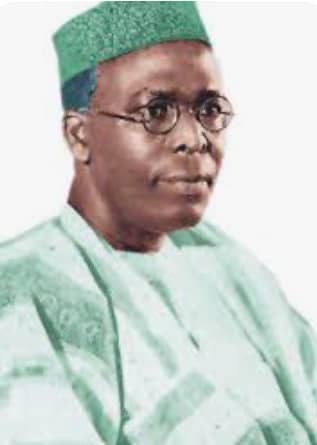
5.2 The Jukun-Ekoi Link: In his eminent work Who is a Nigerian, Dr. Okoi Arikpo alluded to the fact that the Ekoi (Ejagham) are related to the Jukun through the Akpa tradition¹⁵. The Ejagham started migration as a result of upheavals that took place in 1600 in their original abode in present Cameroon. The relationship is best explained by shared Benue-Congo heritage, not long-distance migration.
5.3 The Hamitic Theory: Palmer suggested they are Hamitic people even though the Hamitic theory has been consigned to the dust bin of history. The theory is now discredited as a colonial racial construct.
6.0 CONCLUSION
The Akpa are not extinct. They survive under other names: as the Southern Ejagham dialect group called Ekin, Qua, Kwa, Aqua, Abakpa¹⁶, as the Ekoi people, also known as Ejagham, an ethnic group in the extreme southeast of Nigeria and extending eastward into the southwest region of Cameroon¹⁷, as the Ibom Isi kindred in Arochukwu who have highly influenced the Cross River Igbo culture¹⁸, and as the enduring invocation Uwou Akpa in Ugep.
The Aro themselves are an admixture and indeed fusion of Ekoi, Ibibio, Efik, Edda (Ebonyi) and elements of Igbo people autochthonous to its present location.
The mystery of Akpa, therefore, is not one of disappearance but of transformation: from Akwa Akpa on the estuary of the Cross River to the war command of Osim and Akuma Nnubi, to the ancestral stone of Edim Omin Akpa in Ijiman.
FOOTNOTES
¹ Yakö people – Wikipedia, migration from Akpa around AD 1617 after dispute over burial custom.
² The Yakurr: A Reconstruction of Pre-Colonial History, ir.unilag.edu.ng – military defeat from Akpa compelled migration.
³ Yakö people – Wikipedia – establishment of Idomi and Ugep around AD 1660.
⁴ Migration, History And Origin of the Ugep People – Edem Omilakpa rolling stone against Akpa warriors; Special Adviser on Events Management – Edem Omini Akpa stone located in Ijiman.
⁵ Calabar – Wikipedia – It was originally named Akwa Akpa, in the Efik language.
⁶ Duke Town – Wikipedia – city of Akwa Akpa founded by Efik families from Creek Town.
⁷ Duke Town – Wikipedia – coast named “Calabar” by Portuguese explorer Diogo Cao, reason unknown, not used by Efik.
⁸ A Taxonomic Revision of Boas – Etymology: Refers to type locality of Old Calabar (Akwa Akpa; “Duke Town”), Portuguese name of unknown derivation for 19th century city-state.
⁹ Arochukwu – Alchetron – As Aro-Ibibio wars occurred, there was a stalemate… Eze Agwu clan invited priest Nnachi from Edda clan.
¹⁰ Arochukwu – Wikipedia – Akpa forces led by Osim and Akuma Nnubi formed alliance of 19 states known as Arochukwu kingdom around 1650-1700.
¹¹ Nnubi dynasty – Wikipedia – Osim and Akuma Nnubi were brothers and merchant princes of Akpa people from east of Cross River.
¹² Ibom Isi – Wikipedia – Akpa are descendants of Ejagham in present day Cross River State.
¹³ Ibom Isi – kotoba.ne.jp – lineage originally from Akamkpa kingdom in Ekoi territory.
¹⁴ Integrating Arochukwu into Regional Chronological Structure, Cambridge Core – foundation ca. 1690/1720 interrelated with importation of first guns into Calabar.
¹⁵ CrossRiverWatch – Are The Jukun, Yala And Ejagham People Related? – Okoi Arikpo alluded to Ekoi are related to Jukun through Akpa tradition.
¹⁶ Nigerian Language Classification – Dialects: SOUTHERN EJAGHAM (EKIN, QUA, KWA, AQUA, ABAKPA).
¹⁷ Ekoi people – museum-digital – Ekoi people, also known as Ejagham, are ethnic group in extreme southeast of Nigeria extending eastward into southwest region of Cameroon.
¹⁸ Ibom Isi – Alchetron – Akpa people are mainly in Ibom but traces can be found all over Arochukwu. They have highly influenced Cross River Igbo culture.
REFERENCES
Afigbo, A.E. (1987). The Igbo and their Neighbours.
Arikpo, Okoi. (1969). Who are the Nigerians?
Dike, K.O. & Ekejiuba, F.I. (1990). The Aro of South-Eastern Nigeria 1650-1980.
Latham, A.J.H. (1973). Old Calabar 1600-1891.
Palmer, H.R. (1928). Sudanese Memoirs.
Ubi, A. (1986). The Yakurr: A Reconstruction of Pre-Colonial History. University of Calabar.