
By Okoi Obono-Obla
A Facebook comment under a post by a Chief Executive of a State has generated debate. The comment reads:
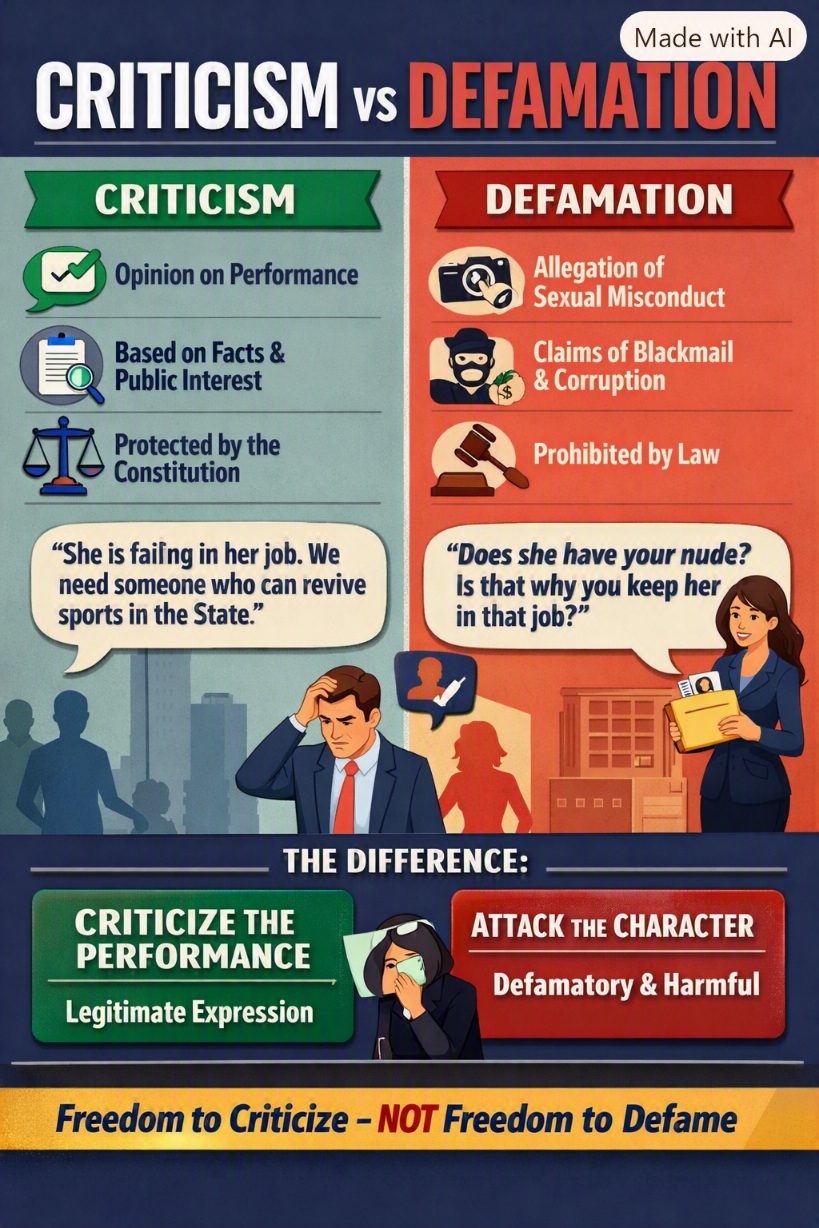
“That woman in the Sports Ministry, does she have your nude? Why not replace her with someone who can revive sports administration in the State?”
Some commentators have asked: Is this defamation or is it just hard criticism of government? The distinction matters.
1. What the law says defamation is
In Nigeria, defamation by publication in permanent form – including writing on Facebook – is libel. For it to be actionable, three things must be present:
Publication to a third party;
Reference to an identifiable person;
Words that in their natural and ordinary meaning tend to lower that person in the estimation of right-thinking members of society.
The test is objective: What would a reasonable reader understand the words to mean, not what the writer says he meant in his heart.
Applied to this statement, the publication and reference elements are met. A comment on the Chief Executive’s page is published to the world, and “That woman in the Sports Ministry” is sufficient reference if people in that State know who occupies that office. You do not need to mention a name.
The sting is in the question: “does she have your nude?”
In its natural meaning, a reasonable reader would take that to mean that the female officer is in possession of nude photographs of her boss, that she obtained them through sexual intimacy, and that she is using them as leverage to retain her office despite incompetence. That is the meaning supplied by the second sentence – “Why not replace her…”
That imputation alleges unchastity, sexual impropriety, blackmail/extortion, and unfitness for public office. Under our law – Civil and Criminal Code Section 373 and Penal Code Section 375 – an imputation of sexual misconduct against a woman is defamatory per se. It requires no innuendo or extrinsic evidence to explain it. As the Supreme Court held in Iloabachie v. Iloabachie, such an allegation is actionable without proof of special damage.
It also incidentally defames the Chief Executive himself, by imputing that he is sexually compromised and allows a sensitive ministry to be run on the basis of sexual blackmail.
In its natural meaning, therefore, the statement is prima facie defamatory.
2. But is it not criticism?
This is where many social media users get it wrong. The Constitution guarantees freedom of expression under Section 39, and every public officer must expect robust, even harsh, criticism. But freedom to criticize is not freedom to defame.
The law protects Fair Comment or Honest Opinion on matters of public interest, but it imposes strict conditions:
a) Criticism is opinion; defamation is allegation of fact.
To say “This Commissioner is incompetent, she has failed to revive sports, she should be sacked” – that is opinion. Even if harsh, even if wrong, it is criticism.
To say “She has his nude photos” – that is an allegation of fact. Framing it as a question does not make it less defamatory. Gatley on Libel is clear: if a question implies a defamatory fact, it defames. You cannot ask “Is he a thief?” and then claim you were only asking.
b) Criticism must be based on true facts.
Fair comment must be anchored on facts that are true or stated in the publication. What true fact is this comment based on? None. The writer invents the fact of the nude and then comments on it.
c) The comment must be on a matter of public interest, without malice.
How sports administration is run is public interest. Who a female director allegedly sleeps with is not. And a comment made with intent to injure or without honest belief loses protection.
What we have in this Facebook comment is a common social media tactic: take a defamatory fact, then attach a legitimate criticism to it to sanitize it. The law does not allow that. The court reads the publication as a whole. Here, the second sentence – which on its own would be legitimate criticism – is used to supply the motive for the first: she is retained despite her inability to revive sports because she has his nude.
Vulgar abuse like “she is useless” may be mere insult. An allegation that a woman is using sexual blackmail to keep her job is not.
Conclusion
We must defend the right of citizens to criticize government fiercely. Democracy dies without it. A citizen is entitled to tell a Governor that his Sports Ministry is moribund and his appointee should be replaced.
What a citizen is not entitled to do is to explain that failure by imputing that the female appointee is a sexual blackmailer in possession of the Governor’s nude photographs.
One is criticism – protected by the Constitution. The other is defamation – prohibited by law. The difference lies in whether you are attacking the person’s performance or attacking her chastity and character with a false factual claim.
Social media has given everyone a megaphone. It has not repealed the law of defamation.