By Okoi Obono-Obla
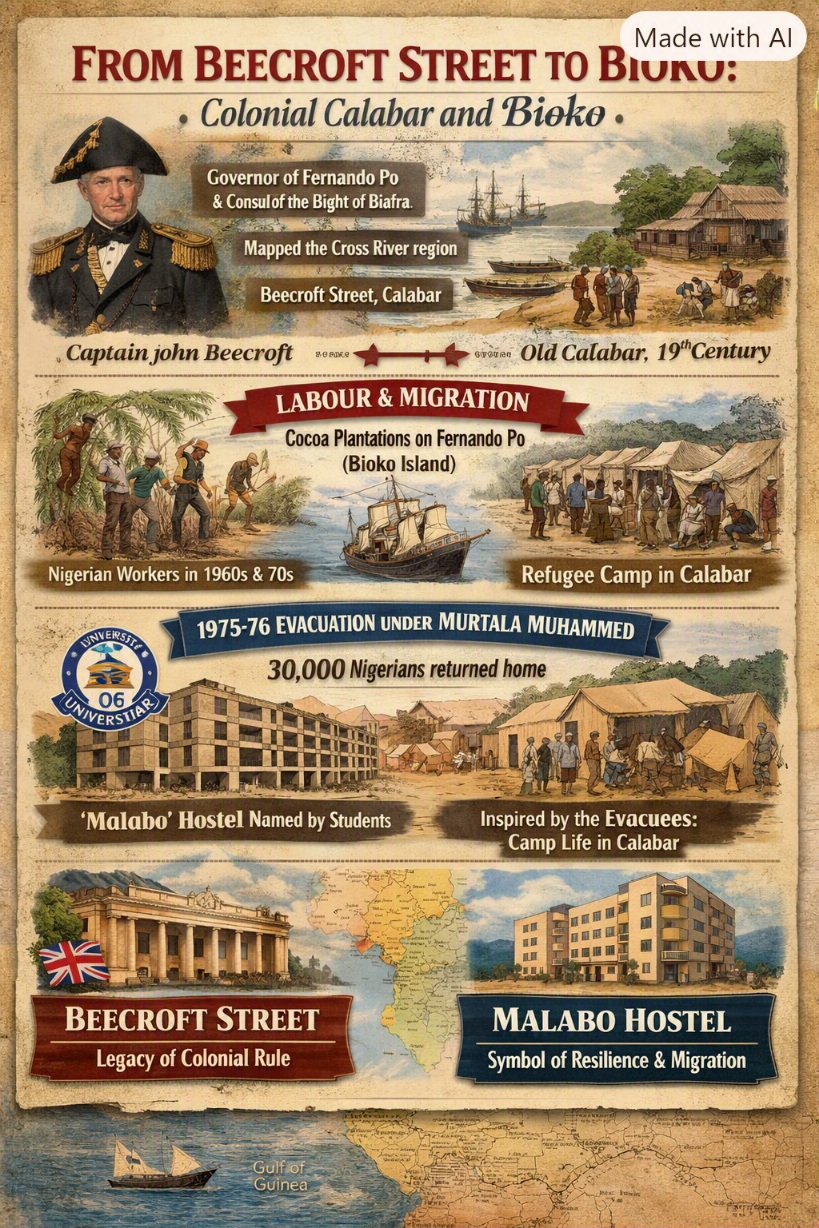
In my piece of 23 July 2026, I traced how Capt. John Beecroft, Governor of Fernando Po (Bioko) and Consul of the Bight of Biafra, sailed up the Cross River, renamed Ugep, and mapped this region for empire – earning him Beecroft Street in Calabar. That same route later carried our people as plantation labourers to Fernando Po, until their mass evacuation in 1975/76 under Murtala Muhammed and their camp life in Calabar inspired UNICAL students to name their uncompleted hostel ‘Malabo’. One street, one hostel – a 150-year archive of colonial power, migration and resilience. My appreciation to Macarius Essien for the Malabo link.
On 23rd July 2026, I reflected on the deep historical connection between the Cross River Region and present-day Equatorial Guinea, and how that connection is etched into the map of Calabar itself.
At the heart of it is Captain John Beecroft (1790 – 10 June 1854) – British mariner, explorer, trader and colonial administrator. Beecroft served as Governor of Fernando Po [now Bioko Island] and later as British Consul for the Bight of Benin and Biafra. From his base on the island, he made extensive exploratory voyages up the Cross River and Niger in the 1840s and early 1850s. It was in the course of these expeditions that he encountered Ugep and, in typical colonial fashion, gave it a new name. He mapped and documented much of the Bight of Biafra for British commercial and imperial interests. His legacy endures in Calabar, capital of Cross River State, where Beecroft Street is named in his honour – alongside Hewett, Johnstone and other streets bearing the names of imperial agents.

This same geography – the Bight of Biafra – was central to the Transatlantic Slave Trade. From the 15th to the 19th century, millions of Africans were forcibly trafficked through its ports. After Britain abolished the trade in 1807, Fernando Po became a British naval base for suppressing slavery. Ironically, a new system of exploitation replaced the old: contract and indentured labour. Thousands of people from the Cross River region, Igboland and beyond migrated to work on the lucrative cocoa plantations of Fernando Po.
That labour history came to a tragic head after Equatorial Guinea’s independence on 12 October 1968. Under President Francisco Macías Nguema, conditions for Nigerian workers deteriorated drastically. By late 1975, the Federal Military Government under General Murtala Muhammed ordered a full evacuation. By December 1975 about 10,000 Nigerians had returned home, and by the end of January 1976 close to 30,000 had been evacuated.
Upon return, many evacuees could not immediately trace their communities of origin and were accommodated in refugee camps, including camps erected in Calabar.
This brings me to the valuable addition made by Macarius Essien in his response to my post of 23 July 2026. He wrote:
“During the evacuation of Nigerian citizens from Fernando Po in 1976, many of the returnees could not easily trace their communities of origin, and so had to be accommodated temporarily in camps like refugees. That is what made the students of the University of Calabar, who were made to move into a new set of hostels that had not been fully completed, which had no water and other basic facilities, to see their situation as similar to those of the returnees which made them to name those hostels Malabo which was the capital of Equatorial Guinea as at then. Which is the name it is bearing till date.”
He is absolutely correct.
The University of Calabar, established in 1975 as a campus of the University of Nigeria, Nsukka and one of Nigeria’s second-generation federal universities, was struggling to cater for its teeming student population. Hostels were grossly inadequate, poorly finished and lacked basic infrastructure. In a dose of student sarcasm and ingenuity, the students who were moved into those uncompleted hostels likened their plight to that of the evacuees and christened the hostel Malabo – after Santa Isabel, which had been renamed Malabo, capital of Equatorial Guinea.
The name has endured. To this day, the male hostel in UNICAL is known as Malabo Republic, and its residents are fondly called Malabites, while female students are called Malabresses.
Conclusion:
From Beecroft Street to Bioko, the story comes full circle. A British colonialist who once governed Fernando Po from Calabar gave us a street name; over a century later, Nigerians returning from that same island gave us a hostel name. Both names are living archives of the Bight’s complex history – of empire, of labour, of forced and voluntary migration, and of Nigerian resilience.