By Okoi Obono-Obla
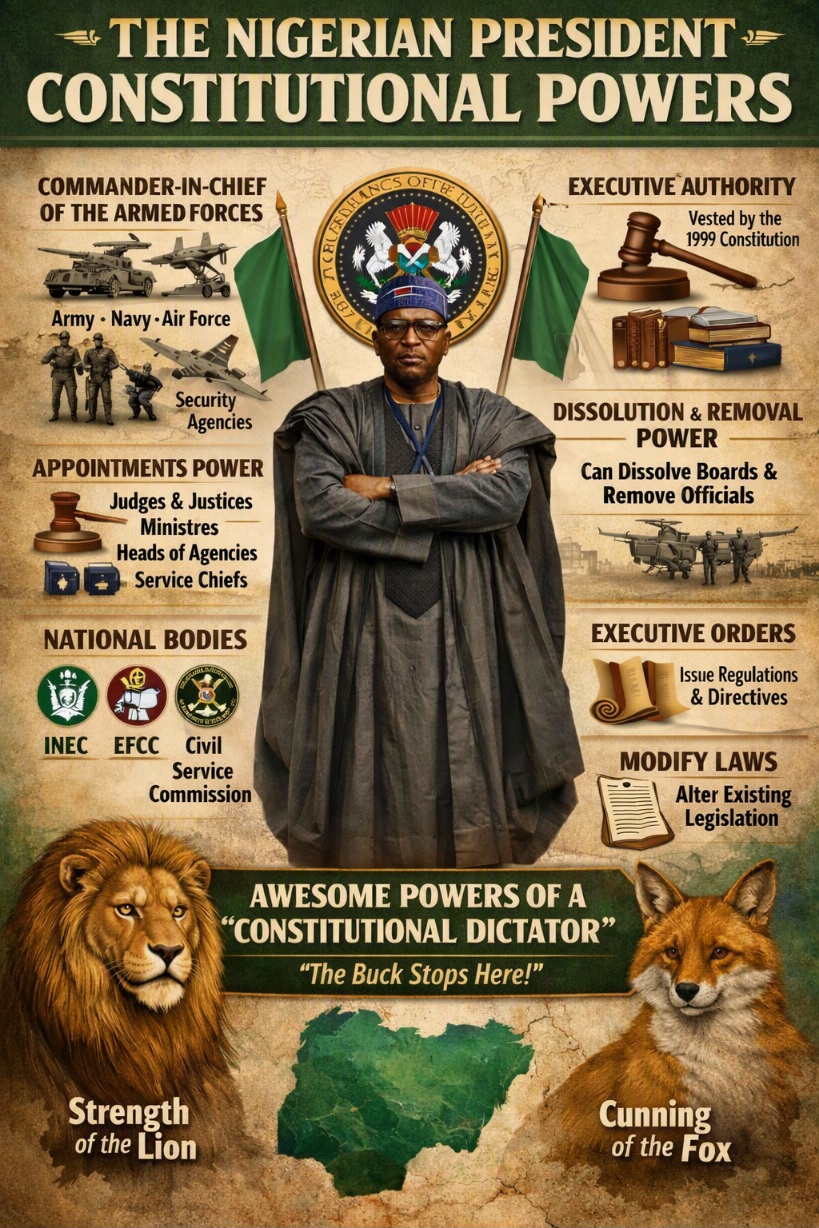
The President of the Federal Republic of Nigeria is one of the most powerful presidents in the world. The Nigerian President is vested with a compendium of powers. He is the Chief Executive of the Federation, Head of State, and Commander-in-Chief of the Armed Forces of the Federation. Indeed, it is the Constitution that makes the President of Nigeria a dictator, not the President himself.
The executive authority of the Federation is vested in him by Section 5(1) of the 1999 Constitution of the Federal Republic of Nigeria (as amended).
The President is also vested with the power to appoint, on the recommendation of the National Judicial Council and subject to confirmation by the Senate, the Chief Justice of Nigeria, Justices of the Supreme Court of Nigeria, the President and Justices of the Court of Appeal, the Chief Judge and Judges of the Federal High Court, the Chief Judge and Judges of the High Court of the Federal Capital Territory, Abuja, and the President and Judges of the National Industrial Court of Nigeria.

He is the appointing authority for the heads of hundreds of agencies, parastatals, commissions, boards and extra-ministerial departments in the executive branch of the Federal Government. All these agencies are created by Acts of the National Assembly. Those enabling laws often vest power in the President to dissolve or remove their boards at any time in the public interest.
The President is also the appointing authority for National Executive bodies under Section 153 of the Constitution, such as the Independent National Electoral Commission, Federal Character Commission, Code of Conduct Bureau, Revenue Mobilisation Allocation and Fiscal Commission, Police Service Commission, National Population Commission, and the Federal Civil Service Commission.
He is equally the appointing authority for the Heads of the Army, Navy, Air Force, Police, Immigration, Civil Defence, and Security and Intelligence Services in the country.
The ample power vested in the President was demonstrated on 6 August 2026 when President Bola Ahmed Tinubu, with a stroke of the pen, directed the Economic and Financial Crimes Commission to take immediate steps to vacate the order freezing one of the accounts belonging to the Osun State Government, on which a Post No Debit order had been obtained over suspicious activities involving money laundering, which the President said was ill-timed and embarrassing and which detractors could capitalize on to accuse him of interference in the democratic process ahead of the Osun State governorship election coming up on 15 August 2026.
The President cannot make laws, as law-making is the constitutional responsibility of the legislative branch. However, under Section 315 of the Constitution, the President may modify existing laws to bring them into conformity with the provisions of the Constitution. In addition, the President can make subsidiary legislation in the form of Executive Orders.
Indeed, the Constitution made the President a sort of constitutional dictator. The framers deliberately made the President a wielder of tremendous influence, clout and acme of power to hold together a fractious country like Nigeria.
In leadership, a leader must use the stick-and-carrot approach to be successful. Sometimes, when the occasion demands, a leader must use carrots to cajole his people. At other times, he must wield the stick to whip recalcitrant followers into line. The Italian political sociologist Vilfredo Pareto, building on Niccolò Machiavelli’s famous dictum in The Prince, argued that a successful leader must combine the ruthlessness of a lion and the cunning of a fox. In history, we have had successful leaders like Lee Kuan Yew of Singapore who skillfully deployed both approaches.
The Nigerian Constitution vested awesome and compendious powers in the President. He is indeed a constitutional dictator not by his own design but by the Constitution which he has sworn an oath to preserve and defend, without minding whose ox is gored. The Constitution of the United States of America, after which Nigeria’s is modeled, also vests awesome powers in its President, and we have seen practically how incumbent President Donald Trump wields those powers unapologetically to get the job done, because the buck stops at his desk.