by Agbonmagbe Kazeem
History and faith do not always tell the same story; but together, they often preserve the memory of extraordinary people.
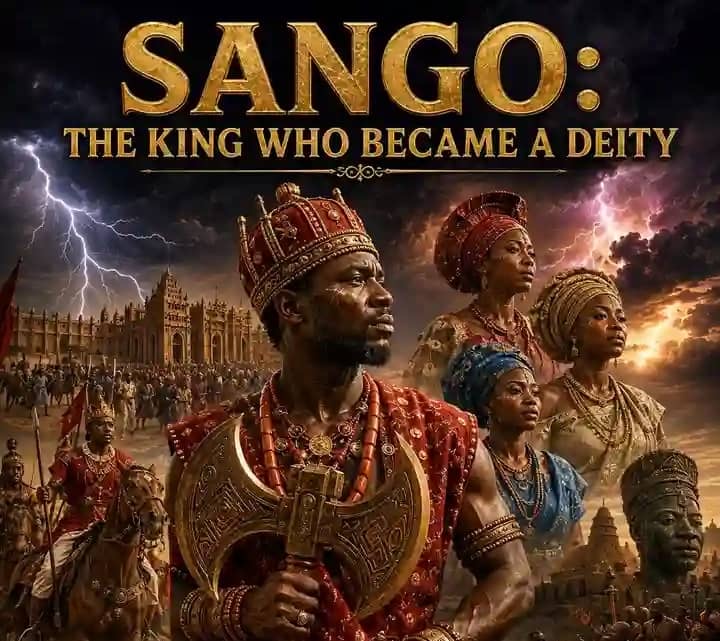
Few figures in African history embody this more powerfully than Sango (Ṣàngó), the celebrated ruler of the early Oyo Kingdom. Remembered as a fearless king, brilliant military leader, and later one of the most revered figures in Yoruba religion, Sango’s legacy has endured for centuries.
Was he simply a king? Or did his extraordinary life inspire a spiritual tradition that transformed him into a sacred figure?

To answer that question, we must distinguish between what historians can verify and what Yoruba oral and religious traditions have faithfully preserved.
1. The Historical Sango
Most historians agree that Sango was a historical ruler who governed the early Oyo Kingdom, although the precise dates of his reign remain uncertain. Yoruba oral traditions generally remember him as the third Alaafin (king) of Oyo, succeeding earlier rulers who helped establish one of West Africa’s most influential kingdoms.
During Sango’s reign, Oyo expanded its political authority and strengthened its military organization, laying foundations for the empire that would later dominate much of present-day southwestern Nigeria and neighboring regions.
Although written sources from his lifetime are unavailable, the remarkable consistency of Yoruba oral traditions strongly suggests that Sango was based on a real historical king whose life became deeply woven into cultural memory.
2. The Rise of Oyo
The Oyo Kingdom emerged in the savanna north of the Yoruba forest belt, where fertile lands and strategic trade routes encouraged political growth.
Over time, Oyo developed into one of Africa’s greatest precolonial states, renowned for:
● Strong centralized government
● Highly organized cavalry
● Long-distance trade
● Skilled diplomacy
● Advanced military strategy
Sango ruled during the kingdom’s formative years, when effective leadership was essential to securing Oyo’s influence.
3. A Powerful and Charismatic Ruler
Yoruba traditions describe Sango as a king of immense courage, commanding presence, and uncompromising authority.
He was admired for:
● Exceptional leadership
● Military success
● Personal bravery
● Decisive justice
● Great charisma
Yet the same traditions also portray him as passionate and quick-tempered, qualities that made him both respected and feared.
These accounts present him not as a flawless hero but as a complex and deeply human ruler.
4. Sango in Yoruba Oral Tradition
Many of the best-known stories about Sango come from Yoruba oral traditions rather than contemporary historical records.
These traditions recount dramatic episodes involving:
● Thunder and lightning
● Supernatural power
● Miraculous events
● His famous wives: Ọya, Ọṣun, and Ọbà
● His symbolic double-headed axe (ọ̀ṣẹ̀ Ṣàngó)
These narratives occupy a central place in Yoruba religion and cultural identity. While historians cannot verify them as historical events, they remain essential expressions of Yoruba spirituality and collective memory.
5. From King to Deity
Following his death, Sango’s memory took on profound religious significance.
According to Yoruba religious tradition, he became one of the Òrìṣà, the sacred beings who serve as intermediaries between humanity and the Supreme Creator.
Sango came to be associated with:
● Thunder
● Lightning
● Fire
● Justice
● Royal authority
● Strength
● Divine power
His double-headed axe became the enduring symbol of justice, balance, and righteous authority.
For millions of devotees, Sango is not simply remembered as an ancient ruler but revered as a sacred spiritual figure.
6. A Legacy Beyond Yorubaland
The transatlantic slave trade carried Yoruba religious traditions across the Atlantic, where Sango’s worship survived and evolved.
Today, he is honored in:
● Nigeria
● Benin
● Brazil
● Cuba
● Trinidad and Tobago
● Haiti
● Other parts of the African diaspora
Although known by different names in various traditions, his association with thunder, justice, and power remains remarkably consistent.
7. History and Sacred Tradition
Sango’s story illustrates an important principle in African history: oral tradition often preserves both historical memory and sacred belief.
Historians generally accept that an early Alaafin named Sango existed, but many miraculous accounts surrounding his life belong to Yoruba religious tradition rather than verifiable historical evidence.
Recognizing this distinction allows us to appreciate both academic scholarship and the rich spiritual heritage that has preserved Sango’s memory for centuries.
8. An Enduring Symbol
Whether remembered as a king, a cultural hero, or a revered Òrìṣà, Sango remains one of the most influential figures in African civilization.
His legacy lives on through festivals, music, dance, oral poetry, religious ceremonies, art, and the enduring traditions of the Yoruba people.
His story reminds us that some leaders shape history not only through the kingdoms they build, but also through the lasting place they occupy in the hearts, beliefs, and identity of their people.
REFERENCES
Mainstream Scholarship
● Samuel Johnson, The History of the Yorubas
● Robin Law, The Oyo Empire, c.1600–1836
● J. F. Ade Ajayi & Michael Crowder (eds.), History of West Africa
● UNESCO, General History of Africa
● Toyin Falola, The Yoruba from Prehistory to the Present
Oral Traditions
● Yoruba oral traditions preserved by traditional historians and praise singers (Akewi)
● Ifá literary corpus
● Traditional accounts maintained by Yoruba religious communities across Nigeria and the African diaspora
“THE HISTORIAN”